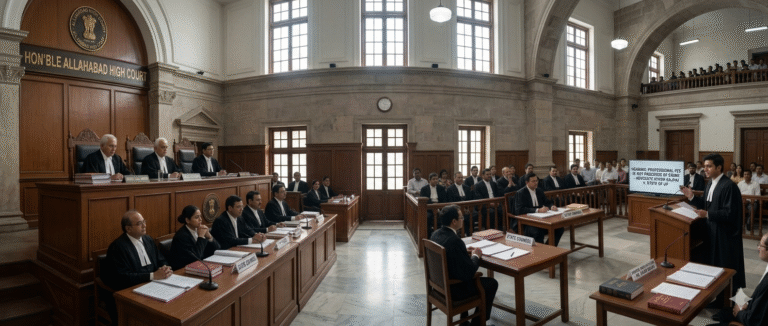
The Allahabad High Court has delivered a significant ruling protecting the independence of the legal profession by holding that professional fees received by an advocate from a client cannot automatically be treated as “proceeds of crime” merely because the client is facing criminal allegations. The court strongly criticized the action of the cyber cell of the Uttar Pradesh Police for freezing the bank account of an advocate without properly appreciating the legal nature of professional remuneration.
The ruling is expected to have far-reaching implications for lawyers across India, particularly in matters involving cybercrime investigations, money laundering allegations, and the powers exercised by investigating agencies to freeze bank accounts.
Background of the Case
The case arose after advocate Ayush Bajpai, a practicing lawyer in Kanpur, approached the Allahabad High Court challenging the freezing of his bank account maintained with the Krishna Nagar branch of the State Bank of India.
The bank account had been frozen on the instructions of the police cyber cell after authorities suspected that certain amounts credited to the account were connected with an alleged cyber fraud committed by one of Bajpai’s clients.
According to the submissions made before the High Court, Bajpai had been engaged as legal counsel for an accused facing allegations of siphoning off money through cyber fraud. The accused transferred legal fees directly to the advocate’s bank account as remuneration for professional services rendered.
However, instead of distinguishing between alleged criminal proceeds and legitimate legal fees, the investigating agency froze the advocate’s entire bank account, prompting him to challenge the action before the High Court.
Court Clarifies the Nature of Advocate’s Fees
A Division Bench comprising Justice J.J. Munir and Justice Arun Kumar made it clear that the professional fee earned by an advocate cannot be equated with proceeds of crime merely because it originates from a client accused of committing an offence.
The Bench observed that an advocate may receive remuneration from a variety of clients, including those facing serious criminal allegations. The identity or alleged conduct of the client does not alter the legal character of the advocate’s professional fee.
The Court emphasized that once an advocate is engaged to provide legal representation, the fee paid for those services constitutes lawful remuneration for professional work performed under the framework of the Advocates Act.
The judges observed that advocates routinely represent individuals accused of serious offences, and treating every payment made by such clients as suspected criminal proceeds would seriously undermine the justice delivery system.
Freezing Lawyers’ Accounts Could Affect Administration of Justice
The High Court expressed deep concern over the consequences of indiscriminately freezing advocates’ bank accounts.
The Bench observed that if investigating agencies begin freezing lawyers’ accounts simply because they have received professional fees from accused persons, advocates may become hesitant to represent individuals involved in criminal proceedings. Such an approach would directly interfere with the constitutional right of an accused person to obtain legal representation.
The Court noted that this practice could embarrass the functioning of courts and obstruct the effective administration of justice.
Importantly, the Bench clarified that the situation would be entirely different if an advocate himself were involved in criminal activity or if there were evidence showing that funds credited to the advocate’s account represented proceeds of the advocate’s own criminal conduct.
In the absence of such allegations, professional fees cannot automatically be categorized as illegal proceeds.
Government Asked to Clarify Policy
Recognizing the broader implications of the issue, the High Court directed the Additional Chief Secretary (Home), Government of Uttar Pradesh, to file an affidavit within two weeks.
The affidavit has been sought to explain how police authorities should deal with cases involving seizure or freezing of advocates’ bank accounts in a manner that does not interfere with the administration of justice or the functioning of courts.
The Court’s direction indicates its concern that investigating agencies require clear guidelines before exercising powers that may adversely affect the legal profession.
Previous Decisions Also Protect Bank Accounts
The Division Bench also relied upon earlier judgments delivered by coordinate benches of the Allahabad High Court.
The Court observed that it is already well settled that merely because a fraudulent transaction is suspected, the cyber cell cannot freeze an entire bank account.
Instead, only the amount representing the suspected proceeds of crime may be subjected to appropriate legal action, while the remaining funds cannot be indiscriminately blocked.
In the present case, the Court also recorded that the disputed account reflected only modest credits, including transactions of ₹20,000 and ₹3,700, making the action of freezing the entire account appear disproportionate.
Counter Affidavits Directed
The High Court has directed both the cyber cell authorities and the branch manager of the State Bank of India to file their respective counter-affidavits explaining the basis of their action.
The matter has been listed for further hearing on 17 July.
Significance of the Judgment
This decision reinforces the independence of the legal profession and safeguards the constitutional right to legal representation. The judgment recognizes that advocates perform a vital public function by representing clients irrespective of the allegations against them.
The ruling also serves as an important reminder that investigative powers must be exercised cautiously and proportionately. Freezing the entire bank account of a lawyer merely because legal fees have been received from an accused person not only affects the advocate’s livelihood but also risks undermining access to justice.
By distinguishing professional remuneration from alleged criminal proceeds, the Allahabad High Court has strengthened the protection available to legal practitioners while ensuring that genuine investigations against advocates involved in criminal conduct remain unaffected. The forthcoming affidavit from the State Government is likely to provide further clarity on the safeguards that investigating agencies must follow before taking coercive action against members of the legal profession.