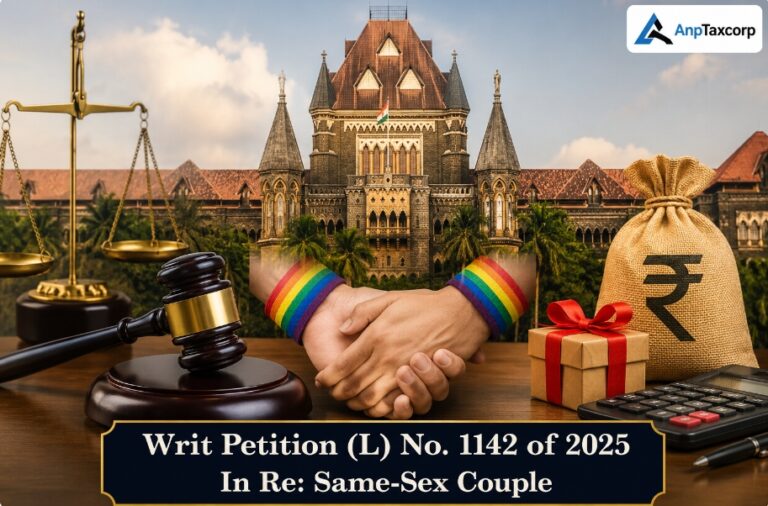
The Income Tax Department has opposed a writ petition filed by a same-sex couple before the Bombay High Court, seeking extension of the tax exemption available on gifts exchanged between spouses under Section 56(2)(x) of the Income Tax Act, 1961. The case raises significant questions regarding the interpretation of the term “spouse” under tax laws and its relationship with India’s existing marriage laws.
The matter is currently pending before a Division Bench of the Bombay High Court comprising Justices Burgess Colabawalla and Firdosh Pooniwalla. The court is yet to deliver its judgment.
Background of the Case
The petitioners approached the Bombay High Court challenging the constitutional validity and applicability of Section 56(2)(x) of the Income Tax Act to the extent that it grants exemption from taxation on gifts received from a spouse but does not extend the same benefit to partners in a same-sex relationship.
Under Section 56(2)(x), gifts received without consideration are generally taxable if their value exceeds the prescribed monetary threshold. However, the law provides several exceptions, one of which is gifts received from a “relative.” In the case of an individual, this definition includes gifts received from a spouse, making such transfers fully exempt from income tax.
The petitioners argued that denying this exemption solely because their relationship is not legally recognised as a marriage results in unequal treatment and discrimination.
Income Tax Department’s Stand
In an affidavit dated October 14, 2025, the Income Tax Department strongly opposed the petition and requested the Bombay High Court to dismiss it as being legally untenable.
The affidavit was filed by Sandeep Dahiya, Principal Commissioner of Income Tax (Judicial), who contended that the petition is fundamentally misconceived because it seeks relief that falls outside the scope of the Income Tax Act.
According to the department, the petitioners are effectively asking the Income Tax Act to redefine the meaning of the term “spouse,” even though no marriage law in India currently recognises same-sex marriages or treats partners in such relationships as spouses.
The department maintained that the Income Tax Act cannot independently create or modify the legal definition of marriage or spouse when those terms derive their meaning from the country’s marriage laws.
Interpretation of “Spouse” Under Tax Laws
The Income Tax Department argued that the term “spouse” used in the Income Tax Act must be interpreted consistently with the legal framework governing marriages in India.
Since Indian marriage laws presently do not recognise marriages between same-sex couples, the department submitted that such partners cannot be treated as spouses for the purpose of claiming tax exemptions available under Section 56(2)(x).
The affidavit further stated that the petitioners had not cited any statutory provision or legislation recognising their relationship as a valid marriage. Therefore, extending the exemption would amount to creating a new legal category through judicial interpretation, which, according to the department, is beyond the scope of the Income Tax Act.
Department Calls Petition an Abuse of Legal Process
The Income Tax Department also contended that the writ petition constitutes an abuse of the legal process.
It argued that the relief sought does not arise from any ambiguity or defect in the provisions of the Income Tax Act itself. Instead, the petition attempts to obtain recognition of a marital status that is presently unavailable under Indian law.
According to the department, the issue concerns the legal recognition of marriage rather than the interpretation of taxation provisions. Consequently, it submitted that the Income Tax Act cannot be used as a vehicle to redefine concepts already governed by separate personal and marriage laws.
The affidavit urged the High Court to dismiss the petition on this ground.
Legal Context
The issue assumes significance in the backdrop of the Supreme Court’s 2023 judgment on same-sex marriage, where the Constitution Bench declined to grant legal recognition to same-sex marriages, observing that the matter falls within the legislative domain.
While the Supreme Court recognised the rights and dignity of LGBTQIA+ individuals, it held that any legal framework conferring marital status or related statutory benefits would require intervention by Parliament.
The Income Tax Department has relied on this broader legal position in asserting that tax benefits linked to the status of “spouse” cannot be extended unless the relationship is recognised under existing marriage laws.
What Lies Ahead?
The Bombay High Court is yet to pronounce its decision on the petition. The outcome could have wider implications for the taxation of gifts and other statutory benefits available to married couples under the Income Tax Act.
If the court accepts the department’s arguments, the existing position would continue, limiting the exemption under Section 56(2)(x) to spouses whose marriages are recognised under Indian law.
On the other hand, if the court takes a broader constitutional view, the judgment may influence future debates on equal treatment, tax law interpretation, and the rights of same-sex couples. However, any substantial change in the legal definition of “spouse” is likely to require legislative action unless directed otherwise by a higher constitutional court.
Conclusion
The Bombay High Court’s decision in this case is expected to clarify whether the tax exemption for gifts between spouses under Section 56(2)(x) of the Income Tax Act can be interpreted to include same-sex couples in the absence of statutory recognition of their marriage.
For now, the Income Tax Department maintains that the exemption is strictly limited to legally recognised spouses and that any expansion of the term “spouse” must come through legislative reform rather than judicial interpretation under the Income Tax Act. The legal fraternity and taxpayers alike will closely watch the court’s ruling, as it may have important implications for tax law, constitutional principles, and the evolving legal landscape concerning LGBTQIA+ rights in India.