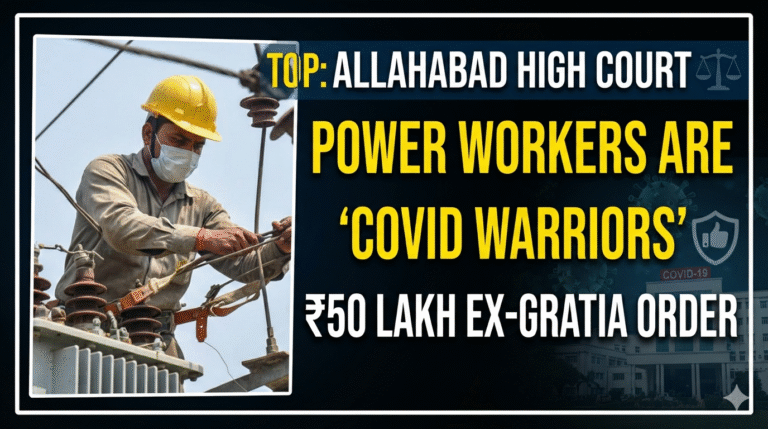
The definition of a frontline pandemic worker has long been a subject of both public gratitude and legal debate. While doctors, nurses, and hospital staff are universally recognized for their direct role in patient care, a landmark ruling by the Lucknow bench of the Allahabad High Court has fundamentally expanded this scope.
In a significant judgment, the court held that electricity department employees who worked tirelessly to maintain uninterrupted power supplies to hospitals and oxygen plants during the peak of the pandemic are legally entitled to the status of “COVID Warriors”.
The Crux of the Case: Pushpa Devi v. State of U.P.
The ruling stems from a writ petition filed by Pushpa Devi, the widow of Sunder Lal. Lal was an employee of the Madhyanchal Vidyut Vitran Nigam Ltd. (MVVNL) who contracted COVID-19 and tragically passed away in April 2021 while discharging his duties.
Initially, the state government had rejected the family’s claim for financial assistance, applying a strict and narrow interpretation of its April 2020 welfare framework. The state argued that ex-gratia benefits were reserved only for medical personnel and individuals explicitly assigned to direct hospital duties.
Rejecting this restrictive stance, the division bench of Justices Shekhar B. Saraf and Abdhesh Kumar Chaudhary quashed the government’s rejection order. The court remarked that maintaining an uninterrupted power grid was an indispensable lifeline. Without electricity, life-saving equipment like ventilators and oxygen generation plants would have ceased to function, fundamentally crippling the healthcare infrastructure when it was needed most.
Rejecting the “Narrow Interpretation”
The High Court emphasized that social welfare legislation and government orders enacted during a crisis must be interpreted pragmatically. Restricting “COVID Warrior” status solely to clinical staff ignores the vital ecosystem of essential services—such as power, water supply, and telecommunications—that allowed hospitals to remain operational.
By establishing that essential service workers faced identical existential threats while keeping public lifelines active, the court balanced the scales of equity and labor dignity.
A Stern Warning Against Procedural Delays
Beyond the expansion of frontline definitions, the judgment delivers a powerful critique of bureaucratic stagnation. The court noted with concern that the family’s rightful claim had been tangled in administrative red tape for more than five years.
Rather than sending the matter back to state authorities for “reconsideration”—a cyclical legal practice that often prolongs a litigant’s agony—the bench chose to finalise the matter directly. Citing recent Supreme Court precedents, the bench observed that constitutional remedies are not meant for mere academic discourse. When a legal right is clearly justified, relief must be granted “then and there, unflinchingly”.
Consequently, the Uttar Pradesh government has been directed to release the full ₹50 lakh ex-gratia compensation to the grieving widow within a strict timeline of eight weeks.
Key Takeaways for Public Administration
- Holistic Lifeline Recognition: True crisis management relies on an intertwined network of healthcare and utility services.
- Pragmatic Legal Interpretations: Courts will look past rigid bureaucratic definitions to honor the true intent of welfare mandates.
- Accountability in Judicial Relief: Protracted delays in administrative compensation undermine the state’s duty of care toward its workforce.
This progressive directive sets a monumental legal precedent across India, ensuring that the silent, behind-the-scenes pillars of our public infrastructure are granted the recognition and protection they rightfully deserve.