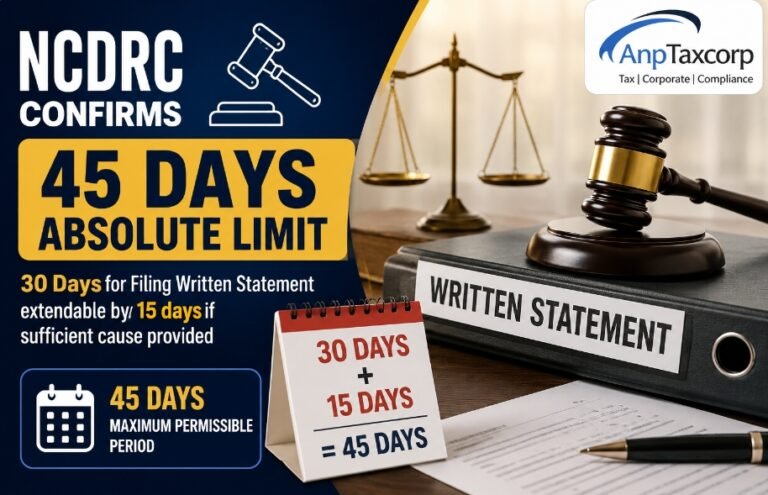
The National Consumer Disputes Redressal Commission (NCDRC) has once again clarified the law relating to the filing of written statements by opposite parties in consumer disputes. In a significant decision, the Commission held that while an opposite party must ordinarily file its written statement within 30 days, the Consumer Commission may grant an extension of up to 15 additional days if sufficient cause is shown. However, the total period of 45 days is absolute and cannot be exceeded.
The ruling came in HDFC Bank Ltd. v. Thomas Alexander, 2026 SCC OnLine NCDRC 130, decided on 23 July 2026, where the Commission set aside an order of the State Consumer Disputes Redressal Commission that had wrongly refused to take the written statement on record.
Background of the Case
The dispute arose when HDFC Bank Ltd. challenged an order passed by the State Consumer Disputes Redressal Commission. The State Commission had dismissed the bank’s application seeking condonation of delay in filing its written statement and directed that the written statement be removed from the record.
According to the bank, the notice of the consumer complaint was served on 22 September 2025, while a copy of the complaint was received on 24 September 2025. The written statement was electronically filed on 6 November 2025. The bank contended that the filing was made on the 45th day from the date of service and therefore fell within the maximum period permitted under the Consumer Protection Act, 2019.
Since the written statement was filed beyond the initial 30-day period, the bank also submitted an application seeking condonation of the delay, explaining the reasons for not filing it earlier.
However, the State Commission rejected the application on the ground that the written statement had been filed beyond the statutory period prescribed under Sections 38(2)(a) and 49(1) of the Consumer Protection Act, 2019.
Aggrieved by this decision, HDFC Bank approached the NCDRC by filing a revision petition under Section 58(1)(b) of the Consumer Protection Act, 2019.
Issue Before the NCDRC
The principal question before the National Commission was whether the State Commission had correctly concluded that the written statement was filed beyond the maximum permissible period of 45 days and was therefore liable to be rejected.
Findings of the Commission
The NCDRC carefully examined the dates and found that the State Commission had committed a factual error while calculating the limitation period.
The Commission observed that the written statement had been e-filed on 6 November 2025, which amounted to 44 days from 24 September 2025, the date on which the bank first received the copy of the complaint. Consequently, the written statement was filed within the maximum period permitted by law.
The Commission further noted that the bank had already filed a separate application explaining the reasons for the delay beyond the initial 30 days. There was nothing on record to indicate that the delay was deliberate or mala fide.
Reliance on Supreme Court Judgment
While deciding the matter, the NCDRC relied upon the landmark judgment of the Supreme Court in New India Assurance Co. Ltd. v. Hilli Multipurpose Cold Storage (P) Ltd., (2020) 5 SCC 757.
In that decision, the Supreme Court authoritatively held that:
- A written statement should ordinarily be filed within 30 days from the date of receipt of the complaint.
- The Consumer Commission has the discretion to extend this period by a further 15 days, provided sufficient reasons are shown.
- The total period of 45 days is mandatory and cannot be extended under any circumstances.
The NCDRC observed that since HDFC Bank had filed its written statement within this statutory limit, the State Commission ought to have accepted it instead of rejecting it.
Decision
Allowing the revision petition, the NCDRC set aside the order of the State Commission.
The Commission held that the written statement had been filed within the legally permissible period of 45 days and that the delay beyond the first 30 days had been satisfactorily explained. Consequently, the application seeking condonation of delay was also allowed, and the written statement was directed to be taken on record.
Legal Significance of the Judgment
This decision serves as an important reminder for both litigants and Consumer Commissions regarding the strict timelines prescribed under the Consumer Protection Act, 2019.
The ruling reinforces that the initial period for filing a written statement is 30 days, with a possible extension of 15 additional days upon showing sufficient cause. However, once the total period of 45 days expires, the Consumer Commission loses the authority to accept the written statement.
Equally important, the judgment highlights that Consumer Commissions must accurately compute the limitation period before rejecting a written statement. A factual error in calculating the number of days may result in denial of a valuable opportunity to contest the complaint on merits, leading to unnecessary litigation.
Conclusion
The NCDRC’s ruling in HDFC Bank Ltd. v. Thomas Alexander provides much-needed clarity on the computation of the limitation period for filing written statements in consumer disputes. While the Consumer Protection Act mandates expeditious disposal of consumer complaints, procedural fairness requires that parties filing within the statutory 45-day limit should not be deprived of their right to defend the case.
The decision underscores that the 45-day period is an absolute statutory ceiling, but where a written statement is filed within that limit along with a satisfactory explanation for the delay beyond the initial 30 days, Consumer Commissions should ordinarily permit it to be taken on record.