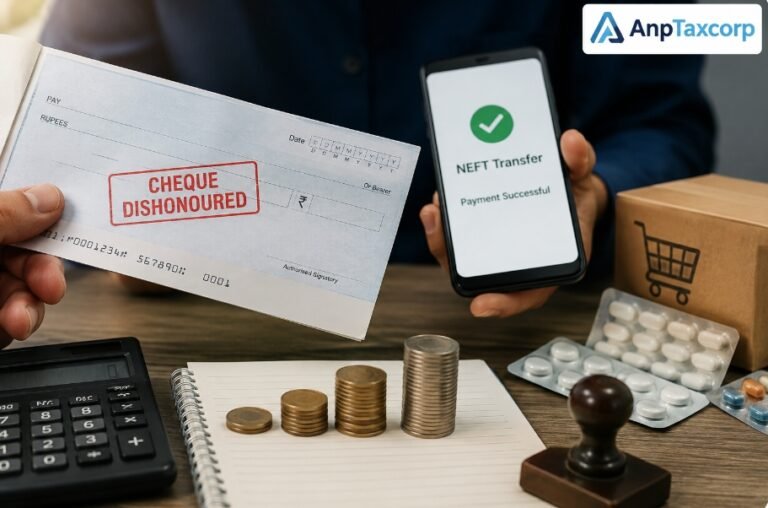
In a significant ruling clarifying the scope of proceedings under the Negotiable Instruments Act, 1881, the Delhi High Court has held that the effect of admitted part payments made before the presentation of dishonoured cheques cannot be conclusively determined while deciding a revision petition against a summoning order. The Court observed that such issues involve disputed questions of fact and require a full-fledged trial based on evidence.
Justice Madhu Jain ruled that whether a dishonoured cheque continued to represent a legally enforceable debt after the drawer made part payments is a matter that can only be examined during the trial. Consequently, the Court restored the Metropolitan Magistrate’s summoning order after finding that the Sessions Court had exceeded its jurisdiction by deciding disputed factual issues at the revision stage.
Background of the Dispute
The dispute arose out of a commercial transaction involving the supply of pharmaceutical goods. MS Pharmaceuticals supplied medicines worth ₹10.02 lakh to Nityam Pharma under an invoice dated 21 August 2019.
To discharge the liability, the purchaser initially issued three cheques in favour of the supplier. However, these cheques were dishonoured after the drawer instructed the bank to stop payment.
According to the complainant, the purchaser subsequently made certain part payments through NEFT and also issued eight fresh cheques towards the balance outstanding amount. Despite these payments, an outstanding liability of ₹6.52 lakh remained. When the fresh cheques were presented for encashment, they were dishonoured due to insufficient funds.
Following the dishonour, MS Pharmaceuticals issued a statutory demand notice under Section 138 of the Negotiable Instruments Act, demanding payment of the remaining outstanding amount of ₹6.52 lakh. As the payment was not made within the statutory period, criminal proceedings were initiated before the Metropolitan Magistrate.
Sessions Court Quashed the Summoning Order
In March 2021, the Metropolitan Magistrate found sufficient grounds to summon the accused.
However, the accused challenged the summoning order before the Sessions Court. The revisional court set aside the summoning order on the ground that the statutory demand notice was legally defective.
The Sessions Court observed that the demand notice claimed an amount lower than the aggregate value of the dishonoured cheques. According to the revisional court, the notice failed to correspond with the amount represented by the cheques and therefore did not satisfy the mandatory requirements of Section 138 of the Negotiable Instruments Act. It also described the notice as an omnibus demand notice.
Delhi High Court’s Analysis
The Delhi High Court disagreed with the reasoning adopted by the Sessions Court.
The Court noted that the complainant had specifically disclosed all relevant facts in the statutory notice, including:
- The original invoice value of ₹10.02 lakh.
- The dishonour of the earlier cheques.
- The admitted part payments received through NEFT.
- The issuance of fresh cheques.
- The detailed calculation showing how the outstanding liability stood reduced to ₹6.52 lakh.
Justice Madhu Jain observed that the notice clearly explained the basis of the reduced claim and therefore could not be described as vague or omnibus.
Role of Section 56 of the Negotiable Instruments Act
One of the principal arguments advanced by the accused was based on Section 56 of the Negotiable Instruments Act, which deals with endorsements recording part payments on negotiable instruments.
The respondents argued that once part payments had been made before the presentation of the cheques, those cheques no longer represented the exact legally enforceable liability. Since no endorsement reflecting the part payments had been made on the cheques, it was contended that the requirements of Section 138 were not fulfilled.
The High Court, however, refrained from expressing any final opinion on this legal issue at the preliminary stage.
The Court held that the impact of Section 56, the legal consequences of the admitted part payments, and the question whether the dishonoured cheques continued to represent a legally enforceable debt are all mixed questions of law and fact. These issues can only be properly decided after evidence is recorded during trial.
Trial Is the Appropriate Stage
Justice Madhu Jain categorically observed that disputed factual issues cannot be conclusively decided while exercising revisional jurisdiction against a summoning order.
The Court held that the trial court is the appropriate forum to determine:
- Whether the admitted part payments altered the liability represented by the cheques.
- Whether the statutory requirements under Sections 138 and 56 of the Negotiable Instruments Act were satisfied.
- Whether the dishonoured cheques continued to represent a legally enforceable debt on the date of presentation.
Since these questions require appreciation of oral and documentary evidence, they cannot be decided merely on the basis of pleadings at the summoning stage.
High Court Restores Summoning Order
Holding that the Sessions Court had prematurely decided disputed issues, the Delhi High Court set aside its order dated 7 October 2024 and restored the Metropolitan Magistrate’s summoning order dated 15 March 2021.
The Court further directed both parties to appear before the trial court on 8 August 2026, where the matter will proceed in accordance with law.
Conclusion
The judgment reinforces the settled legal principle that courts exercising revisional jurisdiction should not adjudicate disputed questions of fact while examining the validity of a summoning order. The Delhi High Court has clarified that the legal effect of part payments made before the presentation of dishonoured cheques is a matter requiring evidence and cannot be conclusively determined at the preliminary stage. The decision is expected to serve as an important precedent in cheque dishonour litigation, particularly in cases involving partial payments and disputes regarding the extent of legally enforceable debt under the Negotiable Instruments Act.