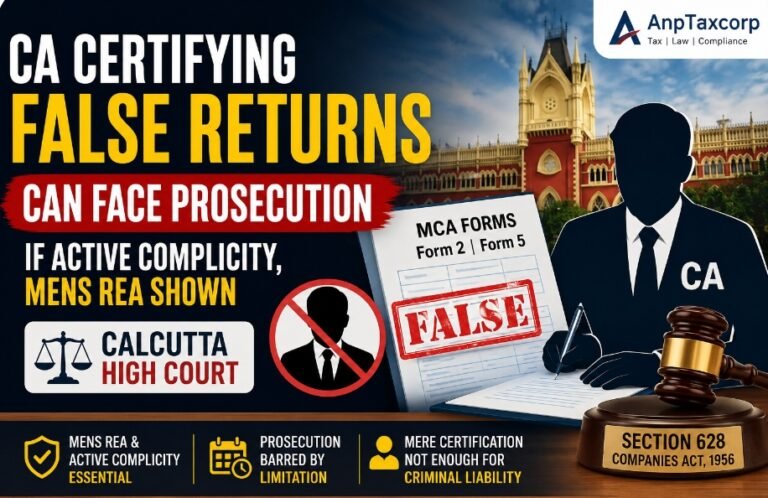
The Calcutta High Court has clarified that an independent Chartered Accountant (CA) who certifies a false statutory return or e-form cannot claim automatic immunity from criminal prosecution merely because the professional is not an executive officer of the company.
However, the Court has also emphasised that mere certification of a statutory document is not sufficient to establish criminal liability. To prosecute an independent professional under Section 628 of the Companies Act, 1956, the complaint must contain specific allegations and supporting material indicating knowledge of the falsity, intentional concealment, active participation or conscious connivance.
The ruling was delivered by Justice Uday Kumar in Registrar of Companies, West Bengal v. Ranjan Meghani, CRR 4267 of 2022, arising from a challenge by the Registrar of Companies (ROC) against the discharge of practising Chartered Accountant Ranjan Meghani.
Key Legal Issue Before the Court
The principal question before the Calcutta High Court was whether an independent professional who merely certifies statutory e-forms can be prosecuted under Section 628 of the Companies Act, 1956, even though such professional does not fall within the conventional category of a company’s executive officer.
The Court rejected the broad proposition that an independent professional can never be prosecuted under Section 628.
It observed that the provision applies to “any person” who knowingly makes a materially false statement or intentionally conceals a material fact in a return, report, certificate or other document required under the Companies Act.
Therefore, according to the Court, an independent CA may attract criminal liability where the prosecution is able to demonstrate active complicity coupled with mens rea.
At the same time, the Court made it clear that professional certification by itself cannot automatically translate into criminal liability.
Background of the Case
The proceedings arose out of an ROC investigation into Adorable Agrotech Ltd. The company’s authorised share capital reportedly increased dramatically from ₹5 lakh in 2010 to approximately ₹70.35 crore by 2014 through five successive increases.
A substantial part of this expansion was allegedly achieved through the issuance of non-convertible redeemable preference shares.
The investigation revealed that large numbers of investors were allotted such preference shares on individual dates. For instance, 1,431 persons received allotments on September 15, 2011, while 9,120 persons received allotments on July 1, 2013.
The ROC alleged that the transactions effectively involved public collection of money in the nature of deposits and that the statutory requirements governing public offers had not been complied with.
Alleged Irregularities in MCA Filings
The company subsequently uploaded various electronic forms on the Ministry of Corporate Affairs (MCA) portal, including Form 5 and Form 2.
The inspection report identified several alleged irregularities in the Form 2 filings, including:
- Names of certain shareholders allegedly being absent;
- Mismatch between allotment dates and filing particulars;
- Repetition of shareholder names; and
- Other discrepancies concerning the allotment records.
The ROC alleged that the forms were filed despite allegedly containing false particulars.
Certain forms relating to allotments dated October 15, 2011 and December 15, 2011 had been certified by practising Chartered Accountant Ranjan Meghani.
The prosecution alleged that the company director, Biswajit Biswas, was responsible for the mala fide conduct and deliberate concealment. However, Meghani was also arrayed as an accused because of his role in certifying the statutory forms.
CA Was an Independent Professional, Not Company Management
Before the High Court, Meghani argued that his role was confined to professional certification of statutory e-forms.
He was not a promoter, executive director, internal manager or key managerial personnel of the company.
The Court accepted the distinction between an independent professional certifier and a person forming part of the company’s executive management.
It observed that a Chartered Accountant engaged independently to verify and certify statutory returns or e-forms operates in a professional capacity as an external expert. Such professional functions are governed by professional standards, statutory requirements and the ethical framework applicable to the profession.
Therefore, the Court held that the mere fact that a CA has certified a document containing incorrect information does not, by itself, establish criminal liability.
Mens Rea and Active Complicity Are Essential
The most significant aspect of the judgment is the Court’s emphasis on mens rea and active complicity.
Section 628 covers a person who knowingly makes a materially false statement or intentionally conceals a material fact in documents required under the Companies Act.
Consequently, the prosecution must establish more than the simple fact that the accused signed or certified a document.
In Meghani’s case, the Court found that the complaint did not contain sufficiently specific allegations demonstrating that he:
- Had personal knowledge of the alleged financial fraud;
- Knew that the information contained in the forms was false;
- Participated in fabrication of company records; or
- Actively connived with the company’s management.
The allegations concerning deliberate concealment and execution of the allegedly false forms were primarily directed against the company’s director and management.
Against Meghani, the principal allegation was that he had certified the statutory forms.
The Court concluded that this was insufficient to satisfy the threshold of criminal liability under Section 628.
Professionals Cannot Be Prosecuted Merely for Relying on Management Records
The judgment also provides an important safeguard for independent professionals.
A CA engaged for certification generally works on the basis of books of account, records, documents and information supplied by the company’s management. Unless there are specific circumstances demonstrating that the professional knew the information was false or deliberately participated in its falsification, criminal prosecution cannot be sustained merely because the certified document subsequently turns out to be incorrect.
This distinction is particularly relevant for Chartered Accountants, auditors and other professionals who perform statutory certification functions for companies.
Prosecution Also Barred by Limitation
The Court provided an additional reason for upholding Meghani’s discharge.
The disputed e-forms and documents related to the period between 2011 and 2014, whereas the criminal complaint was filed by the ROC only on March 17, 2020.
Since Section 628 read with Section 75 prescribed a maximum punishment of two years’ imprisonment, the Court held that the three-year limitation period under Section 468(2)(c) of the CrPC was applicable.
There was also no application seeking condonation of the delay under Section 473 CrPC, nor was there any satisfactory explanation for the substantial delay.
Accordingly, the Court held that the prosecution against Meghani was independently barred by limitation.
Calcutta High Court Upholds CA’s Discharge
The Calcutta High Court ultimately upheld the Special Court’s order discharging Ranjan Meghani and dismissed the ROC’s revision insofar as it concerned him.
The revision proceedings had separately abated against another practising Chartered Accountant, Bhal Chandra Khaitan, following his death during the pendency of the proceedings.
Importantly, the Court clarified that its ruling was limited to the criminal liability of an independent professional certifier. It did not prevent the ROC from taking appropriate legal action against the company, its promoters, executive directors or internal management personnel in accordance with law.
Key Takeaway
The judgment establishes an important balance between professional accountability and protection against unwarranted criminal prosecution.
An independent Chartered Accountant is not automatically immune from prosecution for certifying a false statutory return. Where evidence demonstrates that the CA knowingly certified false information, intentionally concealed material facts or actively connived with company management, Section 628 may be attracted.
Conversely, where the complaint merely alleges that the professional certified documents without demonstrating knowledge, mens rea or active participation, criminal prosecution cannot be sustained merely because the underlying documents subsequently prove to be false.
The decision therefore reinforces a crucial principle: professional certification alone does not establish criminal culpability; specific allegations of conscious knowledge and active complicity are necessary.
Case Details
Case Title: Registrar of Companies, West Bengal v. Ranjan Meghani
Case No.: CRR 4267 of 2022
Court: Calcutta High Court
Judge: Justice Uday Kumar
Principal Provision: Section 628, Companies Act, 1956
Limitation Provisions: Sections 468(2)(c) and 473, CrPC