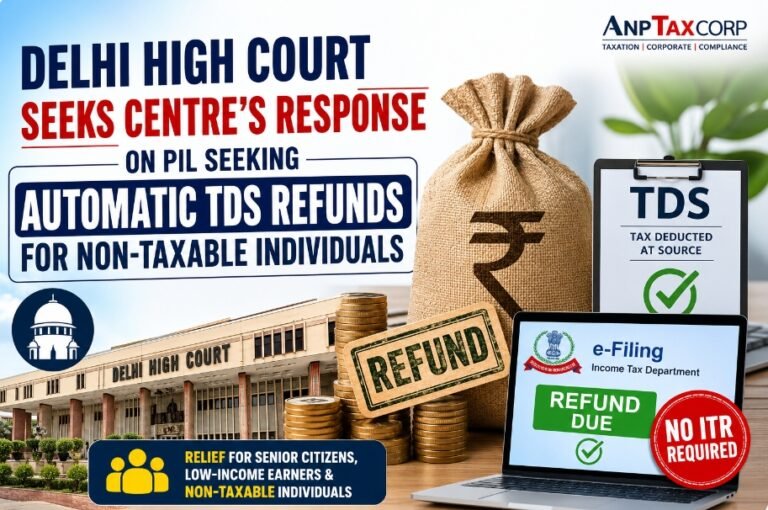
The Delhi High Court has sought a response from the Union Government and the Central Board of Direct Taxes (CBDT) on a Public Interest Litigation (PIL) seeking an automatic mechanism for refund of Tax Deducted at Source (TDS) to individuals whose income is below the taxable threshold.
A Division Bench comprising Chief Justice Devendra Kumar Upadhyaya and Justice Tushar Rao Gedela issued notice on the petition filed by petitioner-in-person Aakash Goel. The matter is scheduled to be considered next in October.
The PIL raises an important issue concerning taxpayers who have TDS deducted from their income even though they ultimately have no income-tax liability. The petitioner has challenged the requirement of filing an Income Tax Return (ITR) merely to obtain a refund of such excess TDS.
PIL Challenges Mandatory ITR Filing for TDS Refund
The petition argues that the existing tax-refund mechanism places an unnecessary compliance burden on individuals who are otherwise not legally required to file an ITR.
According to the petitioner, the issue particularly affects senior citizens, daily wage earners, blue-collar workers and other individuals with relatively low incomes. In several cases, TDS may be deducted from interest, contractual payments, salary or other income even though the recipient’s total taxable income remains below the applicable threshold.
Under the existing mechanism, such individuals generally have to complete the ITR filing process to claim back the amount deducted as TDS.
The petitioner contends that this requirement can become disproportionate where the refund amount is small. The cost of professional assistance, documentation, digital compliance and the time involved in filing a return may sometimes exceed the amount sought to be recovered.
The plea therefore describes the present arrangement as a potential “compliance trap”, arguing that a refund mechanism should not become so burdensome that taxpayers effectively give up their legitimate refunds.
Petition Invokes Articles 14, 265 and 300A
The PIL raises constitutional concerns under Articles 14, 265 and 300A of the Constitution of India.
The petitioner argues that where an individual has no actual tax liability, retaining TDS merely because the person has not filed an ITR could amount to an unreasonable procedural barrier to recovery of money belonging to that individual.
Article 265 provides that no tax can be levied or collected except by authority of law. The petition argues that retaining amounts as tax where there is no corresponding tax liability raises questions under this constitutional provision.
Article 300A, which protects the right to property, has also been invoked. The petitioner contends that continued retention of excess TDS, where no tax is ultimately payable, may amount to deprivation of property without sufficient legal justification.
The plea further alleges that imposing the same filing requirement on every person seeking a refund, regardless of whether that person is otherwise required to file a return, may be arbitrary and disproportionate.
Nearly 2.35 Crore Individuals Had TDS Credits But Did Not File ITRs
The petitioner has relied upon the Income Tax Department’s Annual Return Statistics for Assessment Year 2023-24 to highlight the potential scale of the issue.
According to the petition, approximately 2.35 crore individuals had TDS credits but did not file income-tax returns during the relevant period.
The PIL further states that around 8.59 crore individuals had TDS credits of less than ₹5,000.
The petitioner argues that for individuals having relatively small TDS credits, mandatory ITR filing may not be economically sensible, particularly where professional assistance is required. The burden could be particularly significant for persons with limited digital literacy or limited access to online tax-compliance facilities.
Petition Seeks Automatic TDS Refund System
A significant aspect of the PIL is its demand for an automated or suo motu TDS refund mechanism.
The petitioner argues that the Income Tax Department already possesses extensive taxpayer information through systems such as PAN-linked databases, Form 26AS, the Annual Information Statement (AIS) and the Non-Filer Monitoring System (NMS).
According to the plea, these databases provide the tax administration with sufficient information to identify taxpayers who have TDS credits but apparently have no corresponding tax liability.
The petition therefore questions why similar technological infrastructure cannot be used to identify and automatically refund excess TDS to eligible individuals.
The petitioner contends that using technology extensively for tax administration and detection of non-compliance, while requiring citizens to undertake a separate digital filing process to recover their own money, creates an imbalance in the system.
Challenge to Section 433 of Income Tax Act, 2025
The PIL specifically challenges Section 433 of the Income Tax Act, 2025, insofar as it requires furnishing of a return before a refund can be granted.
The petitioner has sought a direction to read down the provision so that the return-filing requirement for obtaining a refund applies only to persons who are otherwise statutorily required to furnish a return under Section 263.
The plea argues that individuals who are not otherwise required to file returns should not be compelled to enter the return-filing process solely for recovering TDS that exceeds their actual tax liability.
Relief Sought for Small TDS Refunds
Among the principal prayers made before the Delhi High Court is a direction to process unclaimed TDS refunds, particularly refunds of up to ₹5,000 relating to the preceding three assessment years, without insisting upon ITR filing.
The petitioner has also sought establishment of a permanent automatic TDS refund mechanism for future assessment years.
If accepted, such a mechanism could significantly reduce compliance costs for individuals whose income falls below the taxable limit and who otherwise have no tax liability.
Delhi High Court Seeks Government’s Response
The Delhi High Court has now sought responses from the Union Government and the CBDT. The Court’s decision at this stage is awaited, and the next hearing is scheduled for October.
The PIL raises a broader question about the balance between tax administration, procedural compliance and taxpayer convenience. Whether the existing ITR requirement should continue to apply uniformly to all refund claims, or whether technology can be used to automatically identify and refund small TDS credits to eligible non-taxable individuals, is now before the High Court for consideration.
Case Details
Court: Delhi High Court
Petitioner: Aakash Goel, Petitioner-in-Person
Issue: Automatic refund of TDS to individuals having no tax liability
Key Provision Challenged: Section 433, Income Tax Act, 2025
Constitutional Provisions Invoked: Articles 14, 265 and 300A
Next Hearing: October