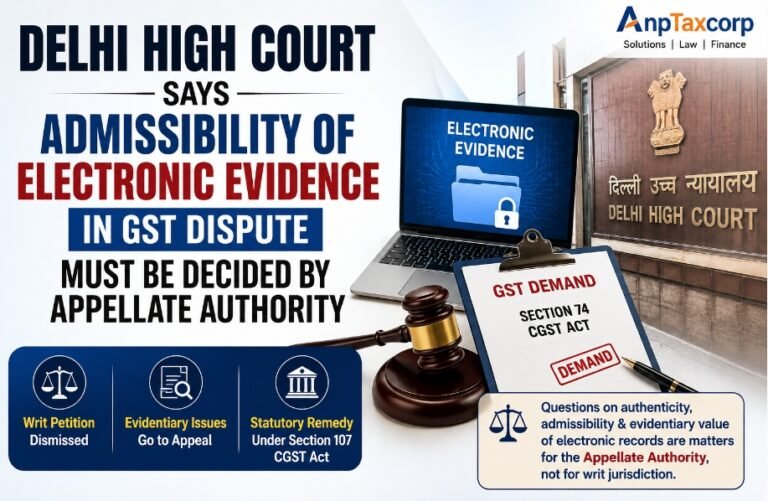
The Delhi High Court has declined to interfere with a GST demand exceeding ₹1.5 crore, holding that disputes concerning the admissibility, authenticity, chain of custody and evidentiary value of electronic records should ordinarily be examined by the statutory appellate authority rather than in proceedings under Article 226 of the Constitution.
A Division Bench comprising Justice Anil Kshetrapal and Justice Shail Jain dismissed the writ petition filed by Wizard Digitek Computers Pvt. Ltd., which challenged a GST adjudication order passed under Section 74 of the Central Goods and Services Tax Act, 2017 (CGST Act).
The case is significant because it highlights the limits of writ jurisdiction in GST matters, particularly where the challenge involves disputed questions of fact, appreciation of evidence and the manner in which the adjudicating authority evaluated investigation material.
GST Demand Based on Third-Party Electronic Records
The proceedings against the petitioner arose from an investigation conducted by the GST authorities. During the investigation, the department relied upon various materials, including electronic data allegedly recovered from the laptop of a third party, loose papers and statements recorded from persons during the investigation.
Based on these materials, the adjudicating authority confirmed GST demands exceeding ₹1.5 crore, together with applicable interest and penalty.
The taxpayer approached the Delhi High Court challenging the adjudication order. One of its principal arguments was that the demand was founded substantially on electronic material whose authenticity and legal admissibility had not been properly established.
The petitioner also questioned the reliance placed upon statements of third parties without providing an effective opportunity for cross-examination.
Taxpayer Alleged Violation of Natural Justice
The petitioner contended that the adjudicating authority had failed to properly consider its detailed reply and had denied it an effective opportunity of hearing.
The taxpayer further argued that the electronic records relied upon by the department were obtained from a third party and that the statutory requirements governing their admissibility had not been satisfied. Reliance was also placed on the alleged deficiencies in the forensic examination of the electronic material.
Another contention was that the persons whose statements were relied upon by the GST authorities should have been made available for cross-examination.
The petitioner additionally argued that the department could not reopen the relevant period because the taxpayer had already undergone a statutory audit under Section 65 of the CGST Act.
High Court Finds No Complete Denial of Hearing
The Delhi High Court, however, rejected the argument that the principles of natural justice had been violated merely because the taxpayer disagreed with the manner in which its defence had been considered.
The Bench noted that the petitioner had participated in the adjudication proceedings through its authorised representative and had submitted a detailed written response.
According to the Court, the grievance essentially concerned the manner in which the adjudicating authority appreciated the taxpayer’s defence, rather than a complete denial of an opportunity to present its case.
Therefore, such a grievance, by itself, was not sufficient to justify the exercise of extraordinary writ jurisdiction under Article 226.
Electronic Evidence Issues to Be Examined in Appeal
A significant part of the judgment concerns the taxpayer’s challenge to the electronic evidence.
The petitioner had questioned the admissibility of the electronic records on the ground of non-compliance with Section 63 of the Bharatiya Sakshya Adhiniyam, 2023, and also disputed the authenticity of the material based on the forensic report.
The High Court observed that these issues involve examination of the evidentiary foundation of the GST demand.
The Court noted that questions such as whether the statutory requirements for admitting electronic evidence were satisfied, whether the chain of custody was properly established, whether forensic examination adequately authenticated the electronic records and what evidentiary weight should be assigned to such material are matters directly connected with the merits of the adjudication.
The Bench therefore declined to undertake such an examination in writ proceedings.
Section 107 Appeal Is the Appropriate Remedy
The Court emphasised that the issues raised by the taxpayer would require detailed appreciation of evidence and disputed factual matters.
This included questions concerning:
- Admissibility of electronic evidence;
- Authenticity and forensic verification of digital records;
- Chain of custody of electronic material;
- Evidentiary value of investigation documents;
- Denial of cross-examination;
- Reliance on statements recorded during investigation; and
- The effect of the earlier statutory audit under Section 65 of the CGST Act.
According to the High Court, these matters fall within the domain of the statutory appellate authority under Section 107 of the CGST Act.
The judgment therefore reinforces the principle that a taxpayer cannot ordinarily bypass the statutory GST appellate mechanism merely by raising evidentiary or factual objections in a writ petition.
Key Takeaway for GST Taxpayers
The ruling does not mean that electronic evidence relied upon by GST authorities is automatically admissible. Rather, the Court clarified that the proper forum for examining such evidentiary objections, where they involve disputed facts and appreciation of evidence, is ordinarily the statutory appellate authority.
The judgment also demonstrates that a mere allegation of violation of natural justice may not be sufficient for invoking Article 226 when the taxpayer actually participated in the adjudication process and submitted its defence.
For taxpayers facing GST demands based on digital records, third-party data or investigation statements, the decision highlights the importance of raising detailed objections before the adjudicating authority and, where necessary, pursuing the statutory appeal under Section 107 of the CGST Act.
Case Details
Case: Wizard Digitek Computers Pvt. Ltd. v. Union of India & Ors.
Case No.: W.P.(C) 3874/2026
Court: Delhi High Court
Bench: Justice Anil Kshetrapal and Justice Shail Jain
Provision involved: Section 74 and Section 107, CGST Act, 2017; Article 226, Constitution of India
Subject: GST demand, electronic evidence, natural justice, cross-examination and writ jurisdiction
The Delhi High Court ultimately dismissed the writ petition, leaving the taxpayer to pursue its statutory remedies before the competent appellate forum.