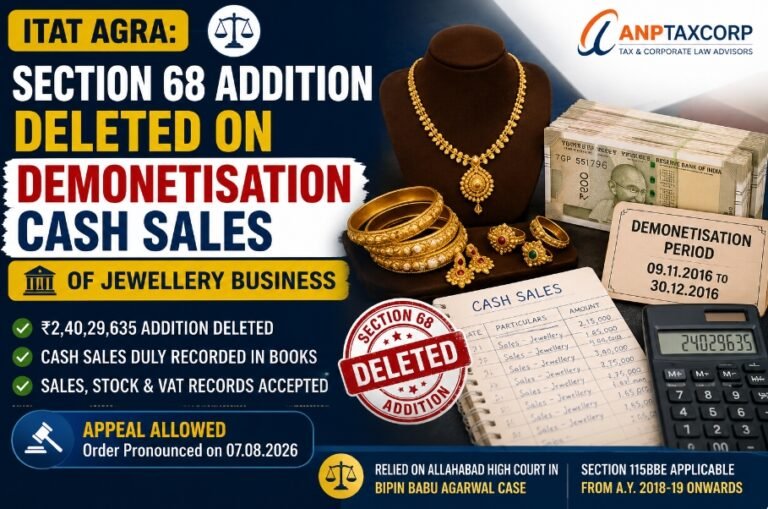
The Income Tax Appellate Tribunal (ITAT), Agra Bench, has deleted a substantial addition of ₹2,40,29,635 under Section 68 of the Income Tax Act, 1961, relating to cash deposits made during the demonetisation period by a firm engaged in the trading and manufacturing of gold and silver ornaments.
The Tribunal held that cash sales duly recorded in the assessee’s regular books of account, supported by stock records, sales invoices, VAT returns and audited financial statements, could not be treated as unexplained cash credits merely because the Assessing Officer considered the sales during the demonetisation period to be unusually high.
The appeal concerned Assessment Year 2017-18 and arose from the order passed by the CIT(A)/NFAC under Section 250 of the Income Tax Act. The Tribunal pronounced its order in the Open Court on 7 August 2026.
Background of the Case
The assessee was a partnership firm engaged in the trading and manufacturing of gold and silver jewellery. It maintained its accounts under the mercantile system and filed its income-tax return on 28 October 2017, declaring total income of ₹2,07,39,850.
The return was initially processed under Section 143(1). Subsequently, the case was selected for complete scrutiny through CASS. During the assessment proceedings, the Assessing Officer examined cash deposits of ₹2,40,29,635, particularly those made during the demonetisation period from 9 November 2016 to 30 December 2016.
The assessee explained that the deposits represented genuine cash receipts arising from its jewellery business. According to the assessee, the underlying cash sales had been duly recorded in the books and the corresponding income had already been accounted for in the return of income.
However, the Assessing Officer was not convinced by the explanation. He took the view that the cash sales recorded during October and November 2016 were inflated and artificial and treated the amount of ₹2,40,29,635 as unexplained cash credit under Section 68, with the consequential application of Section 115BBE.
The first appellate authority, CIT(A)/NFAC, upheld the addition, following which the assessee approached the ITAT.
Assessee’s Explanation Before ITAT
Before the Tribunal, the assessee argued that the entire transaction trail was supported by contemporaneous business records.
It had produced, among other documents:
- Audited books of account;
- Cash book and ledger;
- Stock register;
- Sales and purchase registers;
- Sales invoices;
- Bank statements;
- VAT returns;
- Audit report;
- Details of specified bank notes (SBN) and non-SBN deposits.
A significant argument raised by the assessee was that the Department had not rejected the books of account and had not invoked Section 145(3) of the Income Tax Act.
The assessee further submitted that the Assessing Officer had not identified any specific discrepancy in its purchases, sales invoices, quantitative records, stock position or closing stock.
Accordingly, merely questioning the volume of cash sales, without bringing independent material to establish that those sales were fictitious, could not justify an addition under Section 68.
Comparison of Cash Sales and Deposits
The assessee also placed comparative figures before the Tribunal to demonstrate that the cash transactions could not be examined in isolation.
Cash sales during October and November 2016 were stated to be approximately ₹3.13 crore, whereas the corresponding figure for the preceding year was around ₹5.52 crore.
Similarly, total cash deposits during Financial Year 2016-17 were approximately ₹8.13 crore, compared with about ₹24.93 crore during Financial Year 2015-16.
The assessee also highlighted that cash sales during the relevant demonetisation period were approximately ₹85.77 lakh, compared with approximately ₹7.77 crore during the corresponding period of the preceding year.
The assessee explained that jewellery sales were also influenced by festive occasions, marriage seasons and other customary periods of increased demand.
ITAT’s Findings
After examining the material on record, the ITAT found merit in the assessee’s contentions.
The Tribunal noted that the cash sales under consideration were not standalone entries created during the demonetisation period. Rather, they formed part of the assessee’s regular business records and were reflected in the audited books.
The Tribunal also observed that the Assessing Officer had not demonstrated defects or inconsistencies in the assessee’s:
- Purchase records;
- Sales records;
- Stock register;
- Quantitative details;
- Closing stock;
- Books of account; or
- Other supporting documents.
The corresponding sales receipts and profits had also been accounted for by the assessee and included in the income disclosed in the return.
Reliance on Allahabad High Court Decision
The Agra Bench placed reliance on the decision of the jurisdictional Allahabad High Court in Bipin Babu Agarwal, which involved similar circumstances concerning a jewellery trader and cash sales during the demonetisation period.
In that case also, the transactions were supported by sale invoices, books of account, stock records and VAT returns. The High Court had found that the issue essentially involved appreciation of factual material and held that mere suspicion, without supporting evidence, was insufficient to sustain the Revenue’s adverse conclusion.
Following this principle, the ITAT held that recorded cash sales supported by corresponding stock and other statutory records could not automatically be characterised as unexplained cash credits merely because the Assessing Officer considered the quantum of sales to be excessive.
Consequently, the addition of ₹2,40,29,635 under Section 68 was deleted.
Section 115BBE Rate Also Considered
The Tribunal also considered the assessee’s alternative ground concerning the applicability of the enhanced tax rate under Section 115BBE.
Relying upon the decision in S.M.I.L.E Microfinance Ltd. v. ACIT, the Tribunal held that the enhanced 60% rate under Section 115BBE was applicable from Assessment Year 2018-19 onwards, and not to the relevant Assessment Year 2017-18.
However, since the Tribunal had already deleted the principal addition under Section 68, the issue relating to the rate of tax became largely academic.
Conclusion
The ITAT Agra’s ruling provides an important lesson for cases involving demonetisation-period cash deposits and cash sales.
The decision reinforces the principle that a high volume of cash transactions, by itself, does not establish that the underlying sales are fictitious or unexplained. Where an assessee can substantiate sales through regular books, invoices, stock records, VAT/GST records, banking transactions and other contemporaneous evidence, the Revenue must identify specific defects or material evidence before treating such business receipts as unexplained income.
The Tribunal accordingly allowed the assessee’s appeal and deleted the Section 68 addition of ₹2.40 crore.
The assessee was represented by Shri Anil Verma, Advocate, and Shri Dheeraj Kathpal, Advocate.
Key Takeaway
For jewellery and other cash-intensive businesses, the ruling underscores the importance of maintaining complete and consistent books of account, stock records, invoices, tax returns and banking records. Proper documentary support can be critical in defending genuine business sales against allegations that demonetisation-period cash deposits represent unexplained income.