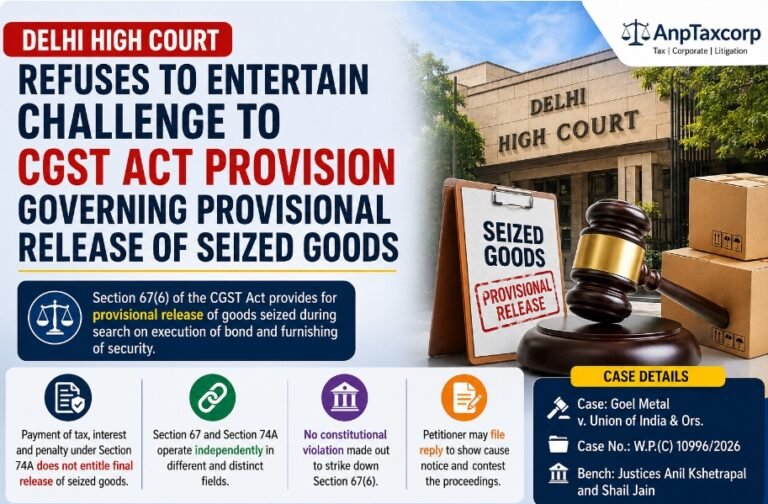
The Delhi High Court has declined to interfere with a writ petition challenging the constitutional validity of Section 67(6) of the Central Goods and Services Tax (CGST) Act, 2017, which provides the mechanism for provisional release of goods seized during GST search proceedings.
The Division Bench comprising Justice Anil Kshetrapal and Justice Shail Jain observed that a person challenging the constitutional validity of a statutory provision must demonstrate how the provision violates a constitutional requirement.
The ruling was delivered in Goel Metal v. Union of India & Ors., W.P.(C) 10996/2026, where the petitioner also questioned the applicability of Rule 140 of the CGST Rules and sought relief against a show cause notice proposing confiscation and penalty proceedings.
Challenge to Section 67(6) of the CGST Act
The dispute arose from the seizure of goods during proceedings conducted under the GST law. The petitioner questioned the continued provisional nature of the release mechanism under Section 67(6) of the CGST Act.
The petitioner argued that the expression “on a provisional basis” should not continue to operate where the taxpayer has already discharged the applicable tax, interest and penalty under Section 74A(9) of the CGST Act.
According to the petitioner, once the statutory dues had been paid, there was no justification for treating the release of the seized goods as merely provisional.
The petitioner therefore sought an interpretation under which payment of the applicable tax, interest and penalty would result in the final release of the seized goods, rather than requiring continued compliance with the provisional-release mechanism.
Section 67 and Section 74A Operate Independently
The Delhi High Court did not accept the petitioner’s interpretation.
The Court highlighted the distinct purposes served by Section 67 and Section 74A of the CGST Act.
Section 67 deals with the powers of the GST authorities relating to inspection, search and seizure. Where goods are seized during search proceedings, Section 67(6) permits their release on a provisional basis, subject to the execution of a bond and furnishing of appropriate security.
On the other hand, Section 74A concerns the determination and recovery of tax that has not been paid, has been short-paid, has been erroneously refunded, or where input tax credit has been wrongly availed or utilised.
The Court therefore observed that the two provisions operate in different and distinct fields. The determination or payment of tax liability under Section 74A does not, by itself, alter the statutory mechanism governing seized goods under Section 67.
Constitutional Challenge Not Established
While considering the challenge to the validity of Section 67(6), the Bench emphasised that merely questioning a statutory provision is not sufficient to establish a constitutional violation.
A petitioner seeking a declaration that a statutory provision is unconstitutional must demonstrate that the provision infringes a constitutional mandate or otherwise suffers from a constitutionally recognised defect.
In the present matter, the Court was not persuaded that the petitioner’s challenge to Section 67(6) warranted judicial interference through writ jurisdiction.
The decision consequently leaves the statutory mechanism under Section 67(6) intact, including the requirement that seized goods may be released provisionally subject to the conditions prescribed under the GST framework.
Challenge to Show Cause Notice
The petitioner had also challenged a show cause notice issued in connection with alleged supply of copper scrap involving fraudulent availment or utilisation of input tax credit.
The petitioner sought quashing of the notice and the consequential confiscation and penalty proceedings.
The High Court, however, declined to interfere at this stage. It observed that the petitioner could submit an appropriate reply to the show cause notice and raise all relevant factual and legal contentions before the competent authority.
This approach reinforces the principle that courts ordinarily exercise caution in interfering with show cause notices, particularly where the statutory adjudication process has not yet been completed.
Key Takeaways for GST Taxpayers
The Delhi High Court’s decision carries important implications for taxpayers whose goods are seized during GST search proceedings.
First, payment of tax, interest and penalty does not automatically convert a provisional release into a final release where the statutory scheme continues to govern the seized goods.
Second, Section 67 and Section 74A serve separate purposes. Payment or determination of tax liability under Section 74A cannot necessarily be treated as extinguishing the consequences arising from seizure under Section 67.
Third, a constitutional challenge to a GST provision requires more than an alternative interpretation of the statutory language. The petitioner must establish a specific violation of constitutional principles.
Finally, taxpayers receiving a show cause notice relating to confiscation, fraudulent transactions or wrongful input tax credit should ordinarily utilise the statutory adjudication mechanism and place their factual and legal defence before the appropriate authority.
Conclusion
The Delhi High Court’s ruling in Goel Metal v. Union of India & Ors. clarifies the distinction between the GST provisions dealing with seizure of goods and determination of tax liability. The Court has declined to read Section 67(6) as providing automatic final release of seized goods merely because tax, interest and penalty have been paid under Section 74A.
The judgment highlights the importance of understanding the independent operation of different provisions of the CGST Act and also reiterates the limited scope for judicial intervention against show cause notices at the initial stage of statutory proceedings.
Case: Goel Metal v. Union of India & Ors.
Case No.: W.P.(C) 10996/2026
Court: Delhi High Court
Bench: Justice Anil Kshetrapal and Justice Shail Jain