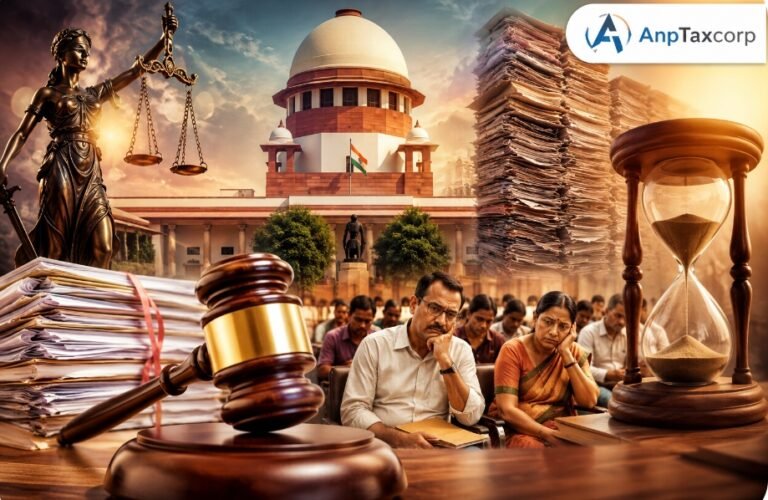
The Supreme Court has expressed serious concern over the functioning of consumer dispute redressal commissions across India, particularly the growing pendency of cases and prolonged delays in hearings. The Court has directed the President of the National Consumer Disputes Redressal Commission (NCDRC) to submit a detailed report on the status of pending cases, disposal rates, infrastructure and the time likely to be required for clearing the backlog.
The significant observations were made by a Bench comprising Chief Justice of India Surya Kant, Justice Joymalya Bagchi and Justice V. Mohana in In Re: Pay and Allowance of the Members of the U.P. State Consumer Disputes Redressal Commission, W.P. (C) No. 1144/2021.
Supreme Court Concerned Over Delay in Consumer Cases
During the hearing, the Supreme Court took note of reports highlighting serious delays before consumer commissions. The Chief Justice referred to an instance where a consumer complaint filed in 2019 was listed only once in 2022 and reportedly did not receive another effective hearing for several years.
The Court questioned whether such functioning was consistent with the purpose for which specialised consumer forums were established.
The observations assume significance because consumer commissions were created to provide consumers with a relatively speedy, accessible and inexpensive mechanism for resolving disputes. Prolonged delays can substantially undermine the very objective of consumer protection legislation.
NCDRC Directed to Submit Detailed Pendency Report
The Supreme Court has directed the NCDRC President to furnish comprehensive information regarding the functioning of the National Commission.
The report is expected to contain details including:
- Total number of pending cases before the NCDRC;
- Composition and present strength of the Commission;
- Average rate of disposal of cases;
- Estimated time required to clear the existing backlog; and
- Other relevant information concerning the functioning and capacity of the Commission.
The Court has asked that the report be submitted within two weeks.
The Supreme Court has also sought separate information concerning pendency before the State Consumer Commissions. The respective State Departments of Consumer Affairs have been directed to assist in compiling the required data.
Performance Evaluation of District Consumer Commissions
The Supreme Court has further directed the Presidents of State Consumer Commissions to evaluate the performance of District Consumer Commissions within their respective jurisdictions for the previous three years.
The direction reflects the Court’s concern that merely increasing the number of members or providing better remuneration may not resolve the problem unless there is corresponding accountability and measurable performance.
The Court questioned whether there is any effective system for assessing the performance of members appointed to consumer commissions.
“Quality Crisis” in Consumer Redressal Mechanism
The Chief Justice expressed particular concern over what he described as a “quality crisis” at the District Consumer Commission level.
The Court indicated that consumer forums must properly examine the nature of complaints, consider the merits of disputes and deliver decisions efficiently. A system intended to provide specialised and speedy consumer justice cannot function effectively if cases remain pending for years without meaningful progress.
The Court also observed that even when matters are disposed of by State Consumer Commissions, subsequent appeals and challenges before the National Commission can contribute to the accumulation of arrears at the NCDRC.
Infrastructure and Appointments Also a Concern
The Supreme Court identified two broad structural concerns: inadequate infrastructure and deficiencies in appointments.
At the same time, the Court made it clear that accountability should not mean expecting commission members to function without adequate working facilities.
The Bench emphasised the need for sufficient infrastructure, support staff and proper working conditions. During the hearing, the amicus curiae, Senior Advocate Gopal Sankarnarayanan, reportedly highlighted the absence of even basic facilities, including women’s toilets, at some consumer commission premises.
Thus, the Court’s concern extends beyond judicial performance to the overall institutional environment in which consumer commissions operate.
Need for Performance Accountability
Another significant issue raised by the Supreme Court relates to appointments of retired judges and other members to consumer commissions.
The Court questioned whether appointment to such bodies is accompanied by an effective mechanism of performance assessment and accountability. The Chief Justice raised the concern that consumer commissions should not become merely a post-retirement placement without corresponding responsibility for disposal and quality of adjudication.
Senior Advocate Gopal Sankarnarayanan, appearing as amicus curiae, supported the need for a performance evaluation mechanism. He suggested that the views and experience of advocates appearing before the commissions could potentially assist in developing an objective assessment system.
Possible Increase in NCDRC Strength and Circuit Benches
The Supreme Court also considered whether increasing the strength of the NCDRC could help address the mounting backlog.
The possibility of establishing circuit benches in areas having a particularly high volume of consumer litigation was also discussed. Such an approach could improve accessibility and reduce the burden on the principal benches.
However, strengthening the consumer justice system would require a combination of adequate manpower, infrastructure, technological support, efficient case management and meaningful performance monitoring.
Implications for Consumers and Consumer Justice
The Supreme Court’s intervention is significant for consumers across India. Consumer protection legislation is premised on the availability of an effective and expeditious dispute-resolution mechanism. When complaints remain pending for years, consumers may face substantial financial and emotional hardship.
The directions issued by the Supreme Court could therefore lead to greater transparency regarding the functioning of consumer commissions and may eventually result in reforms concerning appointments, infrastructure, case management and accountability.
The matter will now be closely watched as the NCDRC and State authorities compile the data sought by the Supreme Court.
Case Details
Case: In Re: Pay and Allowance of the Members of the U.P. State Consumer Disputes Redressal Commission
W.P. (C) No.: 1144/2021
Court: Supreme Court of India
Bench: CJI Surya Kant, Justice Joymalya Bagchi and Justice V. Mohana
The Supreme Court’s latest directions underline an important principle: consumer justice must not merely be accessible in theory; it must also be timely, efficient, accountable and capable of delivering meaningful relief.