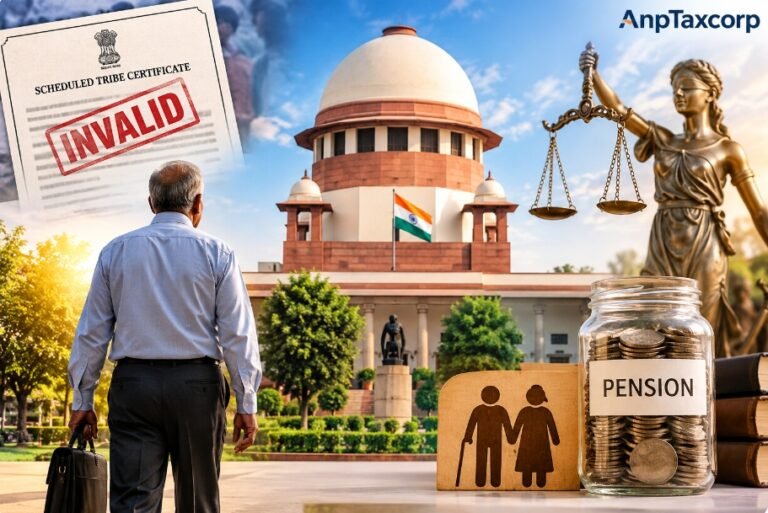
The Supreme Court has granted significant relief to a retired employee whose Scheduled Tribe (ST) community certificate was declared invalid after he had completed more than three decades of government service.
In Shirish Pandharinath Patil v. State of Maharashtra & Ors., decided on 3 September 2026, a Bench comprising Justice Aravind Kumar and Justice Vipul M. Pancholi invoked the Supreme Court’s extraordinary powers under Article 142 of the Constitution of India to protect the employee’s retiral and pensionary benefits.
The Court made it clear, however, that such protection would not amount to recognition or validation of his claim of belonging to the concerned Scheduled Tribe.
Background of the Case
The appellant was appointed as a Junior Engineer (Civil) with the Municipal Corporation of Greater Mumbai in 1994 on the basis of a community certificate showing him as belonging to the ‘Tokre Koli’ Scheduled Tribe.
After serving the municipal corporation for several years, the validity of his community certificate came under scrutiny. In 2020, the competent Caste Scrutiny Committee declared the certificate invalid.
The employee challenged the scrutiny committee’s decision before the Bombay High Court, but the High Court upheld the decision. He thereafter approached the Supreme Court by filing a Special Leave Petition.
During the pendency of the proceedings before the Supreme Court, the appellant was permitted to continue in service pursuant to an interim order. He ultimately completed his service and retired on 30 June 2025 upon attaining the age of superannuation.
Following his retirement, the principal issue before the Supreme Court was whether his long period of service could be protected for the limited purpose of granting retiral and pensionary benefits.
Supreme Court’s Decision
The Supreme Court agreed to protect the employee’s service for the limited purpose of calculating and releasing his retirement benefits.
The Court noted that the appellant had entered service on 21 October 1994 and remained in service until 30 June 2025, thereby completing more than three decades of continuous service.
Considering the length of service and the fact that the appellant had already retired, the Bench considered it appropriate to exercise its powers under Article 142 to ensure that he was not deprived of his retiral and pensionary benefits.
Accordingly, the Court directed that the service rendered by the appellant from 21 October 1994 until his retirement on 30 June 2025 would be protected only for the purpose of computation and release of retiral and pensionary benefits, subject to the applicable service rules.
Article 142 and Complete Justice
Article 142 empowers the Supreme Court to pass orders necessary to do “complete justice” in matters pending before it.
The Court relied upon the principles laid down in Chairman and Managing Director, Food Corporation of India & Ors. v. Jagdish Balaram Bahira & Ors. (2017).
In that decision, the Supreme Court had recognized that an appointment obtained on the basis of an invalid caste or tribe certificate ordinarily cannot be sustained. Nevertheless, in appropriate and exceptional circumstances, the Court may exercise its constitutional power under Article 142 to prevent injustice.
The Bench also considered its earlier decision in Surekha Baljorsingh Thakur v. Caste Scrutiny Committee & Anr. (2024) while considering protection of the employee’s retiral benefits.
Relief Limited to Retirement Benefits
Importantly, the Supreme Court carefully restricted the scope of the relief.
The order does not validate the appellant’s caste certificate or establish that he belongs to the Tokre Koli Scheduled Tribe.
The Court specifically clarified that neither the appellant nor any member of his family would be entitled to claim any future benefit on the basis of the invalidated caste certificate.
Thus, the protection granted by the Supreme Court is confined exclusively to the computation and release of retiral and pensionary benefits arising from the service already rendered.
Key Takeaway
The judgment demonstrates the Supreme Court’s willingness to balance the legal consequences of an invalid community certificate with considerations of equity, long years of service and complete justice.
While an invalid caste or tribe certificate cannot ordinarily provide a permanent basis for claiming reservation-related employment benefits, the Supreme Court may, in exceptional circumstances, invoke Article 142 to protect accrued retirement benefits arising from an extraordinarily long period of service.
The decision therefore draws an important distinction between protecting retiral benefits earned through long service and recognizing or validating an invalid caste claim.
Case Details
Case: Shirish Pandharinath Patil v. The State of Maharashtra & Ors.
Court: Supreme Court of India
Bench: Justice Aravind Kumar and Justice Vipul M. Pancholi
Date of Judgment: 3 September 2026
Key Provision: Article 142 of the Constitution of India
Outcome: Appeal partly allowed; service protected for limited computation and release of retiral and pensionary benefits.