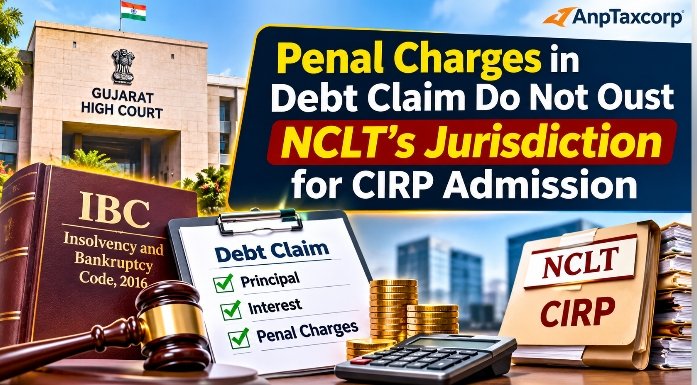
Gujarat High Court rules that inclusion of penal charges and interest in a financial creditor’s claim does not oust NCLT jurisdiction under Section 7 of IBC.
Introduction
The Gujarat High Court has clarified that the inclusion of penal charges and interest in a financial creditor’s debt claim does not, by itself, deprive the National Company Law Tribunal (NCLT) of its jurisdiction to entertain an application for initiation of the Corporate Insolvency Resolution Process (CIRP) under Section 7 of the Insolvency and Bankruptcy Code, 2016 (IBC).
The Court emphasised that the primary consideration at the admission stage of a Section 7 application is whether a financial debt exists and whether a default exceeding the prescribed statutory threshold has occurred. Disputes concerning the calculation, verification or admissibility of individual components of the creditor’s claim can be examined during the insolvency proceedings.
The ruling reinforces the distinction between determining the existence of a financial default and examining the accuracy of the total amount claimed by a financial creditor.
Background of the Case
The matter arose from loan transactions between Sheth Fincap Services Private Limited and the borrower entities, including Takshashila Resicom Private Limited. The loans were advanced against mortgage security.
Following disputes relating to the transactions, a criminal complaint was lodged, resulting in the registration of an FIR in September 2025. Subsequently, the financial creditor issued recovery notices demanding outstanding amounts exceeding ₹6.15 crore.
During proceedings concerning anticipatory bail before the Bombay High Court, the directors of the borrower companies submitted affidavits undertaking to repay substantial amounts to the lender. The Court granted them time to fulfil their payment commitments.
However, before the expiry of the time granted, Sheth Fincap Services Private Limited initiated insolvency proceedings against the borrower entities by filing applications under Section 7 of the IBC.
The NCLT, Ahmedabad Bench, admitted the applications, initiated CIRP and appointed an Interim Resolution Professional (IRP).
Aggrieved by these orders, Takshashila Resicom Private Limited and its directors approached the Gujarat High Court by filing a writ petition.
Contentions Raised by the Petitioners
The petitioners challenged the maintainability of the insolvency proceedings, alleging that the financial creditor had improperly invoked the IBC as a debt recovery mechanism.
Their principal contention was that the creditor’s claim included substantial penal charges and interest which, according to them, could not automatically be treated as financial debt under the IBC.
They further argued that the inclusion of such disputed components affected the validity of the debt claim and that the NCLT lacked jurisdiction to entertain the insolvency application.
On the other hand, the financial creditor opposed the writ petition, pointing out that the IBC provides an established appellate mechanism under Section 61. It also highlighted that the petitioners had already approached the National Company Law Appellate Tribunal (NCLAT), challenging the NCLT’s admission orders.
Gujarat High Court’s Observations
Justice Nisha M. Thakore observed that the inclusion of interest and penal charges may alter the quantum of the financial creditor’s claim but does not inherently take away the NCLT’s jurisdiction.
The Court explained that proceedings under Section 7 of the IBC involve a summary examination, primarily to determine whether a financial debt exists and whether a default of at least ₹1 crore has occurred.
Importantly, the Court clarified that disputes concerning the verification and reconciliation of penal charges and interest do not automatically render the NCLT incompetent to entertain a Section 7 application.
The Bench also observed that contractual interest and penal charges stipulated in the underlying loan documents may form part of the creditor’s claim, subject to proper verification.
At the same time, the Court recognised the responsibility of the Resolution Professional to scrutinise the claims submitted by creditors. Any component of a claim that remains unverified, lacks support from the underlying loan agreement or is not accompanied by appropriate calculations may be rejected by the Resolution Professional.
Thus, the Court distinguished between the jurisdiction of the NCLT to admit an insolvency application and the subsequent verification of the creditor’s individual claim components.
Alternative Remedy Before NCLAT
Another important aspect of the judgment concerned the availability of an alternative statutory remedy.
The Gujarat High Court noted that the petitioners had already challenged the NCLT’s orders before the NCLAT under Section 61 of the IBC. Their objections regarding penal charges and interest were also pending consideration before the appellate tribunal.
Although the High Court acknowledged that the existence of an alternative remedy does not completely exclude its writ jurisdiction, it held that such a remedy ordinarily warrants judicial restraint.
Since the petitioners failed to establish exceptional circumstances justifying interference under writ jurisdiction, the Court declined to entertain their challenge.
Accordingly, the writ petition was dismissed.
Conclusion and Legal Significance
The judgment in Takshashila Resicom Private Limited & Ors. v. Sheth Fincap Services Private Limited & Ors. provides important clarification on the scope of NCLT’s jurisdiction under Section 7 of the Insolvency and Bankruptcy Code, 2016.
The ruling establishes that a dispute over penal interest or additional charges cannot, by itself, invalidate an otherwise maintainable insolvency application. The existence of financial debt and the occurrence of default remain the central considerations at the admission stage.
For financial creditors, the decision reinforces that the inclusion of contractual interest and penal charges does not automatically defeat CIRP proceedings, provided the underlying claim is legally sustainable and supported by appropriate documentation.
For corporate borrowers, the judgment highlights the importance of raising specific objections regarding the contractual basis, calculation and verification of disputed charges before the appropriate insolvency forum.
Case Details:
- Case Title: Takshashila Resicom Private Limited & Ors. v. Sheth Fincap Services Private Limited & Ors.
- Court: Gujarat High Court
- Case Number: Special Civil Application No. 13836 of 2026
- Date of Decision: 23 October 2026
- Judge: Justice Nisha M. Thakore
-
Relevant Provision: Section 7 and Section 61 of the Insolvency and Bankruptcy Code, 2016.