Introduction
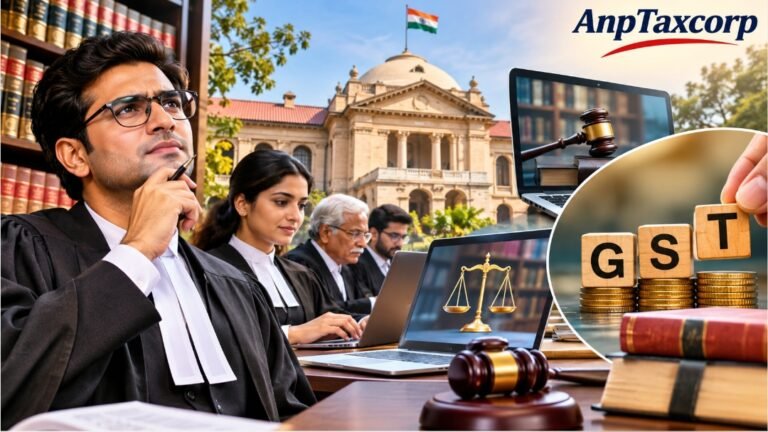
Online legal research platforms have become essential tools for advocates, law firms, legal professionals and law students. These platforms provide access to judicial decisions, statutory provisions, legal commentaries and other important legal resources required for effective legal research and case preparation.
However, subscriptions to such online legal research and educational database services attract GST at an aggregate rate of 18%.
The taxation of these services was challenged before the Allahabad High Court in Aniket Gupta v. Union of India and Four Others, Neutral Citation: 2026:AHC:221725-DB.
The petitioner questioned the classification and taxation of online legal research services under the GST framework, arguing that such services are essential professional requirements rather than luxury or entertainment services.
The High Court, however, dismissed the PIL on the ground of unexplained delay in questioning the tax notifications.
2. Background of the Case
The petitioner, an advocate, approached the Allahabad High Court under Article 226 of the Constitution of India, challenging the relevant Central, State and Integrated GST notifications issued in 2017 and their subsequent amendments.
Under the existing GST classification, online text-based information services are covered under Service Accounting Code (SAC) 998431, attracting GST at 18%.
The petitioner argued that online legal research databases serve a specialised professional purpose. Advocates regularly depend on these platforms to verify judicial precedents, examine statutory interpretations and determine whether a particular judgment has been subsequently reversed, modified or overruled.
According to the petitioner, imposing 18% GST on these essential legal research services increases the cost of professional practice and creates an additional financial burden, particularly for junior advocates and small legal practitioners.
3. Petitioner’s Arguments Against 18% GST
The petitioner raised several important legal and constitutional concerns.
A. Legal research is not a luxury service
It was contended that online legal databases are indispensable tools for advocates. Access to authentic and updated legal information is necessary for presenting accurate legal arguments before courts and tribunals.
Therefore, treating such services like ordinary online information or content services was argued to be inappropriate.
B. Financial burden on junior advocates and litigants
The petitioner submitted that the 18% GST levy disproportionately affects junior advocates, individual practitioners, legal-aid lawyers and litigants appearing in person.
Unlike registered businesses eligible for input tax credit, many individual subscribers cannot recover the GST paid on such subscriptions. Consequently, the tax becomes an additional cost of professional practice.
C. Discriminatory classification
The petition questioned the classification of online legal research databases under SAC 998431.
It was argued that printed publications, e-books, online educational journals and certain knowledge-oriented publications receive different GST treatment.
According to the petitioner, online legal research services should also receive appropriate recognition based on their educational and professional character rather than merely their digital mode of delivery.
D. Violation of constitutional principles
The petitioner alleged that the impugned classification and tax treatment were arbitrary and discriminatory, violating Articles 14 and 21 of the Constitution, read with Articles 38 and 39A.
The petition sought a separate classification for online legal research services with a nil or concessional GST rate.
Alternatively, the petitioner requested that the matter be referred to the GST Council and its Fitment Committee for reconsideration.
4. Allahabad High Court’s Observations
The Division Bench comprising Chief Justice Arun Bhansali and Justice Kshitij Shailendra examined the petition and questioned why the petitioner had challenged the GST rate after such a considerable period.
The Court observed that the notifications imposing GST on online legal research services had been in existence since 2017.
The Bench particularly noted that the petitioner was enrolled as an advocate in 2020 and claimed to have been practising for approximately six years.
However, the petition did not explain what circumstances had suddenly prompted him to become aware of the alleged unreasonableness of the GST rate and initiate the PIL.
The Court was not convinced by the petitioner’s explanation and observed that such a delayed challenge, without any satisfactory justification, could not be entertained.
Accordingly, the Court dismissed the PIL.
5. Whether the Court Examined the Constitutional Validity of 18% GST?
An important aspect of this judgment is that the High Court did not decide the substantive legal issues raised by the petitioner.
The Court did not examine:
-
Whether SAC 998431 is the appropriate classification for online legal research services.
-
Whether imposing 18% GST on legal research databases is constitutionally valid.
-
Whether the classification violates Article 14 of the Constitution.
-
Whether online legal research services deserve a separate or concessional GST rate.
-
Whether the matter should be referred to the GST Council or its Fitment Committee.
The dismissal was based on the unexplained delay in challenging the notifications.
Therefore, this judgment should not be interpreted as a judicial endorsement of the constitutional validity or substantive reasonableness of the 18% GST levy.
6. Legal Implications of the Judgment
The decision highlights an important procedural consideration in constitutional litigation: the significance of delay and laches.
Although Article 226 empowers High Courts to issue appropriate writs for enforcement of legal rights, the exercise of writ jurisdiction is discretionary. Courts may decline to entertain petitions where the petitioner approaches the Court after an unexplained and unreasonable delay.
In the present case, the petitioner challenged notifications that had been operating since 2017 without adequately explaining why the challenge was being initiated several years later.
The judgment also brings attention to the financial burden of GST on essential professional services. However, the larger question of whether online legal research platforms should receive a distinct GST classification or concessional treatment remains undecided in this proceeding.
7. Conclusion
The Allahabad High Court’s decision in Aniket Gupta v. Union of India and Four Others serves as a reminder that even substantial constitutional and taxation issues must be raised within a reasonable time and supported by proper explanations for any delay.
While the petitioner raised significant concerns regarding the affordability of online legal research services and their importance in professional legal practice, the Court declined to examine those issues because the challenge to the 2017 notifications was belated and unexplained.
Importantly, the judgment does not settle the constitutional validity of the 18% GST levy on online legal research subscriptions. The substantive classification and tax-rate issues remain open for consideration in an appropriate proceeding.
Case Details
| Particulars | Details |
|---|---|
| Case Title | Aniket Gupta v. Union of India and Four Others |
| Court | Allahabad High Court |
| Case Number | PIL No. 2544 of 2026 |
| Neutral Citation | 2026:AHC:221725-DB |
| Date of Judgment | 26 October 2026 |
| Bench | Chief Justice Arun Bhansali and Justice Kshitij Shailendra |
| Relevant Classification | SAC 998431 |
| GST Rate Challenged | 18% |
| Decision | PIL dismissed |
Disclaimer: This article is intended for general legal information and educational purposes only. It should not be treated as legal advice.