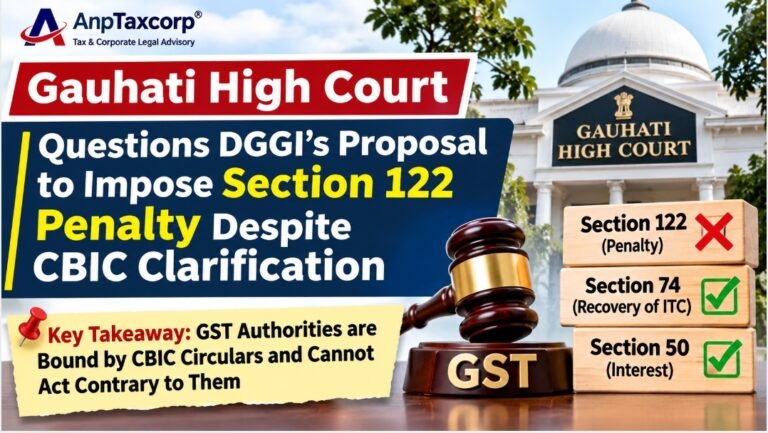
The ruling is significant for taxpayers facing GST demands involving alleged wrongful availment of Input Tax Credit (ITC) without actual receipt of goods or services. It highlights the distinction between recovery of ineligible ITC under Section 74, levy of interest under Section 50 and imposition of penalties under Section 122 of the CGST Act, 2017.
The Court also emphasised that departmental authorities cannot disregard binding instructions issued by the Central Board of Indirect Taxes and Customs (CBIC) while initiating adjudication proceedings.
Background of the Case
The matter arose from a writ petition filed by M/s G.M. Coke Industries, a partnership firm engaged in the manufacture of coke in Assam, before the Gauhati High Court.
The Directorate General of GST Intelligence (DGGI), Guwahati Zonal Unit, issued a demand-cum-show-cause notice dated 30 September 2026 alleging that the petitioner had wrongly availed Input Tax Credit on the strength of invoices and corresponding e-way bills issued by 17 suppliers without actually receiving the underlying goods.
The department alleged wrongful availment of ITC amounting to ₹16,21,12,454 (approximately ₹16.21 crore).
Apart from proposing recovery of the disputed ITC, the show-cause notice also proposed penalties under Sections 122(1)(viii) and 122(2)(b) of the CGST Act, along with corresponding provisions of the Assam GST Act and the IGST Act.
Aggrieved by the proposed action, the taxpayer approached the High Court challenging the legality of the penalty proceedings.
Petitioner’s Arguments: CBIC Circular No. 171/03/2022-GST
Appearing for the petitioner, Senior Advocate Dr. Ashok Saraf relied upon CBIC Circular No. 171/03/2022-GST dated 6 July 2022.
The circular clarifies the treatment of transactions involving the availment or utilisation of ITC without actual receipt of goods or services.
The petitioner’s principal contention was that where a registered person avails or utilises ITC without receiving the underlying goods or services, the department may initiate recovery proceedings under Section 74 of the CGST Act, together with applicable interest under Section 50.
However, the same conduct cannot attract an additional penalty under Section 122 when the CBIC circular expressly clarifies that such penalty is not imposable for that particular contravention.
It was further argued that CBIC circulars are binding on departmental officers and that GST authorities cannot adopt an interpretation contrary to the instructions issued by the Board.
The petitioner also relied upon the Supreme Court’s decision in Commissioner of Customs v. Indian Oil Corporation to support the proposition that departmental circulars bind revenue authorities.
Revenue’s Stand Before the High Court
The Revenue authorities contended that the impugned notice was still at the show-cause stage and that the petitioner had an opportunity to submit its reply before the department took any final decision regarding the proposed recovery and penalties.
However, the High Court examined the specific allegations in the notice alongside the clarification issued by the CBIC and the legal position governing the binding nature of departmental circulars.
Gauhati High Court’s Observations
Justice Soumitra Saikia observed that CBIC Circular No. 171/03/2022-GST specifically clarifies that where ITC is availed or utilised without actual receipt of goods or services, recovery proceedings can be initiated under Section 74 of the CGST Act, together with applicable interest under Section 50.
However, the circular does not permit the imposition of a penalty under Section 122 or any other provision of the CGST Act for the same act.
The Court found that the impugned show-cause notice proposed penalties under Sections 122(1)(viii) and 122(2)(b), equivalent to the amount of ITC involved, in addition to the proposed recovery of the disputed credit.
The Bench observed that the proposed penalty proceedings appeared to be in direct conflict with the CBIC circular.
The Court also relied upon the Supreme Court’s decision in Commissioner of Customs v. Indian Oil Corporation, which recognised that circulars issued by the Board are binding on departmental authorities.
The High Court reiterated that although such circulars are not binding on courts or assessees, they are binding on the Revenue. Consequently, departmental authorities cannot undertake any action that is expressly prohibited by an applicable CBIC circular.
In this regard, the Court observed that a show-cause notice or demand issued contrary to a binding Board circular cannot be sustained in law.
High Court’s Interim Direction
Taking note of the apparent conflict between the proposed penalty proceedings and the CBIC clarification, the Gauhati High Court issued notice to the respondents, returnable within four weeks.
The Court also restrained the authorities from taking further action pursuant to the impugned show-cause notice until the next date of hearing.
It is important to note that this is an interim order at the writ petition stage. The High Court has not finally adjudicated the underlying allegation of wrongful availment of ITC or determined the ultimate tax liability of the petitioner.
Legal Significance and Implications for GST Taxpayers
This decision carries considerable significance for taxpayers facing GST investigations and proceedings involving alleged wrongful availment of Input Tax Credit.
1. Binding nature of CBIC circulars: GST officers are required to follow applicable CBIC circulars while exercising their statutory powers. They cannot disregard departmental instructions merely because they propose a different interpretation of the law.
2. Distinction between ITC recovery and penalty: The decision highlights the distinction between recovery of allegedly ineligible ITC under Section 74, interest under Section 50 and penalty proceedings under Section 122. Each proposed action must have independent statutory and legal justification.
3. Challenge to legally inconsistent show-cause notices: Where a show-cause notice proposes action contrary to a binding CBIC circular, the taxpayer may examine the possibility of challenging such proceedings before the appropriate judicial forum.
4. Importance of departmental clarifications: Taxpayers and their legal representatives should carefully examine relevant CBIC circulars while preparing replies to GST show-cause notices, particularly in cases involving ITC eligibility, fake invoicing and transactions without actual movement or receipt of goods.
Conclusion
The Gauhati High Court’s intervention reinforces an important principle of GST administration: departmental authorities must exercise their statutory powers consistently with binding CBIC instructions.
While the department retains the power to recover ineligible ITC and applicable interest in accordance with law, it cannot impose penalties in disregard of an express CBIC clarification prohibiting such action.
The ruling serves as an important reference for GST practitioners and taxpayers dealing with ITC-related investigations and penalty proceedings. It also underscores the importance of examining the applicability of departmental circulars before accepting or contesting a proposed GST demand.
Case Details
-
Case Name: M/s G.M. Coke Industries v. Union of India
-
Court: Gauhati High Court
-
Case Number: WP(C)/6028/2026
-
Judge: Justice Soumitra Saikia
-
Relevant Provisions: Sections 50, 74, 122(1)(viii) and 122(2)(b) of the CGST Act, 2017
-
Relevant Circular: CBIC Circular No. 171/03/2022-GST dated 06.07.2022
Disclaimer: This article is intended for general legal information and educational purposes only. The observations are based on the reported interim order and should not be treated as a substitute for professional legal advice.