Introduction
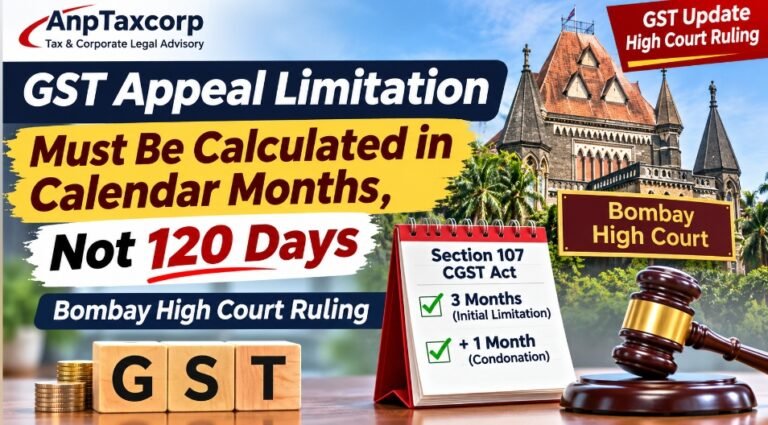
In an important ruling concerning the limitation period for filing GST appeals, the Bombay High Court has clarified that the statutory period prescribed under Section 107 of the Central Goods and Services Tax (CGST) Act, 2017, must be calculated in calendar months and not by treating the combined limitation period as a fixed period of 120 days.
The Court observed that there is a significant legal distinction between a limitation period expressed in terms of days and one expressed in terms of months. Consequently, the statutory period of three months for filing an appeal, along with the additional one-month period available for condonation of delay, cannot automatically be converted into 120 days.
The ruling is particularly significant for taxpayers whose GST appeals have been rejected on the ground of marginal delay arising from an incorrect calculation of the statutory limitation period.
Background of the Case
The matter arose from a writ petition filed by United India Insurance Company Limited before the Bombay High Court. The petitioner challenged an order rejecting its GST appeal on the ground that the appeal had been filed beyond the prescribed limitation period.
The relevant adjudication order was communicated to the company on August 11, 2025. Subsequently, the company filed its appeal on December 11, 2025.
The Appellate Authority calculated the limitation period by treating three months prescribed under Section 107(1) of the CGST Act, together with the additional one-month period available under Section 107(4), as a fixed period of 120 days.
On this calculation, the authority considered the appeal to be delayed by two days and rejected it.
Aggrieved by the rejection, the company approached the Bombay High Court, challenging the method adopted by the Appellate Authority for computing the limitation period.
Legal Provisions Involved: Section 107 of the CGST Act
Section 107 of the CGST Act provides the statutory mechanism for filing appeals against orders passed by adjudicating authorities.
Section 107(1): Under this provision, any person aggrieved by an order passed by an adjudicating authority may file an appeal before the prescribed Appellate Authority within three months from the date on which the decision or order is communicated to such person.
Section 107(4): This provision empowers the Appellate Authority to allow an appeal to be presented within a further period of one month if it is satisfied that the appellant had sufficient cause for not filing the appeal within the prescribed three-month period.
Importantly, the legislature has specifically used the expression “months” in both provisions rather than prescribing a fixed number of days.
Therefore, the central legal issue before the High Court was whether the limitation period could be mechanically calculated as 120 days or whether it had to be computed according to calendar months.
Observations of the Bombay High Court
A Division Bench comprising Justice M.S. Karnik and Justice Sandesh D. Patil examined the statutory language of Section 107(1) and Section 107(4) of the CGST Act.
The Court accepted the petitioner’s contention that there is a clear distinction between a limitation period expressed in days and one expressed in months.
The Bench observed that the limitation period prescribed under Section 107(1), together with the additional period available under Section 107(4), must be calculated in calendar months.
The Court specifically rejected the approach of treating the combined limitation and condonation period as an inflexible period of 120 days.
The reasoning is important because the number of days in individual calendar months is not uniform. A three-month period may comprise 89, 90, 91 or 92 days, depending on the relevant dates and months involved.
Accordingly, converting a statutory period expressed in months into a fixed number of days may result in an incorrect computation of limitation.
Decision of the Bombay High Court
After examining the facts and the relevant statutory provisions, the Bombay High Court concluded that the petitioner’s appeal was within the limitation period prescribed under Section 107 of the CGST Act.
The Court accordingly allowed the writ petition and quashed the Appellate Authority’s order dated May 7, 2026, rejecting the GST appeal.
The Appellate Authority was directed to consider and decide the company’s appeal on its merits and in accordance with law.
Thus, the taxpayer obtained relief against the rejection of its appeal arising from the incorrect computation of the statutory limitation period.
Legal Significance and Implications for GST Taxpayers
This judgment carries considerable significance for businesses, tax professionals and legal practitioners dealing with GST appellate proceedings.
The key takeaways are:
- Calendar months are relevant: The limitation period under Section 107(1) and the additional period under Section 107(4) must be computed in calendar months.
- No automatic 120-day formula: The combined three-month limitation period and one-month condonation period cannot be mechanically treated as 120 days.
- Protection against incorrect rejection: Appeals should not be rejected merely because an authority has incorrectly converted calendar months into a fixed number of days.
- Importance of statutory interpretation: Authorities must follow the language employed by the legislature while calculating statutory limitation periods.
- Opportunity for reconsideration: Taxpayers whose appeals have been rejected on similar grounds may examine whether the limitation calculation adopted by the Appellate Authority was legally sustainable.
However, this judgment should not be interpreted as providing an automatic extension of limitation to every delayed GST appeal. The statutory conditions under Section 107(4), including the requirement to establish sufficient cause, continue to apply wherever condonation is sought.
Conclusion
The Bombay High Court’s ruling reinforces an important principle of statutory interpretation: when legislation prescribes a limitation period in months, the authorities must calculate it in calendar months rather than substitute an arbitrary fixed number of days.
For GST taxpayers, this decision provides meaningful relief against erroneous rejection of appeals based on mechanical computation of limitation.
Taxpayers and professionals should carefully examine the dates of communication of adjudication orders, the applicable statutory limitation period and the manner in which the Appellate Authority has calculated the delay before concluding that an appeal is time-barred.
Case Reference:
United India Insurance Company Ltd. v. Union of India & Ors.
Writ Petition (L) No. 33751 of 2026
Court: Bombay High Court
Bench: Justice M.S. Karnik and Justice Sandesh D. Patil
Decision: May 7, 2026 (order of the Appellate Authority quashed by the High Court)
Statutory Provisions: Sections 107(1) and 107(4) of the CGST Act, 2017.
Disclaimer: This article is intended for general informational and educational purposes only and does not constitute legal advice. Readers are advised to refer to the original judgment and seek professional legal advice based on the facts and circumstances of their individual cases.