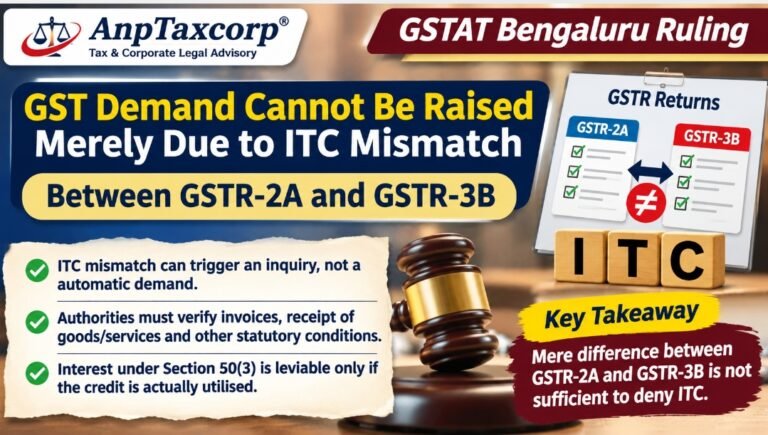
GSTAT Bengaluru rules that ITC cannot be disallowed merely due to GSTR-2A and GSTR-3B mismatch. Invoice-wise verification is necessary before raising GST demand.
Introduction
In an important ruling concerning the availability of Input Tax Credit (ITC) under GST, the Goods and Services Tax Appellate Tribunal (GSTAT), Bengaluru, has held that a mere mismatch between ITC claimed by a taxpayer in Form GSTR-3B and the credit reflected in Form GSTR-2A cannot, by itself, justify the disallowance of ITC or confirmation of a GST demand.
The Tribunal emphasised that a difference between the two statements should trigger a detailed investigation rather than automatically result in an adverse assessment. Tax authorities are required to examine supporting invoices, verify the receipt of goods or services and establish whether the statutory conditions for claiming ITC have been fulfilled.
The ruling reinforces the principle that GST demands must be based on proper verification of facts and supporting evidence rather than mechanical comparisons of return data.
Facts of the Case
The matter arose in the case of Gajanan Nagesh Pai v. Commissioner of Commercial Taxes, Karnataka, decided by GSTAT Bengaluru.
The appellant was a civil contractor executing works for the Public Works Department in Karnataka.
For the financial year 2021-22, the taxpayer had claimed Input Tax Credit amounting to approximately ₹28.02 lakh in his GST returns. However, the credit reflected in the statement generated from suppliers’ returns was only around ₹17.30 lakh.
Consequently, the department treated the difference of approximately ₹10.72 lakh as excess ITC and initiated proceedings for recovery of the disputed credit, along with applicable interest and penalty.
The GST authorities confirmed a total demand of approximately ₹18.27 lakh without undertaking the necessary invoice-wise verification of the disputed ITC.
Aggrieved by the demand, the taxpayer approached the GST Appellate Tribunal.
Arguments of the Parties
The taxpayer contended that the department had disallowed ITC merely on the basis of differences between GSTR-2A and GSTR-3B without properly examining the underlying purchase invoices and other supporting documents.
It was further argued that interest could not be demanded without establishing that the disputed ITC had actually been utilised.
On the other hand, the department submitted that the taxpayer had failed to respond to various notices and had not adequately discharged the burden of establishing his eligibility for the disputed ITC.
Findings and Observations of GSTAT
The Tribunal, comprising Judicial Member Prabhakaran P.M. and Technical Member (State) Ravi Jesuraj S., rejected the approach of mechanically confirming a demand based solely on the mismatch between the two GST statements.
It observed that the difference between GSTR-2A and GSTR-3B represents the beginning of an inquiry and cannot be treated as its conclusion. The proper officer must seek an explanation from the taxpayer, examine the relevant documents and record appropriate findings before determining the eligibility of ITC.
The Tribunal also held that the first appellate authority could not dismiss the taxpayer’s appeal merely because he had failed to appear during the appellate proceedings.
1. Invoice-wise verification is mandatory
The Tribunal highlighted the requirement to follow applicable GST circulars governing verification of ITC mismatches for the relevant period.
For April to December 2021, the assessing authority was required to verify:
- Availability of valid tax invoices or debit notes.
- Actual receipt of goods or services by the recipient.
- Payment made to suppliers against the relevant invoices.
- Whether the corresponding tax had been paid to the Government.
- Compliance with the applicable restrictions under Rule 36(4) of the CGST Rules.
The Tribunal also directed that the additional ITC limit of 5% under Rule 36(4), wherever applicable, should be calculated month-wise, following the prescribed cumulative methodology for April to June 2021.
2. Burden of proving ITC eligibility
Referring to Section 155 of the CGST Act and the Supreme Court’s decision in State of Karnataka v. Ecom Gill Coffee Trading Pvt. Ltd., the Tribunal reiterated that the responsibility to establish ITC eligibility rests upon the taxpayer.
Merely producing invoices and evidence of payment may not be sufficient. The genuineness of the underlying transactions and fulfilment of statutory conditions must also be established.
3. Interest liability under Section 50(3)
The Tribunal clarified that interest under Section 50(3), read with Rule 88B(3) of the CGST Rules, can be levied only where ITC has been both wrongly availed and utilised.
Since the original order did not establish actual utilisation of the disputed credit through examination of the electronic credit ledger, the interest demand could not be sustained.
The penalty liability would also require fresh determination based on the tax ultimately found payable.
Final Decision
GSTAT Bengaluru set aside the impugned orders confirming the demand of ₹18.27 lakh and restored the show cause notice to the proper officer for fresh adjudication.
The taxpayer was directed to furnish an invoice-wise reconciliation along with supporting documents within eight weeks of receiving the Tribunal’s order.
The assessing authority was directed to examine each disputed invoice, provide an opportunity of personal hearing and pass a reasoned order in accordance with law.
Importantly, the Tribunal clarified that it had not expressed any final opinion regarding the eligibility of individual invoices or the ultimate tax liability.
Legal Significance of the Ruling
This decision is significant for taxpayers facing GST demands arising from differences between GSTR-2A and GSTR-3B.
It reiterates that an ITC mismatch cannot automatically be treated as excess credit warranting recovery. Proper verification, consideration of documentary evidence and compliance with applicable statutory provisions are essential before disallowing ITC.
The ruling also highlights the importance of maintaining invoice-wise reconciliations, purchase records, proof of receipt of goods or services and supplier payment details.
For businesses and tax professionals, the decision provides an important basis for challenging mechanical ITC disallowances unsupported by proper verification.
Case Reference: Gajanan Nagesh Pai v. Commissioner of Commercial Taxes, Karnataka
Case No.: APL/103/BUR/2026
Forum: GST Appellate Tribunal, Bengaluru
Conclusion: A mismatch between GSTR-2A and GSTR-3B may justify an inquiry, but cannot, by itself, establish ineligibility of ITC. Every disputed credit must be examined on the basis of applicable legal provisions and supporting evidence.
Disclaimer: This article is intended for general legal information and academic discussion. The actual applicability of the ruling depends upon the facts of each case and the relevant statutory provisions.