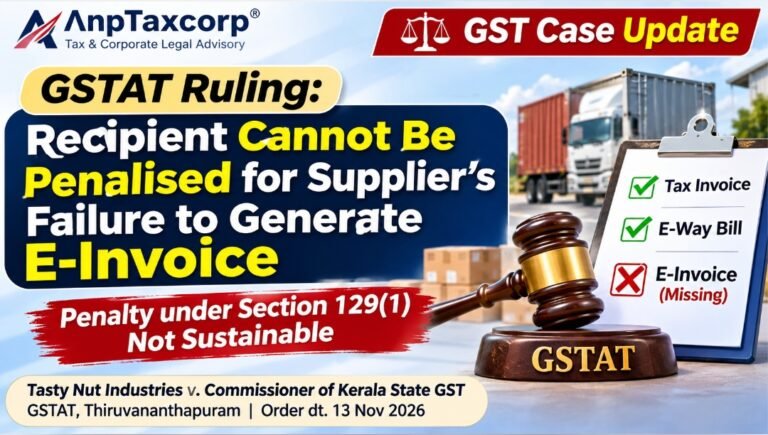
The ruling reinforces an important principle under GST law: a recipient should not automatically be made liable for a procedural default attributable to the supplier.
Background of the Case
The dispute arose in the case of Tasty Nut Industries v. Commissioner of Kerala State GST, Thiruvananthapuram, involving the movement of 4,182 kg of cashew kernels from the taxpayer’s Tamil Nadu GST registration to its Kerala GST registration.
Although the movement involved two GST registrations of the same business, the registrations were treated as distinct persons under GST law. Accordingly, the transaction was considered an inter-State supply attracting IGST.
At the time of transportation, the consignment was accompanied by a proper tax invoice and a valid e-way bill. However, the supplier had not generated the prescribed e-invoice.
During transportation, the Assistant State Tax Officer intercepted the vehicle at Ithikara in Kollam district, Kerala. The officer detained the goods on the ground that the mandatory e-invoice had not been generated.
Consequently, the GST authorities imposed a penalty of ₹1,01,631 under Section 129(1) of the CGST/KGST Acts. The first appellate authority subsequently upheld the penalty, prompting the taxpayer to approach the GST Appellate Tribunal.
Arguments Advanced by the Taxpayer
The taxpayer challenged the detention and penalty, contending that the consignment was supported by all essential transportation documents.
The principal arguments were:
-
A valid tax invoice had been issued for the transaction.
-
A valid e-way bill was available during transportation.
-
The goods carried in the vehicle corresponded with the description and quantity mentioned in the accompanying documents.
-
There was no discrepancy or evidence of tax evasion.
-
The failure to generate an e-invoice was attributable to the supplier and could not be treated as a default committed by the recipient.
The department, on the other hand, maintained that the two GST registrations constituted distinct persons and that the transaction was an inter-State supply. It further argued that compliance with the e-invoicing requirement was mandatory and its non-compliance justified the action taken by the authorities.
Findings and Observations of GSTAT
The GSTAT, Thiruvananthapuram, comprising Vice-President Subramanya Rayaprol and Technical Member Ramamoorthi Sriram, examined the circumstances surrounding the detention and the applicability of Section 129(1).
The Tribunal accepted that the transaction between the Tamil Nadu and Kerala registrations constituted an inter-State supply. However, it distinguished the supplier’s responsibility to generate an e-invoice from the recipient’s liability during transportation.
The Tribunal observed that the tax invoice and e-way bill were already available with the transporter when the vehicle was intercepted. Therefore, the recipient could not be penalised merely because the supplier had failed to prepare the e-invoice.
It specifically held that the penalty imposed on the recipient under Section 129(1) was unsustainable, as there was no justification for penalising the recipient for the supplier’s failure to generate the prescribed e-invoice.
The Tribunal further clarified that non-issuance of an e-invoice, by itself, cannot constitute a valid ground for detention of the vehicle and imposition of penalty in the circumstances of the case.
Importantly, the Tribunal did not grant immunity to the supplier for its non-compliance. It observed that the supplier’s failure to generate the e-invoice could be examined separately by the jurisdictional GST officer in accordance with law.
Legal Precedents Relied Upon
While arriving at its conclusion, the Tribunal relied upon earlier judicial decisions, particularly:
1. OSEL Devices Limited v. Assistant Enforcement Officer – Kerala High Court: The High Court had held that proceedings under Section 129 should not be invoked merely for minor discrepancies where the circumstances do not indicate an intention to evade tax.
2. Nancy Trading Company v. State of U.P. – Allahabad High Court: The Court recognised that detention and penalty proceedings were not justified in the absence of any finding indicating an intention to evade tax, particularly when the prescribed transportation documents accompanied the goods.
These judicial precedents supported the Tribunal’s view that procedural non-compliance must be examined in its proper legal context and should not automatically result in detention and penalty.
Final Decision of the Tribunal
The GSTAT set aside the Order-in-Appeal dated 27 April 2022 passed by the Joint Commissioner (Appeals-I), Kollam, and allowed the taxpayer’s appeal with consequential relief.
The Tribunal conclusively held that:
-
Section 129(1) cannot be invoked against the recipient merely because the supplier failed to generate an e-invoice.
-
The responsibility for issuing the prescribed e-invoice rests with the supplier.
-
Where a proper tax invoice and valid e-way bill accompany the goods, and there is no discrepancy in the description or quantity of the goods, detention and penalty cannot be justified solely on the ground of non-generation of an e-invoice.
-
Any default concerning e-invoice generation may be examined separately by the jurisdictional GST officer in the supplier’s case.
Case Details
| Particulars | Details |
|---|---|
| Case Name | Tasty Nut Industries v. Commissioner of Kerala State GST |
| Tribunal | GSTAT, Thiruvananthapuram |
| Appeal No. | APL/64/TVP/2026 |
| Final Order No. | 21/TVP/KERALA/2026 |
| Citation | 2026 LLBiz GSTAT (TVP) 88 |
| Date of Order | 13 November 2026 |
| Relevant Provision | Section 129(1), CGST/KGST Act |
Disclaimer: This post is intended solely for general information and educational purposes and should not be construed as legal advice or a substitute for professional legal consultation.