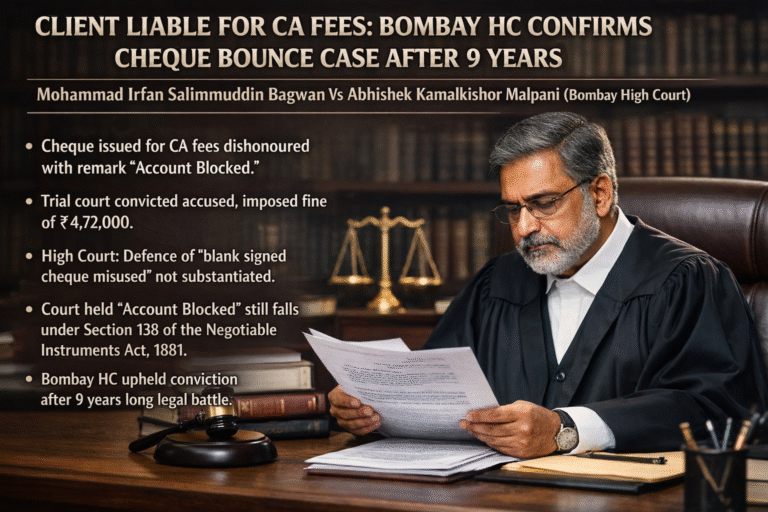
In a significant ruling reaffirming the legal enforceability of professional fees and the presumption attached to cheque transactions, the Bombay High Court has upheld the conviction of an accused in a cheque bounce case under Section 138 of the Negotiable Instruments Act, 1881. The case, Mohammad Irfan Salimmuddin Bagwan vs. Abhishek Kamalkishor Malpani, highlights key principles relating to dishonour of cheques, evidentiary presumptions, and the limited scope of revisional jurisdiction.
Background of the Case
The dispute originated from a complaint filed by a Chartered Accountant for non-payment of professional fees. The accused had engaged the complainant for professional services and, towards discharge of the outstanding liability, issued a cheque. However, upon presentation, the cheque was dishonoured with the remark “Account Blocked.”
Following the dishonour, the complainant issued the statutory demand notice as required under Section 138. Despite receipt of the notice, the accused failed to make payment within the stipulated time. This led to the initiation of criminal proceedings before the Judicial Magistrate.
Findings of the Lower Courts
After examining the evidence on record, the trial court convicted the accused and imposed a fine of ₹4,72,000, directing that compensation be paid to the complainant. The conviction was based on the presumption under Section 139 of the Negotiable Instruments Act, which assumes that a cheque is issued towards discharge of a legally enforceable debt or liability unless proven otherwise.
The appellate court, upon re-evaluation of the case, upheld the trial court’s findings and dismissed the appeal. It found no merit in the arguments raised by the accused and confirmed that the complainant had successfully established the existence of a debt and the issuance of the cheque.
Arguments Raised in Revision
Aggrieved by the concurrent findings, the accused approached the Bombay High Court by way of a revision application. Several contentions were raised to challenge the conviction:
- The cheque was allegedly issued as a security and not towards discharge of any legally enforceable debt.
- The cheque was claimed to be blank at the time of issuance, with its contents filled in later by the complainant.
- It was argued that the complainant failed to recall specific details of the transaction, thereby creating doubt about the liability.
- The accused also contended that dishonour of a cheque due to the remark “Account Blocked” does not fall within the ambit of Section 138.
High Court’s Analysis and Observations
The High Court began by emphasizing the limited scope of its revisional jurisdiction. It reiterated that interference is warranted only when there is a clear case of illegality, perversity, or a patent error in the findings of the lower courts.
Upon examining the record, the Court noted that the professional relationship between the parties was undisputed. The complainant had produced documentary evidence to substantiate that services were rendered and that fees remained unpaid. Importantly, the accused had admitted both the issuance of the cheque and his signature on it.
In such circumstances, the statutory presumption under Section 139 came into play. The burden shifted to the accused to rebut this presumption by leading cogent evidence. However, the Court found that the accused had failed to discharge this burden.
Addressing the argument of a “blank signed cheque,” the Court observed that it is well-settled law that once a cheque is signed, the person issuing it cannot escape liability merely by claiming that its contents were filled in by another person. In the absence of any evidence to prove misuse, such a defence cannot be accepted.
Similarly, the plea that the cheque was issued as a “security” was rejected. The Court held that such a contention must be supported by credible evidence, which was lacking in the present case.
On the issue of dishonour due to “Account Blocked,” the Court clarified that the reason for dishonour does not automatically exclude the applicability of Section 138. What is material is whether the cheque was issued towards a legally enforceable debt and whether it was dishonoured upon presentation. The Court referred to judicial precedents that have interpreted Section 138 broadly to include various reasons for dishonour, provided the underlying liability exists.
The Court also noted that the accused had not raised the “account blocked” argument before the lower courts and had failed to examine any bank official to substantiate this claim. This further weakened his defence.
Final Verdict
After considering all aspects, the Bombay High Court found no illegality, perversity, or error in the concurrent findings of the trial and appellate courts. Consequently, the revision application was dismissed, and the conviction of the accused was upheld.
However, taking a balanced approach, the Court granted a six-week stay on the implementation of the order to enable the accused to approach the Supreme Court.
Key Takeaways
This judgment reinforces several important legal principles:
- Cheques issued towards professional fees are legally enforceable under Section 138.
- The presumption under Section 139 places a significant burden on the accused to disprove liability.
- Defences such as “blank cheque” or “security cheque” must be backed by evidence.
- Dishonour due to reasons like “Account Blocked” can still attract liability under Section 138.
- Revisional jurisdiction is limited and does not permit re-appreciation of evidence unless there is a clear error.
Overall, the ruling serves as a strong reminder of the sanctity of cheque transactions and the legal consequences of defaulting on professional obligations.