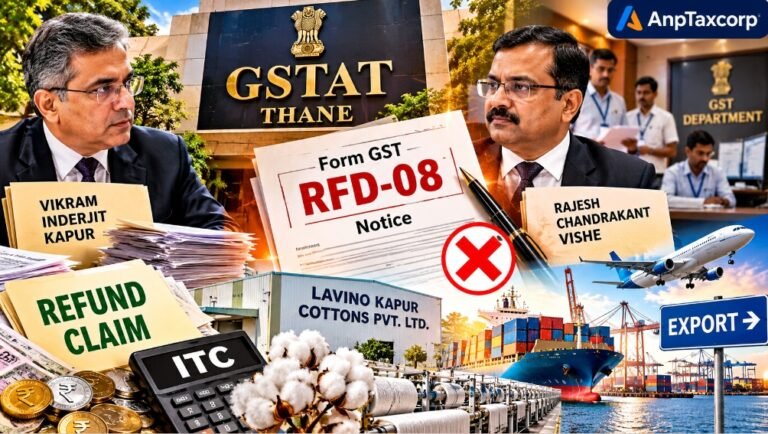
GSTAT Thane rules that failure to issue mandatory Form GST RFD-08 notice before rejecting a refund claim cannot be cured through an appellate hearing. Read the case facts, legal provisions and implications.
Introduction
In an important ruling concerning GST refund proceedings, the Thane Bench of the Goods and Services Tax Appellate Tribunal (GSTAT) has held that a refund claim cannot be rejected wholly or partially without following the mandatory procedure prescribed under Rule 92(3) of the Central Goods and Services Tax (CGST) Rules, 2017.
The Tribunal clarified that an opportunity of hearing during appellate proceedings cannot rectify the original authority’s failure to issue a statutory show-cause notice in Form GST RFD-08 before rejecting the refund claim.
The decision reinforces the importance of procedural compliance, transparency and the principles of natural justice in GST administration. It also highlights that tax authorities must communicate the precise grounds for proposed rejection before taking an adverse decision against a taxpayer.
Case Background
The dispute arose in the matter of Vikram Inderjit Kapur v. Rajesh Chandrakant Vishe, Deputy Commissioner of State Tax, decided by the GSTAT Thane Bench on 22 October 2026.
The appeals concerned refund claims filed by Lavino Kapur Cottons Private Limited, a 100% Export Oriented Unit engaged in manufacturing and exporting absorbent cotton. The company sought refunds of accumulated input tax credit (ITC) arising from exports made without payment of domestic GST.
For August 2020, the company claimed a refund of ₹63,17,232. The adjudicating authority sanctioned part of the amount but rejected ₹18,09,402, citing an alleged mismatch in input tax credit.
However, the authority did not issue the prescribed show-cause notice in Form GST RFD-08 or provide the taxpayer with a hearing before rejecting the disputed portion of the refund.
Aggrieved by the decision, the company approached the first appellate authority. Although the appellate authority acknowledged the procedural violation, it upheld the rejection on the ground that certain supporting documents had not been furnished during the appellate proceedings.
The taxpayer subsequently challenged the appellate orders before GSTAT.
Legal Issue Before GSTAT
The principal question was whether the original authority’s failure to issue the mandatory Form GST RFD-08 notice could be cured by allowing the taxpayer to present its case during the appellate proceedings.
The dispute also involved an alleged ITC mismatch and the applicability of temporary relaxations concerning the Rule 36(4) restriction during the COVID-19 period.
The department argued that the taxpayer had received sufficient opportunities to explain its position before the appellate authority and that the original procedural defect should therefore be treated as cured.
The taxpayer, on the other hand, contended that the absence of a statutory notice had deprived it of a meaningful opportunity to understand and respond to the specific allegations underlying the rejection.
Relevant Legal Provision: Rule 92(3) of the CGST Rules
Rule 92(3) of the CGST Rules, 2017, prescribes the procedure to be followed when a refund claim is proposed to be rejected, wholly or partly.
Under this provision, the proper officer is required to issue a notice in Form GST RFD-08, communicating the grounds on which the refund is proposed to be rejected. The applicant must be given an opportunity to submit a reply in Form GST RFD-09 and an opportunity of being heard before an adverse order is passed.
The purpose of this procedure is to ensure that a taxpayer knows the precise objections raised by the department and can produce relevant records, reconciliations and supporting evidence before the refund decision is finalised.
A general opportunity to participate in subsequent proceedings is not necessarily equivalent to the specific statutory opportunity required at the adjudication stage.
Tribunal’s Findings and Decision
The GSTAT Thane Bench, comprising Judicial Member Ramesh Nair and Technical Member Prallhad S. Paranjape, rejected the department’s argument that the appellate hearing had cured the procedural defect.
The Tribunal emphasised that the requirement to issue Form GST RFD-08 is mandatory. Without the notice, the taxpayer was not informed of the precise basis of the alleged ITC mismatch and could not submit a focused, evidence-based response at the appropriate stage.
The Bench further observed that the first appellate authority had acknowledged the violation of Rule 92(3) but nevertheless upheld the refund rejection on merits. According to the Tribunal, the appropriate course was to remit the matter to the original adjudicating authority for fresh consideration in accordance with law.
Accordingly, the Tribunal set aside the impugned appellate orders and the corresponding original orders to the extent that they rejected the refund claims. The matters were remanded to the adjudicating authority for fresh consideration after following the prescribed procedure.
Importantly, the Tribunal did not decide the substantive question concerning the alleged ITC mismatch or the applicability of COVID-19-related relaxations. Those issues remain open for consideration in the remand proceedings.
Key Legal Principle Emerging from the Judgment
The ruling establishes an important procedural distinction between an opportunity to be heard in an appeal and the statutory opportunity that must be provided before the original adverse decision is made.
The issuance of Form GST RFD-08 serves a specific legal purpose: it informs the taxpayer of the proposed grounds of rejection and enables a meaningful response before the authority reaches its conclusion.
An appellate hearing cannot automatically replace this statutory safeguard. Where the prescribed procedure has not been followed, the appropriate remedy may be to set aside the defective order and direct fresh adjudication in accordance with the law.
However, the judgment does not mean that every procedural irregularity will invariably invalidate an order. The legal consequences depend on the applicable statutory provision, the nature of the violation and the facts of the case.
Practical Implications for GST Taxpayers
This decision offers useful guidance to businesses dealing with disputed GST refunds, particularly exporters and entities claiming refunds of accumulated ITC.
Taxpayers should consider the following compliance measures:
-
Verify the notice: Check whether Form GST RFD-08 was issued before the refund was rejected, wholly or partly.
-
Examine the grounds: Ensure that the notice identifies the specific discrepancies or legal objections relied upon by the department.
-
Submit a documented reply: Use Form GST RFD-09 to provide reconciliations, invoices, returns and other relevant supporting records.
-
Preserve procedural objections: If the prescribed notice or hearing was not provided, raise the objection specifically in the appeal and support it with the relevant records.
-
Seek an appropriate remedy: Depending on the facts and procedural stage, request the setting aside of the defective order and fresh adjudication in accordance with law.
Conclusion
The GSTAT Thane ruling in Vikram Inderjit Kapur v. Rajesh Chandrakant Vishe, Deputy Commissioner of State Tax underscores that procedural safeguards under GST law are substantive protections for taxpayers, not mere formalities.
The decision reinforces the principle that refund claims must be adjudicated through the procedure prescribed by law. An appellate opportunity cannot, by itself, substitute for a mandatory pre-decisional notice.
For businesses facing GST refund disputes, the judgment highlights the importance of examining not only the merits of a refund claim but also whether the tax authorities have complied with the statutory requirements governing its rejection.
Case Reference: Vikram Inderjit Kapur v. Rajesh Chandrakant Vishe, Deputy Commissioner of State Tax; GSTAT Thane; Appeal No. APL/32/THN/2026;
Disclaimer: This article is intended for general legal information and educational purposes. The outcome of an individual GST refund dispute depends on the applicable law, the evidence and the facts of the case.