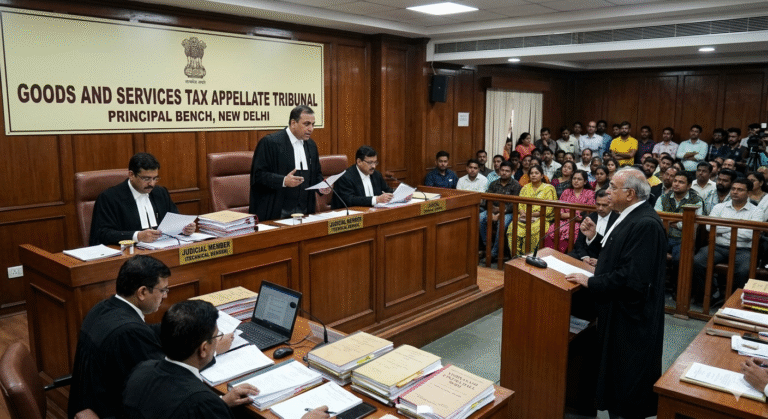
In a significant ruling reinforcing consumer protection under the GST regime, the Principal Bench of the Goods and Services Tax Appellate Tribunal (GSTAT) has upheld an anti-profiteering order against Hyderabad-based Vishwanath Cinema Hall 70MM for failing to transfer the benefit of a GST rate reduction to customers.
The Tribunal confirmed that the cinema hall retained the financial advantage arising from the lower GST rate instead of reducing ticket prices for viewers. As a result, the establishment has been directed to deposit approximately ₹8.99 lakh along with interest.
The judgment highlights the principle that tax reductions introduced by the government must ultimately benefit consumers and cannot be retained by suppliers through pricing adjustments.
Background of the Dispute
The matter originated from a complaint alleging that the cinema hall did not pass on the benefit of a reduction in GST rates applicable to cinema tickets.
Effective from January 1, 2019, GST on cinema tickets priced at ₹100 or below was reduced from 18% to 12%. The objective behind the reduction was to make movie tickets more affordable and ensure that consumers directly benefited from the tax cut.
However, anti-profiteering authorities found that although the GST component had been reduced, the final ticket price charged to customers remained unchanged.
According to the investigation, instead of reducing the overall price, the cinema hall increased the base price of tickets, thereby retaining the benefit of the lower tax burden.
DGAP Investigation and Revised Profiteering Amount
The Director General of Anti-Profiteering (DGAP) conducted an investigation into the allegations and initially determined that the cinema hall had profiteered approximately ₹6 lakh during the relevant period.
Subsequently, a re-investigation and supplementary report were carried out, which revised the profiteered amount upward to ₹8.99 lakh.
The investigation covered transactions between January 1, 2019 and June 30, 2019.
The authorities concluded that the benefit arising from the GST rate reduction had not been transferred to consumers as required under anti-profiteering provisions.
Cinema Hall’s Defence Before GSTAT
Before the Tribunal, the cinema hall argued that cinema ticket pricing in Telangana is regulated under state cinema laws and may vary depending on the nature and popularity of films being exhibited.
It was also contended that certain ticket price revisions for specific movie releases require approval from competent authorities.
However, the DGAP maintained that regardless of state-level pricing structures, the legal responsibility to pass on GST benefits remained with the supplier.
The authorities further pointed out that the cinema hall failed to produce any government notification, approval order, or documentary evidence authorising an increase in ticket prices during the relevant period.
Tribunal’s Findings and Observations
After reviewing the records and submissions, the GSTAT found no supporting evidence showing that the cinema hall had obtained permission to revise ticket prices.
The Tribunal also noted that the respondent did not challenge the methodology adopted by the DGAP nor dispute the calculations contained in the investigation reports.
Importantly, the bench observed that increasing the base price immediately after a tax reduction defeated the purpose of GST rate rationalisation.
Rejecting the cinema hall’s explanation, the Tribunal held that the increase in base ticket prices was legally unsustainable.
The order observed that the findings and calculations of the DGAP remained substantially uncontested.
Deposit Direction and No Penalty Imposed
Holding that the benefit of the GST reduction was not passed on to moviegoers, the Tribunal directed the cinema hall to deposit the profiteered amount of ₹8.99 lakh together with interest at the rate of 18%.
Since individual recipients of the benefit could not be identified, the Tribunal ordered that:
- 50% of the amount be deposited into the Central Consumer Welfare Fund; and
- The remaining 50% be deposited into the Telangana State Consumer Welfare Fund.
Notably, no monetary penalty was imposed in this case.
The Tribunal clarified that the relevant penalty provision became effective only from January 1, 2020, whereas the disputed period extended from January 1, 2019 to June 30, 2019.
Conclusion
The ruling serves as an important reminder that businesses cannot neutralize tax relief measures by increasing base prices. Anti-profiteering provisions under GST are intended to ensure that reductions in tax rates directly benefit consumers.
This decision also reinforces that businesses must maintain documentary evidence to justify any price changes and remain compliant with GST obligations.
Case Title: DG Anti-Profiteering, DGAP v. Vishwanath Cinema Hall 70MM
Case Number: NAPA/25/PB/2025
Follow the Link below to watch the video: