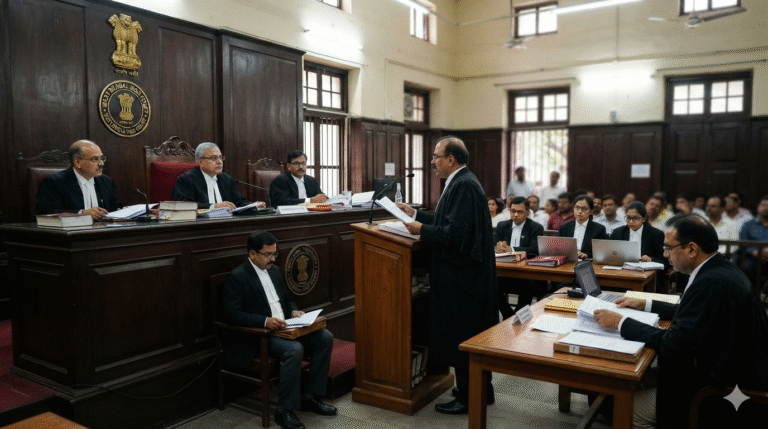
In a landmark ruling reinforcing the importance of procedural fairness in tax administration, the Calcutta High Court has quashed an income tax assessment order and consequential demand of ₹87.20 crore raised against Pricewaterhouse Coopers Private Limited (PwC). The Court held that the Income Tax Department violated the principles of natural justice by issuing a show cause notice and passing the final assessment order on the same day, thereby denying the assessee a meaningful opportunity to be heard.
The judgment in Pricewaterhouse Coopers Private Limited v. Assistant Commissioner of Income Tax, Circle-1(1), Aayakar Bhawan & Ors. reiterates that the right to a fair hearing is not a mere procedural requirement but a fundamental safeguard against arbitrary administrative action.
Background of the Case
PwC filed its return of income for the Assessment Year 2024–25, declaring a substantial business loss. The return was selected for scrutiny under the faceless assessment scheme, and the company responded to multiple notices issued under Sections 143(2) and 142(1) of the Income-tax Act, 1961. During the assessment proceedings, PwC furnished detailed explanations, financial records, and supporting documents whenever called upon by the tax authorities.
Subsequently, the assessment proceedings were transferred from the National Faceless Assessment Centre (NFAC) to the Jurisdictional Assessing Officer under Section 144B(8) of the Act. Following the transfer, additional notices seeking information were issued, and PwC continued to cooperate by filing timely replies.
The controversy arose on 28 March 2026, when the Assessing Officer issued a fresh show cause notice referring to information allegedly received from the Deputy Commissioner of Income Tax, Central Circle, Hyderabad. The notice questioned PwC’s alleged role in providing consultancy or advisory services relating to the acquisition of KSK Energy Ventures Ltd. through Gland Celsus Bio Chemicals Pvt. Ltd. and sought an explanation regarding the fees allegedly earned from the transaction.
PwC submitted a comprehensive reply, supported by documentary evidence, on 30 March 2026, which was the last date prescribed for responding to the notice. However, on that very day, the Assessing Officer passed the final assessment order under Section 143(3), raising a tax demand of ₹87.20 crore and initiating penalty proceedings.
Aggrieved by the assessment, PwC approached the Calcutta High Court under Article 226 of the Constitution.
Arguments Before the High Court
PwC argued that the assessment order was fundamentally flawed because it was passed immediately after the submission of its reply, leaving no realistic possibility for the Assessing Officer to examine the explanation or the supporting documents.
The company submitted that it had fully cooperated during the assessment proceedings and had complied with every notice issued by the Department. It further contended that the final show cause notice introduced fresh allegations, making it all the more necessary for the Assessing Officer to objectively consider the reply before arriving at any adverse conclusion.
PwC also relied on settled judicial precedents emphasizing that an opportunity of hearing must be genuine, effective, and meaningful rather than a mere procedural ritual.
On the other hand, the Revenue maintained that adequate opportunities had already been provided during the assessment process and that the assessment order was passed within the statutory limitation period.
Findings of the Court
The Calcutta High Court rejected the Revenue’s contentions and held that the assessment proceedings suffered from a serious procedural defect.
The Court observed that the principles of natural justice require much more than the formal issuance of a show cause notice. A taxpayer must be given a reasonable opportunity to present its case, and the authority must objectively consider the explanation before arriving at a conclusion.
According to the Court, passing the assessment order on the very day the assessee filed its reply demonstrated that the explanation had not been meaningfully examined. Such an approach reduced the entire hearing process to what the Court described as a “mere ritualistic formality.”
The Court further observed that procedural fairness cannot be sacrificed merely because the statutory limitation period for completing the assessment is nearing its end. Administrative convenience cannot override the taxpayer’s right to a fair hearing.
While delivering the judgment, the Court relied upon several landmark decisions of the Supreme Court that recognize the principles of natural justice as an indispensable component of administrative decision-making. It reiterated that denial of an effective opportunity of hearing renders the assessment legally unsustainable and that such defects cannot be cured merely through appellate proceedings.
Decision
Allowing the writ petition, the Calcutta High Court quashed the assessment order passed under Section 143(3) of the Income-tax Act, the consequential demand of ₹87.20 crore, and the penalty proceedings initiated pursuant to the assessment.
The Court remanded the matter to the Assessing Officer for fresh adjudication with a direction to provide PwC with a meaningful opportunity of hearing before passing any fresh order in accordance with law.
Significance of the Judgment
The ruling is an important reminder that procedural safeguards are integral to the fairness and legitimacy of tax administration. The decision underscores that compliance with the principles of natural justice is not a technical formality but a substantive legal obligation.
For taxpayers, the judgment affirms that authorities must genuinely consider replies to show cause notices before making additions or raising tax demands. For tax authorities, it serves as a caution that hurried assessments completed merely to meet limitation deadlines are vulnerable to judicial scrutiny.
By emphasizing that meaningful hearing is a cornerstone of fair assessment proceedings, the Calcutta High Court has strengthened taxpayer protections and reaffirmed the rule of law in the administration of direct taxes.