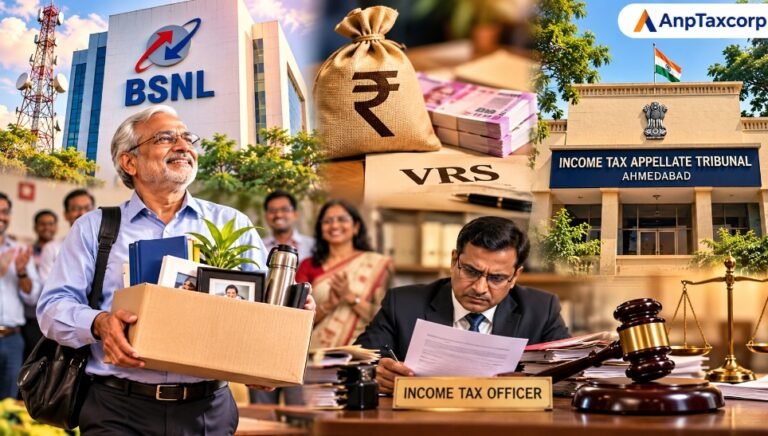
ITAT Ahmedabad allows tax exemption under Section 10(10B) on eligible BSNL VRS-2019 compensation and directs reassessment of taxable income and refunds.
Introduction
The Income Tax Appellate Tribunal (ITAT), Ahmedabad Bench, has delivered a significant ruling in favour of former employees of Bharat Sanchar Nigam Limited (BSNL) concerning the tax treatment of compensation received under the BSNL Voluntary Retirement Scheme, 2019 (VRS-2019).
In Raysinh Atabhai Vala v. Income Tax Officer, the Tribunal held that the compensation received under the scheme qualified for exemption under Section 10(10B) of the Income Tax Act, 1961. It directed the Assessing Officer to recompute the assessee’s taxable income and grant the refund, if any, in accordance with the law.
The decision reinforces the importance of recognising legitimate tax exemptions, even where eligible taxpayers did not claim the benefit while filing their original income tax returns.
Case Details
- Case Title: Raysinh Atabhai Vala v. Income Tax Officer
- Tribunal: Income Tax Appellate Tribunal, Ahmedabad Bench
- Appeal Number: ITA No. 2831/Ahd/2026
- Relevant Provision: Section 10(10B) of the Income Tax Act, 1961
- Subject Matter: Exemption on compensation received under BSNL VRS-2019
- Outcome: Appeal allowed in favour of the assessee
The decision was delivered by a Bench comprising Judicial Member Rahul Chaudhary and Accountant Member Gangadhar Panda. The Tribunal also considered similar appeals involving compensation received under the same voluntary retirement scheme.
Facts of the Case
The dispute arose from the taxability of compensation received by former BSNL employees who opted for the organisation’s VRS-2019.
In one of the appeals, the assessee had received compensation of ₹3,16,797 under the scheme but had not claimed exemption while filing the income tax return, believing that the amount was taxable. Another assessee had received compensation of ₹7,91,017.
Subsequently, the assessees became aware of earlier ITAT decisions holding that compensation received under BSNL VRS-2019 could qualify for exemption under Section 10(10B).
They sought the benefit of the exemption before the appellate authorities. However, the Commissioner of Income Tax (Appeals) rejected their claims, reasoning that voluntary retirement was distinct from retrenchment and that the earlier Tribunal decisions had not correctly interpreted the relevant statutory provisions.
Aggrieved by the appellate orders, the assessees approached the ITAT Ahmedabad Bench seeking appropriate relief.
Legal Issue Before the Tribunal
The principal question was whether compensation received under BSNL VRS-2019 qualified as retrenchment compensation eligible for exemption under Section 10(10B) of the Income Tax Act, 1961.
The proceedings also raised an important practical issue: whether a taxpayer could obtain a legitimate exemption when the benefit had not been claimed in the original income tax return.
The Revenue’s position was that voluntary retirement and retrenchment were legally distinct concepts. The Tribunal was required to consider this objection in light of its earlier decisions concerning the same scheme.
Relevant Legal Provision: Section 10(10B)
Section 10(10B) of the Income Tax Act provides an exemption for eligible retrenchment compensation received by a workman, subject to the applicable statutory conditions and prescribed limits.
The provision generally operates within the framework of compensation payable under the Industrial Disputes Act, 1947, and other applicable laws. The exemption is subject to the relevant conditions and limits, including the applicable monetary ceiling and any notified arrangements.
This provision must be distinguished from Section 10(10C), which separately addresses qualifying payments received under specified voluntary retirement schemes and is generally subject to a maximum exemption of ₹5 lakh.
The Ahmedabad Bench’s decision concerned the applicability of Section 10(10B) to compensation paid under BSNL VRS-2019.
Tribunal’s Analysis and Findings
The ITAT examined its earlier decisions concerning compensation paid under BSNL VRS-2019, including Jayeshkumar Tulsidas Sutaria v. ITO and other decisions addressing the same legal issue.
The Tribunal observed that the Revenue had not demonstrated any material distinction in the facts or legal position that would justify departing from the earlier coordinate Bench decisions.
Accordingly, it followed the established view taken by the Tribunal in similar matters and held that the compensation received by the assessee qualified for exemption under Section 10(10B).
The Tribunal also referred to the Supreme Court’s decision in Collector, Land Acquisition, Anantnag v. Mst. Katiji, which emphasises a justice-oriented approach in considering procedural matters. It further relied on CBDT Circular No. 14 of 1955, which instructs tax authorities to assist taxpayers in obtaining legitimate relief and not to take advantage of their ignorance of their rights.
Applying these principles, the Tribunal concluded that the eligible compensation should not remain taxable merely because the assessee had initially failed to claim the exemption.
Final Decision
The ITAT Ahmedabad Bench allowed the appeals and directed the Assessing Officer to recompute the assessees’ taxable income after granting the applicable exemption under Section 10(10B).
The Assessing Officer was also directed to grant any consequential refund due in accordance with the law. The assessees were required to furnish the relevant compensation details and corresponding income computations.
Key Takeaways for BSNL VRS Retirees
This ruling may be relevant to former BSNL employees who received compensation under VRS-2019 and paid income tax on amounts that may qualify for exemption under Section 10(10B).
Eligible taxpayers should review their VRS compensation documents, income tax returns, assessment records and applicable appellate remedies. However, the decision does not automatically establish exemption for every VRS recipient. Eligibility depends on the applicable statutory conditions, the nature of the payment and the facts of the individual case.
Taxpayers should also distinguish between claims under Sections 10(10B) and 10(10C), as the provisions have different legal requirements.
Conclusion
The ITAT Ahmedabad ruling provides important relief to eligible former BSNL employees by recognising exemption under Section 10(10B) for compensation received under VRS-2019.
The decision highlights the importance of consistent judicial interpretation and the duty of tax authorities to facilitate legitimate tax relief. It also serves as a reminder that taxpayers should examine their exemption entitlements carefully rather than assuming that compensation received on retirement is necessarily taxable.
Disclaimer: This article is intended for general informational purposes and does not constitute legal or tax advice. The applicability of the ruling should be assessed in light of the full order, relevant statutory provisions and individual facts.