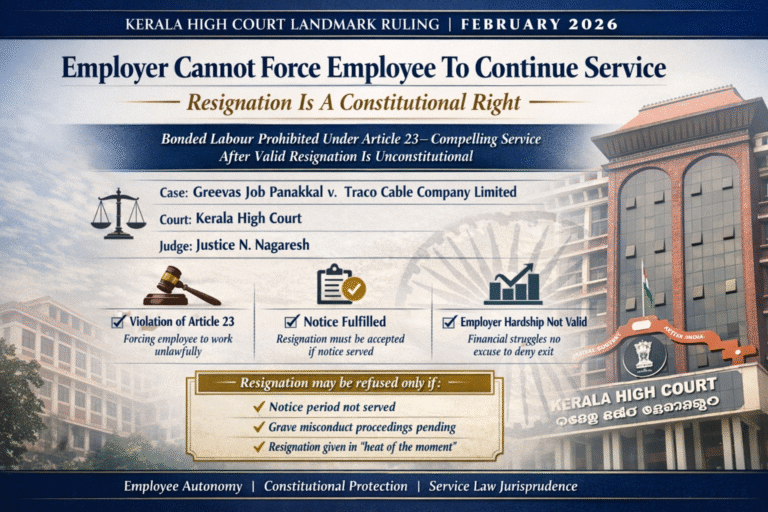
In a significant February 2026 judgment, the Kerala High Court reaffirmed a fundamental principle of employment law — no employer can compel an employee to remain in service once a valid resignation has been submitted in accordance with contractual terms.
The Court held that forcing an employee to continue working against their will, despite compliance with notice requirements, amounts to a violation of Article 23 of the Constitution of India, which prohibits bonded labour.
Background of the Case
The ruling came in Greevas Job Panakkal v. Traco Cable Company Limited, a case involving a Company Secretary employed at a state Public Sector Undertaking (PSU).
The PSU refused to accept the employee’s resignation, citing:
- The company’s precarious financial condition
- His perceived indispensability to the organisation’s revival
The employer argued that the employee’s services were critical for the survival and restructuring of the company.
Court’s Observations
Justice N. Nagaresh made strong observations emphasizing constitutional protections and individual autonomy.
The Court clarified:
- Employment cannot become a form of compulsion.
- Once contractual notice requirements are fulfilled, resignation must ordinarily be accepted.
- Financial hardship of the employer is not a valid legal ground to deny resignation.
- Compelling continued service after a valid resignation resembles bonded labour prohibited under Article 23.
The judgment reinforces that employment relationships are contractual, not coercive.
Special Concern for Company Secretaries and Professionals
The Court also highlighted a critical statutory consequence for professionals such as Company Secretaries.
If an employer refuses to relieve them:
- Their name continues to appear in the Registrar of Companies (RoC) records through Form DIR-12.
- This effectively prevents them from accepting new employment opportunities.
- It may also expose them to ongoing statutory liabilities.
The Court recognized that such refusal can severely damage professional mobility and career prospects.
When Can an Employer Refuse Resignation?
Importantly, the Court outlined limited exceptions where resignation may legitimately be delayed or refused:
1. Contractual Non-Compliance
If the employee fails to serve the agreed notice period or breaches employment terms.
2. Pending Disciplinary Proceedings
If serious misconduct proceedings are already initiated or contemplated, particularly involving financial loss or grave wrongdoing.
3. “Heat of the Moment” Resignation
Where resignation appears impulsive, the employer may briefly pause acceptance to ensure the decision is voluntary and rational.
Outside these narrow circumstances, refusal to accept resignation would be legally untenable.
Final Directions of the Court
The Kerala High Court directed the PSU to:
- Relieve the employee within two months
- Clear all pending salary arrears
- Release terminal benefits without delay
Why This Judgment Matters
This ruling strengthens employee autonomy and reinforces constitutional safeguards in employment relationships. It sends a clear message that:
- Employment is not forced labour.
- Organisational inconvenience cannot override constitutional rights.
- Professional mobility is protected under the law.
The judgment will have significant implications for PSUs, corporate employers, and regulated professionals across India.