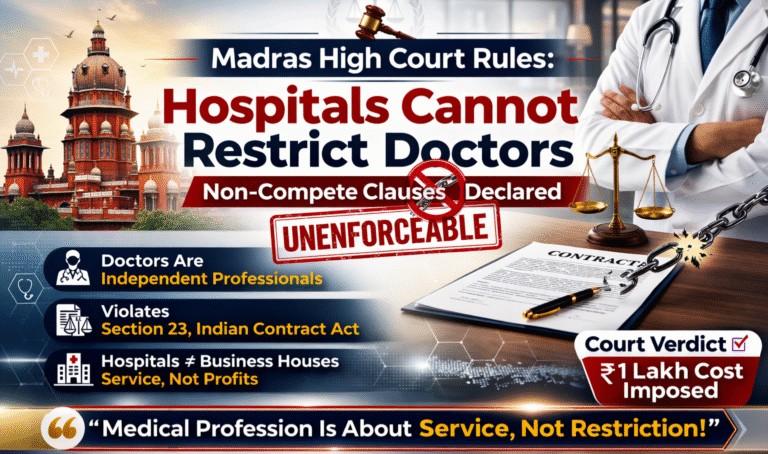
In a landmark ruling, the Madras High Court has held that private hospitals cannot treat doctors like factory workmen by imposing restrictive non-compete and non-solicitation clauses in professional agreements. The Court emphasized that hospitals are service-oriented institutions and cannot function as profit-driven corporate entities that restrict a doctor’s professional freedom.
Case Background
The judgment was delivered by Justice N. Anand Venkatesh while dismissing a petition filed by MIOT Hospitals Private Limited. The hospital had approached the Court seeking appointment of an arbitrator under the Arbitration and Conciliation Act, 1996 to resolve a contractual dispute with cardiothoracic surgeon Balaraman Palaniappan.
The Court not only rejected the hospital’s plea but also imposed costs of ₹1 lakh on it, directing the amount to be paid to the surgeon.
Dispute Over Non-Compete Clause
The hospital and the surgeon had entered into a three-year professional agreement on September 8, 2022. Clause 8.3 of the agreement restricted the surgeon from:
- Joining any “rival hospital,” or
- Setting up independent practice
within a 15 km radius for three years after termination of the contract.
When the surgeon resigned in January 2025 and later joined Apollo Hospitals, the hospital demanded ₹42 lakh as liquidated damages — equivalent to three months’ professional fees — and initiated arbitration proceedings.
Court’s Observations: Doctors Are Independent Professionals
Justice Venkatesh strongly criticized the hospital’s approach, stating that a doctor cannot be treated as a regular employee or technical workman.
The Court observed:
- A hospital only utilizes the services of a doctor.
- A qualified medical professional cannot be equated with an ordinary employee in the technology or factory sector.
- Doctors can thrive independently, but hospitals cannot function without doctors.
The judge described the inclusion of such restrictive clauses as “unfortunate” and remarked that it appeared to be a “cut-copy-paste” practice borrowed from corporate employment contracts.
Rivalry Between Hospitals: A Misnomer
The Court rejected the idea of “rival hospitals,” stating that hospitals are meant to serve patients and society, not compete as commercial business enterprises.
According to the judgment:
- A doctor cannot be restrained from serving patients.
- Preventing a doctor from attending to patients merely because they were earlier treated in another hospital undermines medical ethics and professional dignity.
Section 23 of the Indian Contract Act Applied
The Court held that professional agreements containing non-compete or non-solicitation clauses violate public policy and are hit by Indian Contract Act, 1872.
Such clauses were declared:
- Unlawful
- Unenforceable
- Void ab initio (invalid from the outset)
This observation significantly strengthens the legal position that restrictive covenants cannot curtail a doctor’s right to practice.
Notice Period Dispute Also Rejected
The hospital argued that the surgeon failed to serve the mandatory three-month notice period. However, the Court found that:
- The surgeon submitted his resignation on January 29, 2025.
- He requested to be relieved on April 29, 2025.
- The hospital misinterpreted a later email as the resignation letter.
Even during the hearing, the surgeon expressed willingness to pay one month’s professional fee to settle the matter amicably. The hospital, however, insisted on arbitration.
Justice Venkatesh criticized this stance, remarking that the petition appeared to be an attempt to “witch-hunt” the doctor rather than resolve a genuine dispute.
Key Legal Takeaways
- Hospitals cannot impose post-termination non-compete clauses on doctors.
- Medical professionals are independent practitioners, not factory employees.
- Restrictive covenants in medical service agreements may be void under Section 23 of the Indian Contract Act.
- Arbitration cannot be invoked to enforce unlawful contractual clauses.
Conclusion
This judgment reinforces the principle that the medical profession is rooted in service, not commercial rivalry. By striking down restrictive clauses, the Madras High Court has protected the professional autonomy of doctors and reaffirmed that hospitals must prioritize patient care over corporate control.