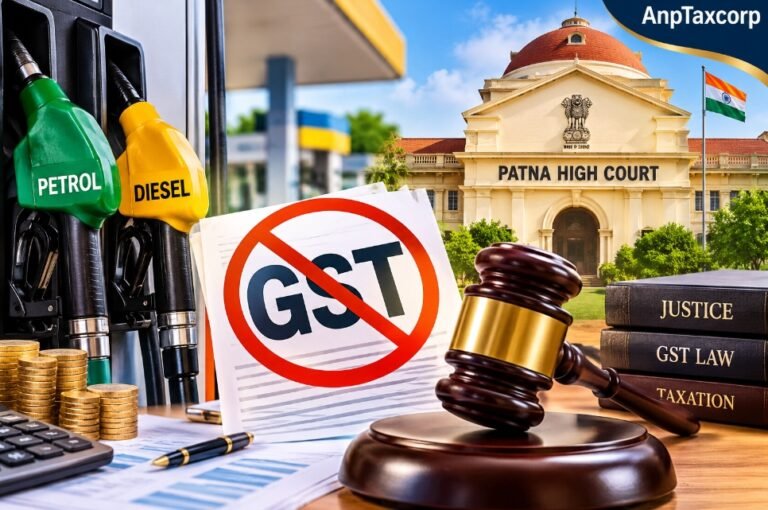
The Patna High Court has delivered an important ruling on the scope of GST jurisdiction over petroleum products, setting aside a tax demand of approximately ₹1.25 crore imposed on a petroleum dealer. The Court found that the assessment appeared to includebg5 Motor Spirit (petrol) and High-Speed Diesel (HSD), products that are presently outside the levy of GST.
The judgment highlights a fundamental principle of indirect taxation: a tax authority cannot impose GST on goods that are not legally covered by the GST levy. Where the very authority to levy tax is absent, the resulting assessment can suffer from a jurisdictional defect.
The case is particularly significant for businesses dealing in petroleum products and other goods that remain outside the GST framework.
Background of the Case
The matter arose in M/s Prem Highway Services v. Union of India, Civil Writ Jurisdiction Case No. 16335 of 2025.
Prem Highway Services is engaged in the business of dealing in petroleum products. The petitioner challenged an assessment order dated 29 April 2024, under which a tax liability of ₹1,25,71,936 had been created.
According to the petitioner, its business involved the sale of Motor Spirit and High-Speed Diesel, both of which are currently subject to taxation under the applicable VAT framework rather than GST.
The petitioner contended that the assessing authority had incorrectly considered invoices relating to these petroleum products for the purpose of determining GST liability.
Petroleum Products Outside the Present GST Levy
One of the central issues before the High Court was whether GST could be imposed on Motor Spirit and HSD.
Although petroleum products are contemplated under the GST legislation, the statutory framework does not automatically bring them within the effective GST levy. Section 9(2) of the CGST Act provides a mechanism under which GST can be levied on certain petroleum products through an appropriate notification.
The petitioner argued that the required notification had not been issued and, consequently, GST could not be imposed on Motor Spirit and HSD merely because the products were dealt with by a GST-registered taxpayer.
This distinction is important. GST registration of a taxpayer does not by itself make every transaction undertaken by that taxpayer taxable under GST. The nature of the goods or services and the applicable charging provisions must first be examined.
Department’s Defence Before the High Court
The State opposed the writ petition and pointed out that the petitioner had not adequately responded to the show-cause notice issued during the assessment proceedings.
The Department also argued that the petitioner had not produced sufficient material before the assessing authority to establish that the disputed invoices related exclusively to non-GST petroleum products.
It was further submitted that the assessment order indicated that some transactions involved goods which were taxable under GST. Therefore, according to the Department, the entire assessment could not simply be treated as invalid.
High Court Examines the Documents
The Division Bench comprising Justice Anil Kumar Sinha and Justice Vikas Kumar examined the material placed before it.
The petitioner produced its GST registration certificate and relevant tax invoices before the Court. On examination of the record, the Court noted that Motor Spirit and HSD were non-GST items and that GST had apparently been imposed in respect of such goods.
This aspect assumed considerable importance because the question was not merely whether the petitioner had complied with procedural requirements. The Court was concerned with the more fundamental question of whether the assessing authority possessed the legal authority to impose GST on transactions involving products outside the GST levy.
Tax Cannot Be Imposed Without Legal Authority
The Patna High Court observed that imposing GST on goods that are outside the GST framework goes to the root of the assessment proceedings.
A taxing authority derives its power from the statute. Therefore, before determining tax liability, the authority must establish that the transaction falls within the charging provisions of the relevant legislation.
If the goods are not subject to GST, an assessment creating GST liability on those goods may suffer from a basic jurisdictional defect.
The ruling therefore reinforces the broader constitutional and statutory principle that tax can be collected only when there is lawful authority for such levy.
Assessment Order Set Aside and Matter Remanded
Rather than finally determining the entire tax liability, the High Court set aside the impugned assessment order and remanded the matter to the adjudicating authority for fresh consideration.
The Court directed the petitioner to appear before the concerned authority within 20 days and submit the relevant documents along with its reply to the show-cause notice.
The adjudicating authority was also directed to provide an opportunity of personal hearing before passing a fresh order.
The Court further directed that the fresh assessment should be completed within two months from the date of the petitioner’s appearance.
Thus, the judgment does not amount to a blanket declaration that no GST liability can ever arise in the petitioner’s business. Instead, it requires the authorities to reconsider the matter after correctly identifying the nature of the transactions and distinguishing between GST-taxable and non-GST supplies.
Key Takeaways for Petroleum Dealers
The judgment carries several practical implications for businesses dealing in petroleum products.
First, taxpayers should maintain clear transaction-wise documentation distinguishing petroleum products outside GST from goods that are taxable under GST.
Second, invoices, purchase records, sales registers, GST returns and VAT-related documents should be properly reconciled. This becomes particularly important where a business deals simultaneously in GST and non-GST goods.
Third, taxpayers should carefully examine the legal basis of any GST demand relating to petroleum products. A demand cannot be sustained merely because the taxpayer possesses a GST registration.
Finally, when a show-cause notice is received, an appropriate response should be filed before the adjudicating authority along with documentary evidence. Failure to respond at the assessment stage can create avoidable litigation, even where the taxpayer ultimately possesses a strong legal defence.
Broader Significance of the Judgment
The Patna High Court’s decision is significant beyond the immediate dispute because it reiterates the importance of jurisdiction in GST assessment proceedings.
GST authorities must determine the correct taxable character of a transaction before creating a demand. Where an assessment includes goods falling outside the current GST levy, the issue is not merely one of calculation but potentially one of jurisdictional authority.
For businesses operating in sectors containing both GST and non-GST supplies, the ruling serves as a reminder that proper classification and documentary records are essential for defending tax positions.
Conclusion
The Patna High Court’s decision in M/s Prem Highway Services v. Union of India provides important guidance on GST assessments involving petroleum products. By setting aside the ₹1.25 crore assessment and directing fresh adjudication, the Court emphasized that GST liability must be determined strictly in accordance with the statutory charging provisions.
The ruling also demonstrates the importance of distinguishing GST-covered supplies from goods that remain outside the GST levy, particularly in businesses dealing with petroleum products.
For taxpayers facing similar GST demands, the judgment highlights the need to examine not only the computation of tax but also the legal authority, jurisdiction, classification of goods and procedural fairness underlying the assessment.
Disclaimer: This article is intended for general legal and taxation information and should not be treated as legal advice. The applicability of the judgment depends upon the facts and circumstances of each case.
Case: M/s Prem Highway Services v. Union of India
Case No.: Civil Writ Jurisdiction Case No. 16335 of 2025
Court: Patna High Court
Issue: GST demand on Motor Spirit and High-Speed Diesel
Amount Involved: ₹1,25,71,936
Outcome: Assessment order set aside and matter remanded for fresh adjudication.