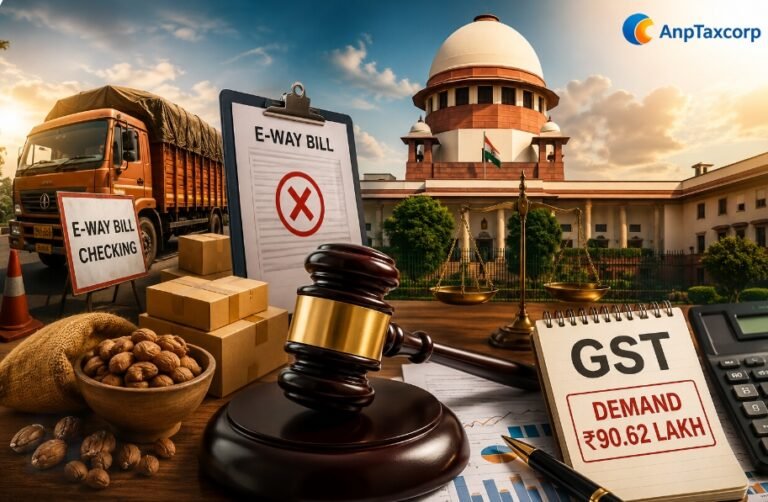
The Supreme Court has refused to interfere with the Allahabad High Court’s decision upholding a GST tax demand and penalty of ₹90.62 lakh against M/s Gurunanak Arecanut Traders. The case highlights the importance of generating a valid GST e-way bill before commencement of transportation and correctly classifying goods under the applicable GST rate.
The Supreme Court bench comprising Justice Manoj Misra and Justice Vijay Bishnoi condoned the delay in filing the Special Leave Petition (SLP) but found no sufficient ground to interfere with the Allahabad High Court judgment. Consequently, the SLP was dismissed.
Goods Intercepted Without a Valid E-Way Bill
The dispute arose when a vehicle transporting arecanuts was intercepted by GST authorities at around 4:28 AM. At the time of interception, the vehicle was not accompanied by a valid e-way bill.
Approximately three hours after interception, the taxpayer generated an e-way bill and produced it before the authorities. However, the subsequent verification created a more serious issue.
The GST authorities found that the goods being transported were described as “Chikni Bhuni Supari” (processed arecanut), whereas the transaction documents classified them as “Arecanut”. The declared goods were subjected to GST at 5%, while the department treated the processed goods as taxable at 18%.
The authorities therefore alleged that the goods had been deliberately misclassified to avail the benefit of a lower GST rate.
GST Authorities Invoke Section 129
Following verification, the goods were detained and proceedings were initiated under Section 129 of the GST law, resulting in a tax and penalty demand.
The department also relied upon several other circumstances to allege an intention to evade tax. These included the absence of a valid e-way bill when the goods were intercepted, discrepancies in the proprietor’s signatures appearing on business documents, and the alleged absence of genuine business activity at the registered premises.
The taxpayer subsequently challenged the proceedings before the Allahabad High Court.
Allahabad High Court Upholds GST Demand
Before the High Court, the taxpayer argued that the authorities had not provided a proper opportunity of hearing before passing the demand and penalty order. It was also contended that classification of the goods could not, by itself, justify detention during transit.
The High Court, however, rejected the challenge.
The court observed that following the amendment to the Uttar Pradesh GST Rules, 2017, effective from April 1, 2018, generation of an e-way bill became mandatory for movement of goods in transit, subject to the applicable provisions.
Importantly, the court held that the subsequent generation of an e-way bill does not cure the violation that existed when the vehicle was intercepted.
In other words, an e-way bill generated after interception cannot retrospectively validate transportation that had already commenced without the required document.
Wrong GST Classification Strengthened the Department’s Case
The High Court also considered the alleged misclassification of the goods significant.
According to the court, the issue was not merely the absence of an e-way bill. The authorities had also found that the goods were declared at a lower GST rate of 5% instead of 18% applicable to the goods as identified during verification.
The combination of these circumstances was considered relevant in determining whether there was an intention to evade tax.
The court referred to the principle considered in the Akhilesh Traders case, concerning the inference of tax evasion where goods are transported without the prescribed e-way bill. While such an inference may potentially be rebutted through appropriate evidence furnished by the owner or transporter, the surrounding facts of the present case did not persuade the court to grant relief.
Supreme Court Declines to Interfere
The taxpayer approached the Supreme Court through Special Leave Petition (Civil) Diary No. 35682/2026.
After condoning the delay, the Supreme Court declined to exercise its jurisdiction under Article 136 of the Constitution and dismissed the SLP.
The decision effectively leaves the Allahabad High Court’s judgment undisturbed.
Key Takeaway for GST Taxpayers
The ruling serves as an important reminder for businesses involved in the transportation of taxable goods:
- A valid e-way bill should be generated before the goods commence transit, wherever legally required.
- Generating an e-way bill only after interception may not eliminate liability arising from the original violation.
- The description and classification of goods in invoices and GST records must accurately correspond with the goods actually transported.
- A mismatch between the declared GST rate and the rate applicable to the goods can strengthen allegations of tax evasion.
- Businesses should maintain proper documentation supporting the nature, classification, value and movement of goods.
The case demonstrates that absence of an e-way bill, coupled with an alleged wrong classification resulting in tax-rate differences, can have serious consequences under GST detention and penalty proceedings.
Case Details
Case: M/s Gurunanak Arecanut Traders vs. Commissioner, Commercial Tax
SLP: Special Leave Petition (Civil) Diary No. 35682/2026
Court: Supreme Court of India
Issue: GST demand and penalty arising from transportation without a valid e-way bill and alleged incorrect classification of goods
Provision involved: Section 129 of the GST law