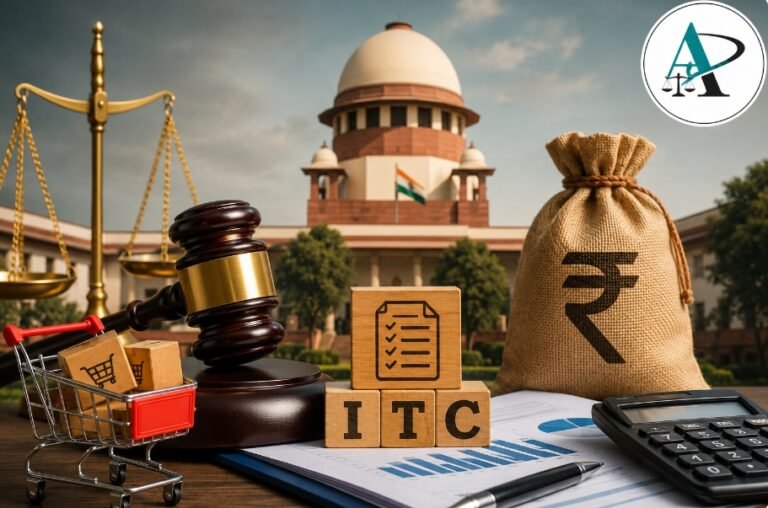
The Supreme Court has upheld the constitutional validity of Section 16(2)(c) of the Central Goods and Services Tax (CGST) Act, 2017, holding that a registered recipient cannot claim Input Tax Credit (ITC) unless the tax charged on the underlying supply has actually been paid to the Government by the supplier.
The ruling is significant for businesses claiming GST input tax credit, particularly where suppliers have failed to discharge their tax liability despite issuing valid tax invoices and reporting the transactions in GST returns.
A bench comprising Justice Sanjay Kumar and Justice Sanjeev Sachdeva dismissed a batch of Special Leave Petitions led by Bhandari Scrap Traders v. Union of India & Ors., thereby affirming the judgment of the Gujarat High Court.
Supreme Court Affirms Gujarat High Court’s Reasoning
The dispute centred on Section 16(2)(c) of the CGST Act, which makes payment of the tax charged on a supply to the Government one of the conditions for the recipient to avail ITC.
The petitioners challenged the constitutional validity of this provision, arguing that a genuine purchaser should not be penalised for a supplier’s failure to deposit GST.
The Supreme Court, however, found no reason to interfere with the Gujarat High Court’s conclusion. It observed that the High Court had comprehensively examined the statutory framework governing ITC and was justified in holding that Section 16(2)(c) neither required invalidation nor any restrictive interpretation.
The Supreme Court expressed its complete agreement with the reasoning adopted by the Gujarat High Court and affirmed the impugned judgment.
Bona Fide Purchaser’s Argument Rejected
Before the Gujarat High Court, the petitioners argued that a recipient may have complied with all requirements apparently within its control.
For instance, the purchaser may possess a valid tax invoice, have actually received the goods or services and find the transaction reflected in GSTR-2A or GSTR-2B. However, the recipient does not have access to the supplier’s GSTR-3B return and therefore cannot independently ascertain whether the supplier has actually deposited the corresponding tax.
The petitioners contended that denying ITC in such circumstances could unfairly penalise an innocent purchaser for an act completely beyond its control.
They relied upon earlier decisions under the Delhi Value Added Tax Act, including On Quest Merchandising India Pvt. Ltd., Arise India Ltd. and Shanti Kiran India Pvt. Ltd., where protection had been extended to bona fide purchasers in certain circumstances involving supplier defaults.
GST Framework Different From Earlier VAT Regime
The Gujarat High Court rejected the attempt to apply the reasoning of the Delhi VAT cases to the GST regime.
According to the court, the GST system operates within a substantially different statutory and constitutional framework. The availability of ITC is intrinsically connected with the tax actually paid into the system.
The court also considered the destination-based character of GST. Unlike the earlier VAT framework, GST facilitates the movement of credit across State boundaries through the IGST settlement mechanism.
If ITC were permitted to flow to the recipient despite the supplier not depositing the corresponding tax, the originating State could effectively be required to transfer revenue that it had never received. This would potentially disrupt the intended revenue-settlement mechanism underlying the destination-based GST structure.
Sections 41, 53, 73 and 74 Provide Statutory Safeguards
Another important aspect considered by the courts was the wider statutory scheme of the CGST Act.
Section 16(2)(c) cannot be examined in isolation. It operates alongside provisions such as Sections 41, 53, 73 and 74, which collectively regulate the availment, reversal and recovery of ITC and tax liabilities.
The Gujarat High Court noted that where ITC is reversed because the supplier has not discharged the corresponding tax liability, the recipient may be able to re-avail the credit once the statutory conditions are subsequently fulfilled, including payment of the outstanding tax by the supplier.
The Supreme Court specifically took note of this statutory mechanism while upholding the High Court’s reasoning.
Earlier Tripura High Court Decision Distinguished
The petitioners also relied upon proceedings arising from the Tripura High Court’s decision in Sahil Enterprises v. Union of India.
The Supreme Court noted that although a Special Leave Petition arising from that judgment had been entertained, the Tripura High Court had not undertaken the same detailed examination of the GST statutory framework that was carried out by the Gujarat High Court.
Therefore, the Supreme Court found no basis to treat the two decisions as equivalent for determining the constitutional validity of Section 16(2)(c).
What the Judgment Means for GST Taxpayers
The ruling reinforces an important principle under the GST regime: ITC is a statutory benefit subject to the conditions prescribed by Parliament.
Merely possessing a tax invoice or having a transaction reflected in GSTR-2A/GSTR-2B may not, by itself, guarantee permanent entitlement to ITC if the statutory conditions relating to payment of tax are not satisfied.
For businesses, the decision highlights the importance of conducting appropriate vendor due diligence, monitoring supplier compliance and maintaining proper documentation relating to purchases and GST transactions.
At the same time, the statutory mechanism for restoration or re-availment of ITC after the supplier fulfils the relevant tax liability remains an important protection for recipients.
Case Details
Case Title: Bhandari Scrap Traders v. Union of India & Ors. and Connected Matters
Court: Supreme Court of India
Bench: Justice Sanjay Kumar and Justice Sanjeev Sachdeva
Issue: Constitutional validity of Section 16(2)(c) of the CGST Act, 2017
Conclusion
The Supreme Court’s decision provides significant clarity on the operation of Section 16(2)(c) of the CGST Act. The Court has confirmed that the statutory requirement relating to payment of tax by the supplier is an integral component of the GST input tax credit mechanism.
The judgment therefore serves as an important reminder that ITC under GST is not an unconditional right of the purchaser. Businesses should exercise greater caution while selecting vendors and regularly monitor supplier compliance to minimise the risk of ITC reversal or denial.