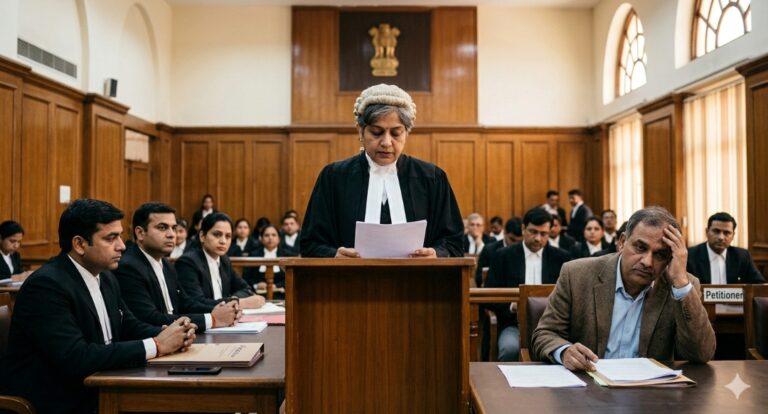
In a landmark ruling for private sector employment law, the Delhi High Court has reinforced the principle of contractual finality. The court held that an employee who accepts and encashes a cheque issued in lieu of a notice period effectively waives their right to challenge the legality of their termination.
Presided over by Justice Neena Bansal Krishna, the judgment in [Employee Name] v. ICICI Bank Ltd. serves as a critical reminder of the binding nature of employment contracts and the “doctrine of election” in legal disputes.
The Core Dispute: Reinstatement vs. Contractual Exit
The case originated when a former employee of ICICI Bank challenged his termination, which had occurred over a decade ago. The bank had terminated his services by invoking a clause in his appointment letter that allowed for termination by providing either a 90-day notice period or salary in lieu of that notice.
The appellant sought a declaration that his termination was “arbitrary, illegal, and unjustified,” demanding reinstatement with full back wages and continuity of service. His primary argument rested on the claim that the bank had not followed due process and that the termination was a “colorable exercise of power.”
The “Waiver by Conduct” Principle
The High Court’s decision hinged on a singular, decisive action: the employee had received and encashed a cheque representing three months’ salary.
Justice Krishna observed that once an employee accepts the financial benefits tied to a termination clause—specifically payments meant to satisfy notice requirements—they are deemed to have accepted the termination itself. Legally, this is viewed as acquiescence. By encashing the cheque, the employee acted in a manner consistent with the contract’s termination provisions, thereby losing the standing to later claim that those same provisions were violated.
The court noted:
“Having taken the benefit of the three months’ salary in lieu of notice, the appellant cannot now be permitted to challenge the termination.”
Public vs. Private Sector Employment
A pivotal aspect of this ruling is the distinction between public and private employment. In public or government sectors, employees often enjoy “status” protected by Article 311 of the Constitution, making arbitrary termination difficult.
However, in the private sector, the relationship is purely contractual. If a contract stipulates that services can be terminated “without cause” by paying a specific sum, the employer is within their rights to do so. The court reaffirmed that private-sector courts cannot force “specifically perform” a contract of personal service—meaning they cannot generally force a private company to take back an employee they have fired, provided the contractual exit payout was made.
Key Takeaways for Employers and Employees
- For Employers: This judgment underscores the importance of clear termination clauses. Ensuring that “salary in lieu of notice” is paid promptly and clearly documented can serve as a robust defense against future litigation.
- For Employees: Legal “protest” must be immediate. If an employee believes their termination is illegal, accepting or encashing severance payments may be interpreted as a waiver of their right to sue.
- The Finality of Conduct: Courts will look at the actions of the parties, not just their later claims. Encashment is a powerful “conduct-based” evidence of acceptance.
Conclusion
The Delhi High Court has sent a clear message: you cannot “have your cake and eat it too.” One cannot accept the contractual benefits of a termination and then move the court to declare that very termination invalid. This ruling brings much-needed clarity to the finality of private-sector separations.