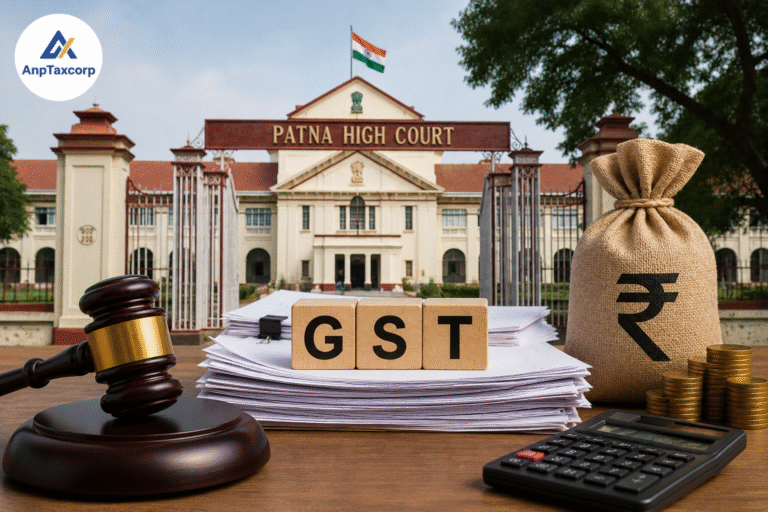
In a significant ruling, the Patna High Court has held that voluntary payment of GST liability after detection during audit does not automatically protect a taxpayer from proceedings under Section 74 of the CGST Act, 2017. The judgment reinforces that where allegations of suppression or wilful misstatement exist, the tax authorities are well within their powers to initiate penal proceedings, even if the taxpayer has deposited tax prior to issuance of a show cause notice (SCN).
Background of the Case
The case, Manju Devi Agarwal vs. Central Board of Indirect Taxes and Customs, revolved around discrepancies identified during GST audit and scrutiny proceedings for the financial years 2017–18 to 2022–23. The petitioner, Manju Devi Agarwal, had filed returns in Form GSTR-1 and GSTR-3B. However, upon examination, the GST department identified multiple irregularities.
These included short payment of tax, excess availment of Input Tax Credit (ITC), and non-payment of GST on certain receipts that were reflected in Form 26AS and the profit and loss account. Based on these findings, the department alleged violations of Sections 9 (levy of tax), 16 (eligibility of ITC), 50 (interest on delayed payment), and 74 (fraud, suppression, or wilful misstatement) of the CGST Act.
Voluntary Payment Through DRC-03
Before the issuance of the SCN under Section 74, the petitioner deposited the alleged tax liability through Form DRC-03 after the discrepancies were pointed out during the audit. However, the department maintained that the payment did not include applicable interest and penalty.
Subsequently, the department issued a show cause notice invoking Section 74, alleging that the discrepancies arose due to suppression of facts and wilful misstatement with an intent to evade tax. The petitioner was therefore directed to pay interest under Section 50 and penalty under Section 74.
Failure to Respond and Adjudication
Despite receiving the SCN, the petitioner did not file any written reply contesting the allegations. During the personal hearing, the authorized representative of the petitioner acknowledged the liability towards interest and penalty and undertook to deposit the same within two months.
Based on this admission and lack of formal objection, the adjudicating authority passed orders dated 04.02.2025 and 06.02.2025, confirming the demand for interest and penalty.
Writ Petition Before High Court
Instead of availing the statutory appellate remedy under Section 107 of the CGST Act, the petitioner approached the High Court after a delay of nearly ten months. The writ petition challenged the validity of the SCN, adjudication orders, garnishee proceedings initiated under DRC-13, and even a circular issued by the Central Board of Indirect Taxes and Customs (CBIC) dated 16.09.2025.
Key Issue Before the Court
The central issue was whether proceedings under Section 74 could continue despite voluntary tax payment before issuance of the SCN, and whether the department was justified in alleging suppression and invoking penalty provisions.
Observations and Ruling of the Court
The Patna High Court dismissed the writ petition and ruled in favour of the tax department. The Court made several important observations:
- The SCN clearly contained allegations of wilful suppression and misstatement with intent to evade tax.
- The petitioner failed to submit any reply disputing these allegations before the adjudicating authority.
- During the personal hearing, the petitioner’s representative admitted liability towards interest and penalty.
Given these facts, the Court held that the petitioner could not subsequently challenge the invocation of Section 74 in writ jurisdiction after having effectively accepted the liability.
Voluntary Payment Not a Shield
The Court emphasized that voluntary payment of tax after detection during audit does not automatically bar proceedings under Section 74. This is particularly true when the case involves serious allegations such as suppression of facts or wrongful availment of ITC.
In other words, merely paying the tax dues does not absolve a taxpayer from interest and penalty if the conduct falls within the scope of fraud or wilful misstatement.
Alternative Remedy Not Availed
Another critical factor in the Court’s decision was the petitioner’s failure to avail the statutory appeal remedy under Section 107 within the prescribed time limit. The Court reiterated that writ jurisdiction cannot be invoked as a substitute for statutory remedies, especially after the limitation period has expired.
Conclusion
This ruling serves as a cautionary precedent for taxpayers. It underscores that voluntary compliance after detection may not be sufficient to escape penal consequences under GST law. Where the department establishes elements of suppression or intent to evade tax, proceedings under Section 74 can be validly initiated and sustained.
Taxpayers must not only ensure timely and accurate compliance but also actively respond to notices and utilize available appellate remedies. Failure to do so may result in irreversible legal and financial consequences.