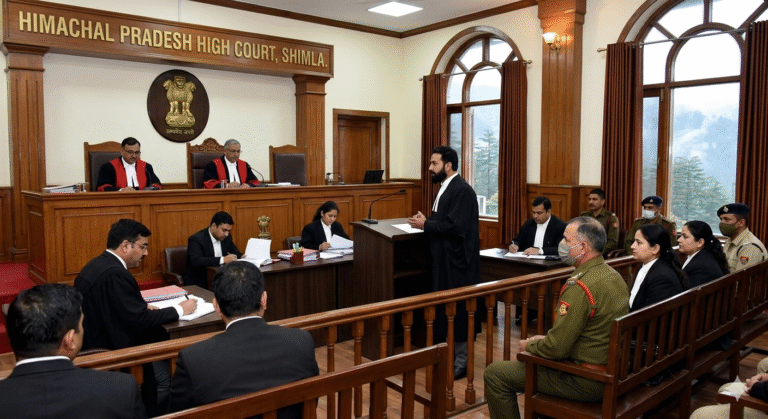
In a notable judgment strengthening employee rights under Indian labour laws, the Himachal Pradesh High Court has reiterated that employers cannot terminate workers arbitrarily after they have completed 240 days of continuous service without complying with mandatory legal requirements under the Industrial Disputes Act, 1947.
The Division Bench comprising Chief Justice G.S. Sandhawalia and Justice Bipin Chander Negi dismissed the appeal filed by Maharishi Markandeshwar Medical College and upheld the findings of the Labour Court and Single Judge, reinforcing that procedural safeguards under labour law are not optional but legally enforceable obligations.
Background of the Dispute
The dispute arose from the termination of Padam Kumar, who had been working as a security guard with the medical college since 2012. According to the facts placed before the Court, the employee proceeded on leave following the death of his mother and returned to resume duties on 21 March 2017.
Upon reporting back, he was allegedly denied work and informed that his services were no longer required. Challenging the termination, the employee approached the appropriate forum claiming illegal retrenchment and violation of statutory protections available under labour laws.
In defence, the medical college denied the existence of a direct employer-employee relationship. It argued that the worker had been engaged through a contractor and alternatively claimed that he had voluntarily abandoned employment.
Employer Failed to Establish Contractor Relationship
One of the central issues before the Court was whether the employee was genuinely a contract worker or directly employed by the institution.
The Court examined the evidence and found substantial deficiencies in the employer’s case. The medical college failed to produce documentary proof establishing lawful engagement through a contractor. Importantly, no valid licence under Section 12 of the Contract Labour (Regulation and Abolition) Act, 1970 was produced.
Further, the alleged contractor was not examined before the Labour Court, and original salary or employment records supporting the contractual arrangement were not placed on record.
The Court observed that when management seeks to deny direct employment and attributes the relationship to a contractor, the burden lies upon the employer to establish such a claim through credible evidence.
In the absence of such proof, the Court accepted the conclusion that a direct employer-employee relationship existed.
Completion of 240 Days Triggered Statutory Protection
The judgment places significant emphasis on the legal consequences of completing 240 days of continuous service.
Under Indian labour jurisprudence, once a workman satisfies this threshold during the preceding twelve calendar months, protections relating to retrenchment under Section 25-F of the Industrial Disputes Act become applicable.
The High Court noted that the employee had completed the statutory period and therefore termination could not legally occur without compliance with mandatory conditions such as:
- Prior notice to the employee;
- Payment of retrenchment compensation; and
- Adherence to statutory procedure before discontinuation of service.
Since none of these requirements had been fulfilled, the termination was held to be legally unsustainable.
Abandonment of Service Cannot Be Presumed
The employer also attempted to justify the action by alleging that the worker had abandoned service.
Rejecting this argument, the Court clarified that abandonment cannot merely be assumed because an employee remained absent or returned after leave.
If an employer believes an employee has abandoned duties, proper procedure must be followed, including issuing notices and conducting disciplinary action where required.
The Bench observed that no show-cause notice, disciplinary proceedings, or opportunity of hearing had been provided before terminating the employee.
Such conduct, according to the Court, amounted to a violation of the principles of natural justice.
Court’s Observations on Due Process
The High Court reaffirmed that procedural fairness remains central to labour adjudication.
The Court recognised that statutory compliance and natural justice serve as safeguards against arbitrary employment practices and cannot be ignored merely because an employer labels a worker as contractual.
The judgment makes it clear that institutions, including medical establishments falling within the ambit of “industry,” remain bound by labour law obligations.
Conclusion
By dismissing the appeal of Maharishi Markandeshwar Medical College, the Himachal Pradesh High Court delivered an important reminder to employers across sectors.
The ruling establishes that completion of 240 days of service creates enforceable legal protections, and employers cannot circumvent labour laws through unsupported claims of contractual engagement or presumed abandonment.
The decision strengthens the principle that termination must follow due process, documentary compliance, and statutory procedure—ensuring that worker protections under the Industrial Disputes Act remain meaningful and effective.
Follow the Link below to watch the video: