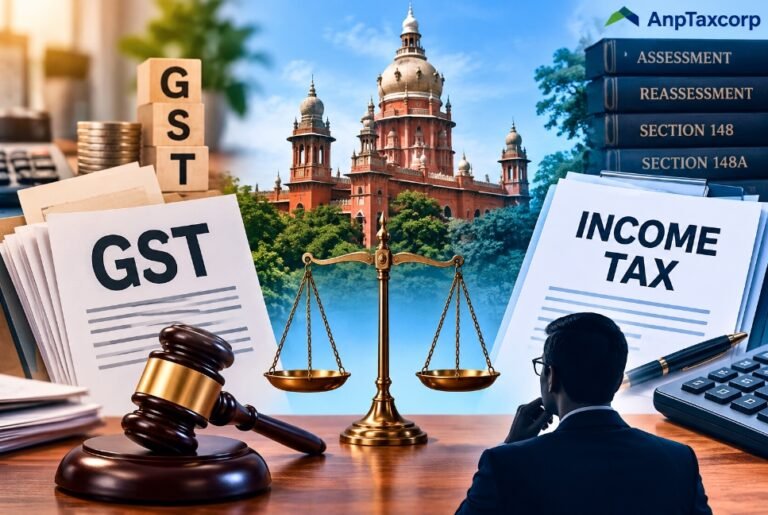
The Madras High Court has emphasised an important principle concerning the interaction between GST proceedings and Income Tax reassessment. The Court has held that an Income Tax authority cannot simply rely upon the findings of a GST adjudication order while completing reassessment proceedings. The reassessment must independently satisfy the requirements prescribed under the Income Tax Act.
The ruling is significant for taxpayers facing parallel proceedings under the Goods and Services Tax laws and Income Tax law, particularly where information arising from GST proceedings is subsequently used by the Income Tax Department to initiate reassessment.
The judgment was delivered by Justice Senthilkumar Ramamoorthy in Ramegowdu Mahendra v. Deputy Commissioner of Income Tax, W.P. No. 32056 of 2026. The case concerned a challenge to a notice issued under Section 148 of the Income Tax Act for Assessment Year 2023-24.
Background of the Case
The petitioner, who was engaged in the business of granite and tiles, challenged an Income Tax reassessment notice dated May 27, 2026 issued under Section 148 of the Income Tax Act.
According to the petitioner, the Income Tax proceedings had been triggered primarily on the basis of an adjudication order passed under the GST law on February 3, 2025. The taxpayer had already challenged the GST adjudication order before the appellate authority, and a deemed stay was stated to be operating in respect of the proceedings.
The taxpayer argued that the GST adjudication order could not automatically become the basis for reopening an Income Tax assessment, particularly when the GST dispute itself remained pending.
The petitioner also contended that the statutory concept of “information” under Section 148 of the Income Tax Act could not be interpreted to mean that every order passed by a GST officer would automatically justify reassessment under the Income Tax Act.
Revenue’s Stand
The Income Tax Department opposed the challenge to the reassessment notice.
The Revenue submitted that the taxpayer’s objections had already been considered while passing the order under Section 148A(3). It further maintained that the Income Tax authorities would independently examine the relevant issues during reassessment and would not mechanically adopt the findings recorded by the GST authorities.
The Revenue therefore argued that the mere fact that GST proceedings had provided information for initiating the Income Tax proceedings did not make the reassessment notice invalid.
High Court Examines Section 148A and Section 148(3)
The Madras High Court examined the statutory framework governing reassessment under the Income Tax Act.
The Court noted that Section 148A requires the Income Tax authority to consider information suggesting that income chargeable to tax has escaped assessment before initiating reassessment proceedings.
The Court also referred to Section 148(3), which contains the statutory framework concerning what constitutes “information” for the purpose of reassessment. The provision includes information received in accordance with the risk management strategy formulated by the Central Board of Direct Taxes (CBDT).
Importantly, the Court observed that there was nothing before it establishing the contents of the CBDT’s risk management strategy or demonstrating whether such strategy specifically contemplated reliance upon a GST adjudication order in the circumstances of the case.
However, since the matter was still at the preliminary stage and the taxpayer had only challenged the Section 148 notice, the Court declined to quash the notice at that stage.
GST Findings Cannot Automatically Determine Income Tax Liability
While refusing to interfere with the reassessment notice, the High Court laid down an important safeguard for taxpayers.
The Court made it clear that the Income Tax Department must conduct the reassessment independently in accordance with the provisions of the Income Tax Act. The Department cannot merely adopt or reproduce the conclusions reached by a GST adjudicating authority.
In other words, a GST order may provide information or material which could potentially trigger examination under the Income Tax Act, but it does not automatically establish the taxpayer’s Income Tax liability.
The Court specifically observed that the Income Tax authorities cannot “ride piggyback” on GST adjudication.
This principle is particularly relevant because the same transaction can have consequences under different taxation statutes. However, the determination made under one statute does not necessarily conclude the issue under another statute.
Outcome of GST Appeal Cannot Be Sole Basis for Reassessment
The Court went a step further and clarified that even the eventual outcome of the GST appeal cannot, by itself, determine the result of the Income Tax reassessment.
If the taxpayer’s GST appeal is dismissed, such dismissal cannot become the sole basis for making an adverse conclusion in the Income Tax reassessment.
Conversely, if the GST adjudication order is eventually set aside, that fact alone would also not automatically determine the outcome of the Income Tax proceedings.
The Income Tax authority must therefore examine the evidence, transactions, books of account and other relevant material independently and arrive at its own conclusion under the Income Tax Act.
Implications for Taxpayers
The ruling provides an important defence for taxpayers facing simultaneous GST and Income Tax proceedings.
Where an Income Tax reassessment has been initiated using information originating from GST proceedings, taxpayers should carefully examine whether the Assessing Officer has independently applied the statutory requirements governing reassessment.
A taxpayer may also need to examine whether the material relied upon actually constitutes legally relevant information suggesting escapement of income and whether adequate opportunity has been provided during the reassessment proceedings.
However, the judgment should not be understood as holding that GST-related information can never be used for Income Tax purposes. GST records, investigation material or adjudication proceedings may provide relevant information to the Income Tax Department. The crucial requirement is that the Income Tax authority must independently apply the Income Tax law rather than treating the GST finding as conclusive.
Conclusion
The Madras High Court’s decision reinforces the principle that GST adjudication and Income Tax assessment are separate statutory proceedings. Information originating from one tax regime may have relevance in another, but the final determination must be made independently under the applicable legislation.
For taxpayers facing reassessment proceedings based on GST investigations or adjudication orders, the judgment highlights the importance of examining the precise basis on which the Income Tax Department has assumed jurisdiction and proposed additions.
Although the Court did not quash the Section 148 notice in the present case, it preserved the taxpayer’s right to challenge the eventual reassessment order in accordance with law. The ruling therefore provides an important reminder that a GST order cannot, by itself, dictate the outcome of an Income Tax reassessment.
Case Details
Case: Ramegowdu Mahendra v. Deputy Commissioner of Income Tax
Court: Madras High Court
Petition: W.P. No. 32056 of 2026
Assessment Year: 2023-24
Key Provisions: Sections 148, 148A and 148(3) of the Income Tax Act
Key Issue: Whether GST adjudication findings can independently determine the outcome of Income Tax reassessment proceedings
Decision: Reassessment must be conducted independently under the Income Tax Act.