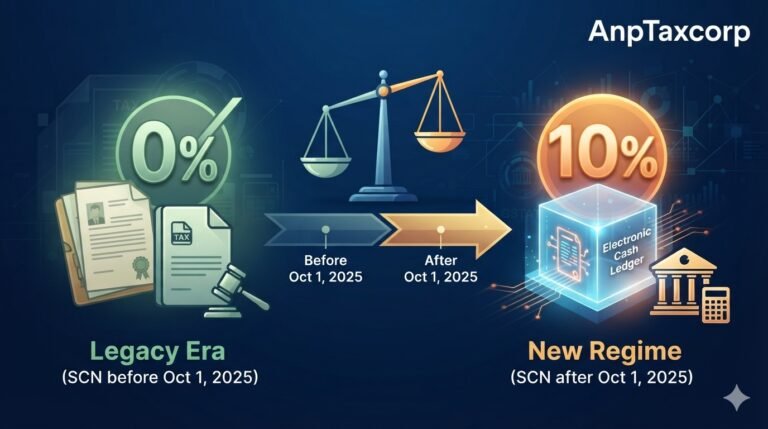
The landscape of Goods and Services Tax (GST) litigation in India underwent a tectonic shift following the enactment of the Finance Act. By introducing a mandatory 10% pre-deposit for penalty-only appeals, the legislature effectively plugged a long-standing loophole.
Historically, the pre-deposit requirement under Section 107 of the CGST Act was tied strictly to the “tax in dispute.” This meant that taxpayers appealing standalone, high-value penalty orders—such as those issued under Section 122(1A) for the alleged wrongful availing or utilization of Input Tax Credit (ITC)—could approach appellate forums without making any upfront, percentage-based financial commitments.
While this amendment significantly altered the financial mechanics of filing an appeal, it also triggered a wave of premature, automated rejections on the GST portal and rigid stances by first appellate authorities. Revenue authorities quickly began demanding the 10% pre-deposit on all pending or freshly filed penalty appeals, regardless of when the dispute actually began.
However, a series of recent, breakthrough rulings from various High Courts and the GST Appellate Tribunal (GSTAT) have drawn a firm line in the sand, establishing that this amendment cannot be applied retrospectively.
The Core Judicial Doctrine: Vested Right of Appeal
The fundamental question brought before the judiciary was simple: When does a taxpayer’s right of appeal actually crystallize?
In landmark rulings such as Gaurav Jain vs. Joint Commissioner (Appeals II) and Rohit Garg v. Union of India, the Delhi High Court delivered much-needed constitutional clarity. The Court reiterated a well-established principle of jurisprudence: the right of appeal is not a mere matter of procedure, but a substantive, vested right.
Crucially, the High Courts ruled that the legal framework governing an appeal is permanently fixed on the date the litigation (lis) commences. In tax disputes, this origin point is the date the Show Cause Notice (SCN) is issued, rather than the date the final assessment order is passed or the date the appeal is physically filed. Consequently, if the revenue department issued an SCN to a taxpayer prior to the effective date of the amendment, the taxpayer retains a vested right to appeal any subsequent penalty-only order under the old rules. They cannot be forced to pay the 10% pre-deposit, even if their appeal is being filed today.
GSTAT and High Courts Reaffirm the Timeline
This anti-retrospective stance has been thoroughly mirrored across appellate levels:
- Tribunal Safeguards: The GSTAT Hyderabad Bench (in key matters like Reddy Veeranna Constructions Pvt. Ltd.) extended this protection to secondary appeals under Section 112(8). The tribunal held that imposing new, burdensome financial pre-conditions onto disputes that originated under an older regime violates principles of natural justice.
- Overruling Systemic Rejections: In an early intervention, the Calcutta High Court took note of structural issues where the GST portal and first appellate authorities were systematically rejecting older appeals for lack of pre-deposits. The Court ordered immediate relief, ruling that importing non-existent statutory conditions into legacy disputes is unconstitutional, and directed registries to entertain these appeals strictly on their legal merits.
The New Pre-Deposit Blueprint
To successfully navigate current and future penalty disputes, tax teams must evaluate their litigation pipeline against two distinct timelines:
- For Legacy Disputes (SCN issued before the amendment date): Taxpayers enjoy a 0% pre-deposit requirement on standalone penalties. Only the explicitly admitted amounts of tax, interest, and penalty must be cleared to activate the appeal.
- For New Disputes (SCN issued after the amendment date): A mandatory 10% pre-deposit of the disputed penalty must be paid out of the Electronic Cash Ledger to file a First Appeal. If the matter escalates to the GSTAT, an additional 10% is required, accumulating to a total 20% cash lock-up.
Unlike tax-related pre-deposits, which feature a statutory monetary cap of ₹40 crore, the amended provisions for penalty-only pre-deposits do not feature a maximum monetary ceiling. For mega-disputes involving hundreds of crores in alleged ITC infractions, this lack of a cap makes strategic litigation planning vital.
Strategic Takeaways for Businesses
Corporates facing aggressive penalty notices must immediately audit the issuance dates of their baseline Show Cause Notices. If an appellate authority or an automated portal glitch blocks a penalty appeal for lack of a 10% deposit on an older dispute, businesses have strong, settled judicial precedents to challenge the demand. Citing the vested right of the lis, taxpayers can successfully contest these retrospective cash demands and safeguard their working capital from unlawful lock-ins.