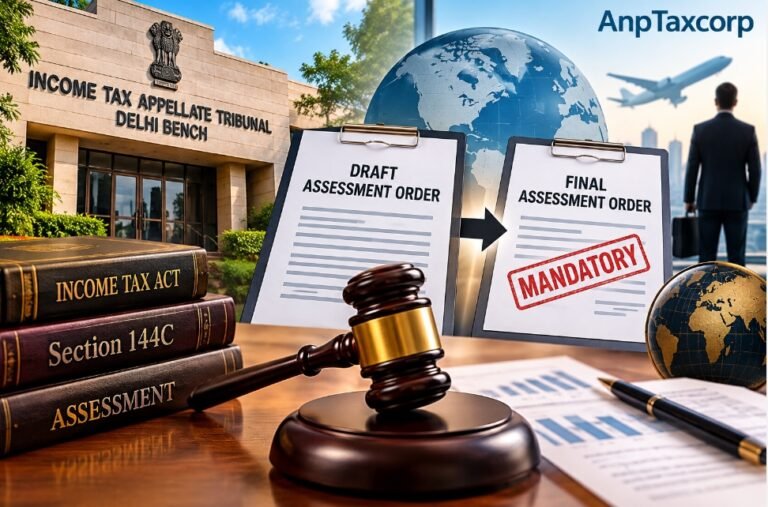
The Income Tax Appellate Tribunal (ITAT), Delhi Bench, has reaffirmed an important procedural safeguard available to foreign companies and other eligible taxpayers under Section 144C of the Income-tax Act. The Tribunal held that where the Assessing Officer proposes a variation in the assessment that is prejudicial to the interests of an eligible assessee, a draft assessment order must mandatorily be issued before passing the final assessment order.
The ruling highlights that failure to follow the statutory draft-assessment procedure is not a minor procedural lapse. Where Section 144C applies, bypassing the draft order can render the final assessment legally unsustainable.
Background of the Case
The issue arose in the case of DCIT v. I Energizer Holdings Ltd., a Mauritius-based foreign company. The matter concerned ITA No. 4654/Del/2015 along with Cross Objection No. 397/Del/2015.
The proceedings originated from a search and seizure operation conducted under Section 132 of the Income-tax Act on the Focus Energy Group on March 22, 2012. During the search, certain documents relating to I Energizer Holdings Ltd. were found and seized.
The company’s assessment was subsequently centralised with Central Circle-10, New Delhi, which was later restructured as Central Circle-19. A satisfaction note was recorded for initiating proceedings under Section 153C, followed by the issuance of a notice under Section 142(1).
The Assessing Officer treated the foreign company as a resident of India under Section 6(3) and determined its income at approximately ₹3.84 crore on a protective basis. The assessment was completed under Section 144.
The Commissioner of Income Tax (Appeals) granted relief to the assessee. The Revenue thereafter challenged the relief before the ITAT.
Assessee Raises a Legal Challenge
During the proceedings before the Tribunal, I Energizer Holdings Ltd. raised an additional legal ground through its cross-objection.
The assessee contended that the Assessing Officer had directly passed the final assessment order without first issuing a draft assessment order under Section 144C(1).
According to the assessee, this statutory procedure was mandatory because it was a foreign company and therefore fell within the definition of an “eligible assessee” under Section 144C.
The assessee also relied upon an earlier decision of the ITAT in its own case for Assessment Years 2008-09 to 2011-12, where final assessment orders passed without following the draft-order mechanism had been held to be unsustainable.
Foreign Companies Covered by Section 144C
A significant aspect of the ruling is the Tribunal’s recognition that a foreign company is expressly covered within the definition of an eligible assessee.
Section 144C(15)(b)(ii) specifically includes a foreign company within the definition of an eligible assessee.
Further, Section 144C(1) provides that where the Assessing Officer proposes to make any variation in the income or loss returned by an eligible assessee which is prejudicial to its interests, the Assessing Officer must first forward a draft of the proposed assessment order to the assessee.
The statutory mechanism is designed to provide an additional opportunity to the taxpayer before the final assessment is completed.
Draft Order Provides an Important Legal Safeguard
Once the draft assessment order is served, the eligible assessee has the statutory option to either accept the proposed variation or file objections before the Dispute Resolution Panel (DRP).
This mechanism is particularly significant for foreign companies and other taxpayers covered by Section 144C because it provides an opportunity to challenge proposed adjustments before the final assessment becomes enforceable.
Therefore, the draft assessment stage is not merely an administrative formality. It forms an integral part of the statutory assessment procedure prescribed under Section 144C.
ITAT Holds Non-Compliance to Be Jurisdictional
The Delhi ITAT examined whether the Assessing Officer’s failure to issue the draft assessment order could be treated as a curable procedural defect under Section 292B.
The Tribunal rejected such an approach.
It observed that the Assessing Officer was required to “firstly” forward a draft assessment order where a prejudicial variation was proposed in the case of an eligible assessee. The requirement was described as a mandatory and statutory requirement of law.
The Tribunal relied upon earlier judicial decisions, including decisions of the Delhi High Court and coordinate benches of the Tribunal, which had recognised the mandatory nature of the Section 144C procedure.
Since the Assessing Officer had proceeded directly to pass the final assessment order without first framing and forwarding the draft order, the Tribunal held that the assessment was vitiated in law.
Final Assessment Order Set Aside
The Tribunal concluded that the Assessing Officer’s failure to comply with Section 144C(1) affected the validity of the final assessment itself.
The Tribunal observed that the Assessing Officer was required to first pass a draft assessment order and thereafter complete the assessment in accordance with the statutory procedure under Section 144C.
As this mandatory step had been completely bypassed, the final assessment order could not be sustained.
Consequently, the Revenue’s appeal on the merits of the assessment became infructuous, while the cross-objection filed by I Energizer Holdings Ltd. was allowed.
Key Takeaway for Taxpayers
The decision reinforces an important principle of income-tax assessment law: where Section 144C applies, procedural compliance is substantive and cannot be casually bypassed.
Foreign companies facing assessments involving prejudicial variations should carefully examine whether the Assessing Officer has followed the mandatory draft-assessment mechanism.
A final assessment order passed without first issuing the required draft order may provide a strong jurisdictional ground for challenging the assessment.
Case Details
Case: DCIT v. I Energizer Holdings Ltd.
ITAT: Delhi Bench
Appeal: ITA No. 4654/Del/2015
Cross Objection: CO No. 397/Del/2015
Key Provision: Section 144C of the Income-tax Act
Issue: Mandatory draft assessment order for eligible assessee
Outcome: Revenue’s appeal dismissed; assessee’s cross-objection allowed.