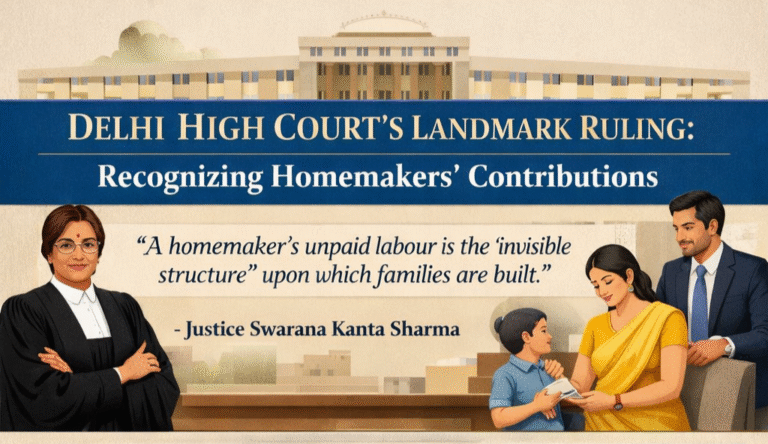
In a significant ruling delivered in February 2026, the Delhi High Court firmly rejected the outdated notion of the “idle wife,” holding that a homemaker’s unpaid domestic labour must be recognised as a substantial economic contribution while determining maintenance.
Justice Swarana Kanta Sharma observed that the work performed by homemakers forms the “invisible structure” upon which families are built. The judgment underscores a progressive shift in judicial thinking—acknowledging that unpaid domestic responsibilities are neither invisible nor insignificant.
Contribution vs. Idleness: A Clear Judicial Message
The Court clarified that managing a household, raising children, and ensuring the smooth functioning of family life are real and measurable contributions. The fact that such work does not generate a monthly salary or reflect in bank statements does not diminish its value.
Equating non-employment with “idleness,” the Court noted, reflects a flawed and outdated understanding of domestic labour. A homemaker’s work enables the earning spouse to pursue professional success without domestic disruption—making it an indirect but critical economic contribution.
Capacity to Earn Is Not the Same as Actual Income
One of the most important aspects of the ruling is the distinction between capacity to earn and actual earning.
The Court held that a well-qualified or educated spouse cannot be denied maintenance merely on the ground that she is “capable of earning.” Unless there is evidence of actual income, maintenance cannot be refused on hypothetical assumptions about employability.
This observation protects spouses who may have paused or sacrificed their careers for family responsibilities and are no longer positioned to immediately re-enter the workforce at the same level.
Recognising Social Realities
The judgment takes judicial notice of ground realities: many women forego promotions, professional growth, or long-term career prospects to prioritise childcare and household management.
Expecting them to seamlessly resume careers after years devoted to domestic responsibilities is unrealistic. The Court recognised that such sacrifices must be factored into maintenance determinations.
Financial Directions in the Case
Setting aside an earlier denial of relief, the Court directed the husband to pay:
- ₹50,000 per month to the wife
- ₹40,000 per month to the minor child
This quantification reinforces that maintenance must reflect both dignity and fairness, ensuring a reasonable standard of living for the dependent spouse and child.
Limited Deductions from Income
Importantly, the Court ruled that only statutory deductions, such as taxes, may be excluded while calculating the husband’s income for maintenance purposes.
Voluntary liabilities—such as personal loans, EMIs, or lifestyle expenses—cannot override the legal obligation to support a dependent spouse and child. This prevents earning spouses from artificially reducing their payable capacity through discretionary financial commitments.
Encouragement of Mediation
The Court also encouraged parties involved in matrimonial disputes to consider mediation. It described maintenance litigation as “intensely adversarial” and emphasised that negotiated settlements often provide more sustainable and less emotionally damaging outcomes.
Conclusion
This ruling marks an important step in strengthening financial protections for homemakers. By rejecting the “idle wife” narrative and formally recognising unpaid domestic labour as an economic contribution, the Delhi High Court has reinforced the principle that dignity, fairness, and social realities must guide maintenance jurisprudence.
The decision serves as a reminder that economic value is not confined to salaries and payslips—sometimes, it lies in the unseen labour that sustains families every single day.