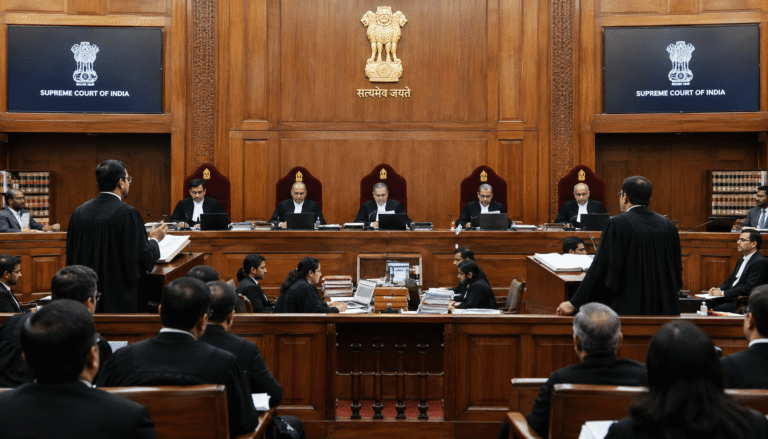
Supreme Court Resolves MAKAIAS Disciplinary Dispute Through ₹20.14 Lakh ‘Golden Handshake’

The Supreme Court has brought an end to a long-running service dispute involving an Administrative-cum-Finance Officer of the Maulana Abul Kalam Azad Institute of Asian Studies (MAKAIAS) by facilitating an amicable settlement between the employee and the Institute. A Division Bench comprising Justice …

Read more

Please share

Airline Liable for Missing Flight Due to Incorrect Terminal Information: Consumer Commission Awards ₹60,000 Compensation

A District Consumer Disputes Redressal Commission in Raipur has held an airline responsible for deficiency in service and unfair trade practice after a passenger missed his flight because the airline failed to communicate the correct departure terminal. The Commission awarded the passenger ₹50,000 …

Read more

Please share

Different Inks on Cheque Do Not Make It Invalid, Says Kerala High Court: Presumptions Under Sections 118 & 139 NI Act Explained

The Kerala High Court has clarified that a cheque does not become invalid merely because its signature, date, amount or other particulars have been written using different inks. The Court observed that there is no legal requirement under the Negotiable …

Read more

Please share

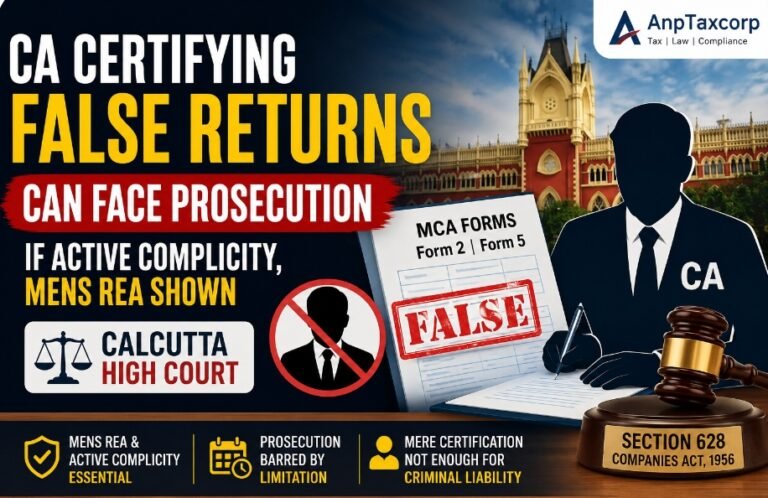
CA Certifying False Returns Can Face Prosecution If Active Complicity and Mens Rea Are Established: Calcutta High Court

The Calcutta High Court has clarified that an independent Chartered Accountant (CA) who certifies a false statutory return or e-form cannot claim automatic immunity from criminal prosecution merely because the professional is not an executive officer of the company. However, the Court …

Read more

Please share

Effect of Part Payments on Dishonoured Cheques Must Be Decided During Trial, Not at Summoning Stage: Delhi High Court

In a significant ruling clarifying the scope of proceedings under the Negotiable Instruments Act, 1881, the Delhi High Court has held that the effect of admitted part payments made before the presentation of dishonoured cheques cannot be conclusively determined while deciding a revision …

Read more

Please share

Himachal Pradesh High Court: 8 Years of Continuous Service Entitles Workman to Regularization and Back Salary Benefits

The Himachal Pradesh High Court has delivered an important judgment reinforcing the rights of long-serving temporary employees. In a significant ruling, the Court held that a workman who had completed the prescribed eight years of continuous service was legally entitled …

Read more

Please share

Equal Pay for Equal Work in India: Constitutional Guarantee, Judicial Evolution, and Limits

The doctrine of “Equal Pay for Equal Work” has evolved into one of the most significant labour and constitutional principles in Indian jurisprudence. What began as a Directive Principle of State Policy has gradually transformed into an enforceable constitutional right through judicial …

Read more

Please share

Indian Medical Association v. V.P. Shantha (1995): The Landmark Judgment That Brought Medical Services Under Consumer Law in India

The relationship between a doctor and a patient has traditionally been built on trust, ethics, and professional responsibility. For many years, there was uncertainty in India over whether patients could invoke consumer protection remedies against doctors and hospitals for medical …

Read more

Please share

Employees Can File Consumer Complaints for Medical Negligence: Supreme Court Clarifies Consumer Rights

In a significant ruling strengthening consumer rights in employer-provided healthcare services, the Supreme Court of India held that medical treatment provided by an employer to its employees as part of service conditions cannot be treated as “free service” under consumer …

Read more

Please share

Notice Returned as ‘Unclaimed’ at Correct Address Amounts to Deemed Service: Kerala High Court Clarifies Section 138 NI Act

In a significant ruling strengthening the legal framework governing cheque dishonour disputes, the Kerala High Court has reiterated that a demand notice returned with the postal endorsement “unclaimed” can still satisfy the statutory notice requirement under Section 138 of the Negotiable Instruments …

Read more

Please share

Supreme Court: Dismissal Is the Harshest Punishment and Must Be Reserved Only for Grave Misconduct

In a significant judgment strengthening employee protection under service jurisprudence, the Supreme Court of India has ruled that dismissal from service should be imposed only in cases involving grave misconduct and only after carefully evaluating all relevant circumstances. The Court …

Read more

Please share