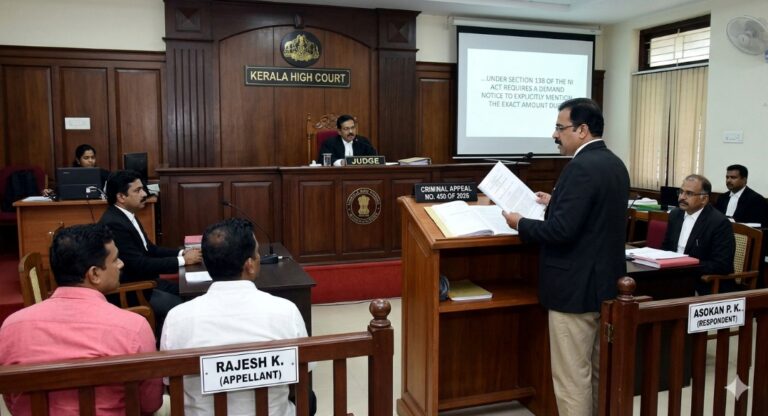
In a significant ruling, the Kerala High Court has clarified an essential procedural requirement under Negotiable Instruments Act, 1881, holding that a cheque dishonour complaint under Section 138 cannot be sustained unless the statutory demand notice explicitly mentions the exact amount due.
This judgment reinforces the strict compliance standards required for initiating cheque bounce proceedings and highlights the importance of precision in legal notices.
Background of the Case
The case titled Rajesh K v. Asokan P. K and Anr. arose from a cheque dishonour dispute involving an amount of ₹95,000. The complainant had approached the trial court alleging commission of an offence under Section 138 of the Negotiable Instruments Act after the cheque issued by the accused was dishonoured.
However, the Judicial First Class Magistrate Court II Peramabra acquitted the accused. The primary reason for acquittal was the absence of a legally valid demand notice as required under the statutory provisions.
Aggrieved by the acquittal, the complainant filed an appeal before the Kerala High Court.
Core Legal Issue
The central question before the High Court was:
Whether a statutory demand notice under Section 138 is valid if it does not specifically mention the cheque amount, but merely refers to the cheque number and date?
This issue goes to the root of cheque dishonour litigation, as issuance of a valid demand notice is a mandatory precondition for prosecuting an offence under Section 138.
Observations by the High Court
Justice A Badharudeen, while deciding the appeal, undertook a detailed analysis of proviso (b) and (c) to Section 138 of the Negotiable Instruments Act.
The Court emphasized that an offence under Section 138 is not automatic upon dishonour of a cheque. Instead, it is a “deemed offence”, which becomes complete only after fulfilling certain statutory conditions:
- Dishonour of cheque
- Issuance of a written demand notice
- Failure of the drawer to make payment within 15 days of receiving the notice
The Court stressed that each of these stages must be strictly complied with.
Importance of Specifying the Demand Amount
A key takeaway from the judgment is the interpretation of the phrase:
“makes a demand for the payment of the said amount of money”
The Court held that this phrase clearly mandates that the notice must specify the exact amount payable.
According to the Court:
- A notice that does not mention the cheque amount is incomplete in law
- The recipient of such a notice is deprived of the opportunity to make payment within the statutory period
- Consequently, the legal requirement of a valid demand notice remains unfulfilled
The Court categorically observed that without a specific demand amount, there is no valid notice in the eyes of law.
Rejection of the Appellant’s Argument
The appellant argued that omission of the amount should not invalidate the notice since:
- There was only one transaction between the parties
- The accused was aware of the cheque amount
However, the High Court rejected this argument, holding that:
- Statutory compliance cannot be presumed or inferred
- Legal requirements must be fulfilled strictly as prescribed
- External circumstances or assumptions cannot substitute explicit statutory mandates
This reinforces the principle that procedural compliance under penal provisions must be precise and unambiguous.
Final Verdict
The Kerala High Court upheld the acquittal of the accused and dismissed the appeal. It concluded that:
- Absence of the specific cheque amount in the demand notice renders the notice invalid
- Without a valid notice, the offence under Section 138 cannot be said to be complete
- Consequently, prosecution based on such defective notice is not maintainable
Key Takeaways for Legal Professionals and Businesses
This ruling has important implications for litigants, lawyers, and businesses dealing with cheque transactions:
- Precision in Demand Notices is Mandatory
Always mention the exact cheque amount in the statutory notice. - Strict Compliance with Section 138 Requirements
Courts will not relax procedural mandates, even if the liability is otherwise clear. - Defective Notice Can Defeat the Entire Case
Even a minor omission like non-mention of amount can invalidate proceedings. - No Scope for Assumptions
Knowledge of the parties or existence of a single transaction does not cure defects in notice.
Conclusion
The Kerala High Court’s ruling serves as a crucial reminder that cheque dishonour cases hinge not only on substantive liability but also on strict procedural adherence. A statutory notice under Section 138 must clearly and unequivocally demand the specific amount due, failing which the entire prosecution may collapse.
For practitioners, this judgment underscores the need for meticulous drafting of legal notices to ensure enforceability and avoid fatal technical defects.
Case Details:
-
- Rajesh K v. Asokan P. K and Anr.
- Criminal Appeal No. 212 of 2013
- Counsel for Appellant: E. Narayanan
- Counsel for Respondents: Alex M. Thombra (Sr. PP)
Follow the Link below to Watch the video: