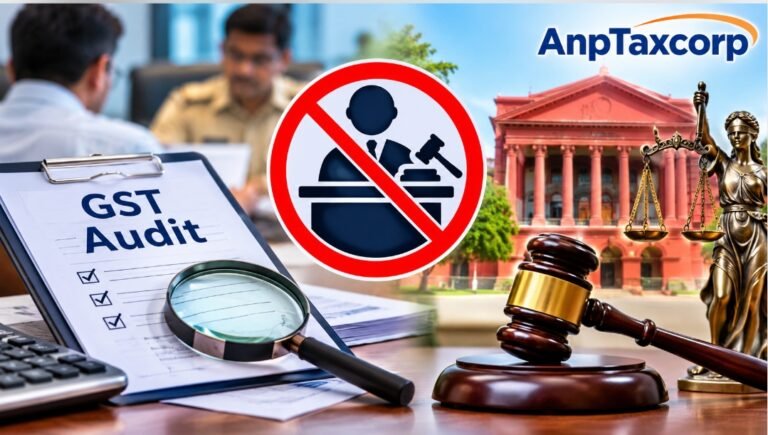
The Karnataka High Court has reiterated an important principle of fairness in GST proceedings: an officer who raises audit objections against a taxpayer should not subsequently act as the adjudicating authority in proceedings arising from those very objections. The ruling reinforces the requirement of impartiality in tax administration and highlights the importance of a fair and independent adjudication process under the GST law.
In a significant decision concerning GST audit and adjudication, the High Court set aside an adjudication order and a subsequent show cause notice issued by the same Commercial Tax Officer who had earlier raised audit objections against the taxpayer. The matter was remitted for fresh consideration by another officer, subject to certain conditions.
The decision is particularly relevant for taxpayers facing GST demands arising from departmental audits, as well as tax professionals handling GST litigation and adjudication proceedings.
Background of the Case
The dispute arose in the case of Mr. Ravikumar Nagappa Kattimani v. The State of Karnataka, Writ Petition No. 204216 of 2026 (T-RES), concerning a taxpayer engaged in contract works.
During the GST audit for the financial year 2022–23, certain audit objections were raised against the taxpayer. Following the audit, the Commercial Tax Officer initiated proceedings by issuing an intimation in Form GST DRC-01A, followed by a show cause notice under Section 73 of the CGST/SGST Act, 2017. The officer subsequently passed an adjudication order confirming the tax demand.
However, the same officer also issued another show cause notice raising additional observations based on audit findings. This second notice was challenged before the High Court on the ground that the officer who had raised the audit objections was subsequently acting as the authority responsible for initiating and adjudicating proceedings arising from those objections.
Karnataka High Court’s Observations
The High Court examined the sequence of events and took note of the fact that the same Commercial Tax Officer had participated in raising audit objections and thereafter proceeded to issue show cause notices and adjudicate the matter.
The Court observed that the officer had issued another show cause notice in Form GST DRC-01 dated 16 September 2026 under Section 73(1), read with Sections 122(2)(a) and 50 of the CGST/SGST Act, 2017, raising further observations based on the audit findings.
The Court found that the same officer could not appropriately continue to raise audit objections, seek explanations from the taxpayer, issue show cause notices and adjudicate proceedings arising from those objections.
The High Court also referred to its earlier decision in Presidency Builders and Developers v. Deputy Commissioner of Commercial Taxes, Mangalore, which had addressed the issue of an officer raising audit objections and subsequently undertaking adjudication based on those objections.
The principle emerging from these decisions is that tax adjudication must be conducted by an authority capable of considering the taxpayer’s response independently and objectively.
Second Show Cause Notice Also Set Aside
The High Court further held that issuing a second show cause notice for the same assessment year, in the facts of the case, was impermissible. The additional notice was based on observations arising from the audit process and was issued by the same officer who had already dealt with the earlier proceedings.
The Court considered that the matter required fresh examination by a higher or differently assigned authority, ensuring that the adjudication process was not affected by the officer’s earlier role in raising the audit objections.
Final Decision of the High Court
The Karnataka High Court set aside the adjudication order as well as the second show cause notice and remitted the matter for fresh consideration.
The matter was directed to be reconsidered from the stage of the taxpayer’s reply to the first show cause notice, subject to the condition that the petitioner deposit 10% of the tax demand.
The Court also granted liberty to the petitioner to raise all contentions available under law, including objections relating to the audit report, before the newly assigned adjudicating officer.
Legal Significance of the Ruling
This judgment highlights the importance of maintaining procedural fairness and impartiality in GST adjudication. Audit proceedings and adjudication proceedings serve different purposes. An audit is intended to examine compliance and identify discrepancies, whereas adjudication requires an independent assessment of the allegations, the taxpayer’s explanation, supporting documents and applicable provisions of law.
Where an officer has already formed or expressed conclusions through audit objections, allowing that same officer to adjudicate the resulting dispute may raise concerns regarding the fairness and impartiality of the proceedings.
The ruling may therefore be relevant in cases where taxpayers are subjected to GST demands arising from audit objections and the same officer is involved at multiple stages of the proceedings.
However, the judgment should not be understood as automatically invalidating every GST adjudication order passed by an audit officer. The facts, statutory provisions, nature of the officer’s involvement and applicable judicial precedents would need to be examined in each individual case.
Practical Takeaway for GST Taxpayers
Taxpayers facing GST proceedings originating from departmental audits should carefully examine:
-
Whether the audit officer and adjudicating authority are the same person.
-
Whether the officer has personally raised or formulated the audit objections.
-
Whether the subsequent show cause notice is based substantially on the officer’s own audit findings.
-
Whether multiple show cause notices have been issued for the same period and overlapping issues.
-
Whether the adjudication process reflects independent consideration of the taxpayer’s reply and supporting evidence.
Where circumstances indicate a lack of impartiality or procedural irregularity, the taxpayer may consider raising an appropriate legal objection before the adjudicating authority or, where warranted, invoking the writ jurisdiction of the High Court.
The Karnataka High Court’s ruling serves as a reminder that GST proceedings must not only be legally sustainable but must also comply with the principles of natural justice and fair adjudication.
Case Details
-
Case Name: Mr. Ravikumar Nagappa Kattimani v. The State of Karnataka
-
Court: Karnataka High Court
-
Case Number: Writ Petition No. 204216 of 2026 (T-RES)
-
Decision Date: 23 November 2026
-
Key Issue: Whether an officer who raised GST audit objections could subsequently issue show cause notices and adjudicate proceedings arising from those objections.
-
Outcome: Adjudication order and second show cause notice set aside; matter remanded for fresh consideration by a newly assigned officer, subject to 10% deposit of the tax demand.
Disclaimer: For informational and educational purposes only. Please refer to the original judgment and seek professional legal advice before acting upon this information.