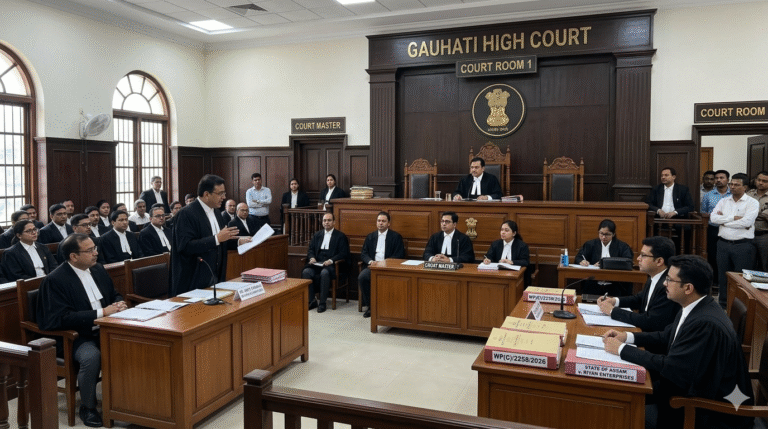
In a significant ruling reinforcing procedural safeguards under GST law, the Gauhati High Court has held that issuance of a Summary Show Cause Notice in Form GST DRC-01 alone cannot replace the statutory requirement of issuing a proper Show Cause Notice under Section 73 of the Assam Goods and Services Tax (AGST) Act, 2017.
The judgment, delivered on 13 May by Justice Manish Choudhury in M/s Riyan Enterprises and Another v. State of Assam [WP(C)/2258/2026], reiterates that compliance with statutory procedure is not merely a formality but a mandatory legal requirement before any tax demand can be finalized.
Background of the Case
The petitioner, M/s Riyan Enterprises, a registered government contractor under GST, approached the Gauhati High Court challenging demand proceedings initiated under Section 73 of the AGST Act.
The dispute arose after the GST authorities passed an adjudication order alleging tax liability against the petitioner. However, according to the petitioner, the authorities had never issued the statutory Show Cause Notice contemplated under Section 73(1) before determining tax liability.
Instead, the department had only uploaded and served a Summary Show Cause Notice in Form GST DRC-01 through the GST portal.
The petitioner argued that such action violated the mandatory legal procedure prescribed under the AGST Act and Rules because a summary notice cannot legally substitute a detailed statutory notice.
Core Legal Issue Before the Court
The primary issue before the Court was whether GST authorities could validly initiate and conclude proceedings under Section 73 solely based on Form GST DRC-01 without issuing an independent statutory Show Cause Notice.
Section 73 of the AGST Act provides the mechanism for determination of tax not paid, short paid, erroneously refunded, or input tax credit wrongly availed in cases not involving fraud or wilful misstatement.
The statutory framework requires the proper officer to first issue a Show Cause Notice specifying:
- Grounds for proposed demand;
- Alleged violations;
- Basis of computation;
- Opportunity for the taxpayer to respond.
Only after providing such opportunity can the authorities proceed to determine tax, interest, or penalty.
High Court’s Observations
Justice Manish Choudhury held that the GST department failed to comply with the mandatory statutory requirements.
The Court observed that Rule 142 of the AGST Rules contemplates issuance of Form GST DRC-01 only as a summary of the Show Cause Notice and not as the Show Cause Notice itself.
The Court emphasized that procedural fairness forms an integral part of tax administration and taxpayers must receive a complete notice containing the allegations and grounds against them.
The judgment categorically stated that merely uploading a summary in electronic format does not satisfy the legal obligation imposed under Section 73(1).
The Court observed:
A Summary Show Cause Notice cannot be treated as a substitute for the substantive Show Cause Notice prescribed under the statute.
According to the Court, initiation of proceedings without issuing a proper statutory notice deprives the taxpayer of meaningful opportunity to defend the case.
Distinction Between DRC-01 and Statutory Show Cause Notice
One of the important aspects highlighted in the judgment is the distinction between:
Form GST DRC-01
- Electronic summary uploaded on the GST portal;
- Intended to communicate brief details of proceedings.
Statutory Show Cause Notice under Section 73
- Formal legal document;
- Contains detailed allegations, legal grounds, and proposed liability;
- Provides the taxpayer a meaningful opportunity of hearing.
The Court clarified that these two documents perform different legal functions and cannot be treated interchangeably.
Final Verdict
After examining the statutory scheme and procedural requirements, the Gauhati High Court concluded that the adjudication proceedings suffered from a fundamental procedural defect.
The Court held that non-issuance of the mandatory Show Cause Notice rendered the entire adjudication process legally unsustainable.
Accordingly, the Court set aside:
- The adjudication order dated 30 April 2024; and
- All consequential actions arising from that order.
Key Takeaway for Taxpayers
This ruling serves as an important reminder that GST authorities must strictly adhere to statutory procedures before raising tax demands.
For taxpayers, the decision reinforces the principle that procedural rights are substantive rights. Any tax demand initiated without issuance of a valid Show Cause Notice may be open to judicial challenge.
The judgment is likely to have wider implications in GST litigation where authorities rely solely on Form GST DRC-01 without issuing a proper notice under Section 73.
Case Number: WP(C)/2258/2026
Court: Gauhati High Court
Coram: Justice Manish Choudhury
Follow the Link below to watch the video: