In a significant ruling that strengthens taxpayer protections against arbitrary reassessment proceedings, the Gujarat High Court has held that merely recording high-value bank transactions is not sufficient to reopen an income tax assessment unless there is tangible material demonstrating actual escapement of taxable income.
The decision came in the case of O3 Developers Pvt. Ltd. v. Income Tax Officer, Ward 3(1)(1), Ahmedabad, where the Court set aside reassessment proceedings initiated for Assessment Years (AY) 2019–20 and 2021–22.
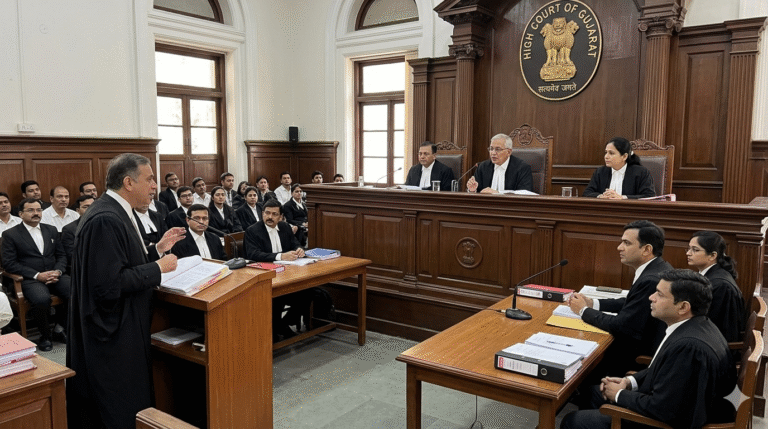
A Division Bench comprising Justice A.S. Supehia and Justice Vaibhavi D. Nanavati emphasized that suspicion based solely on financial transaction volume cannot replace legally required evidence for reopening completed assessments.
Background of the Dispute
The Income Tax Department initiated reassessment proceedings against O3 Developers Pvt. Ltd. after reviewing bank statements that reflected substantial debit and credit transactions. The transactions included movements relating to unsecured loans and other financial dealings.
According to the department, the pattern and magnitude of these transactions did not appear consistent with the company’s declared business activities. The authorities also raised additional concerns, including:
- Absence of an NBFC (Non-Banking Financial Company) licence;
- Non-charging of interest on certain loans;
- Recognition of mark-to-market losses; and
- Transactions involving bullion.
Based on these observations, reassessment notices were issued under the Income Tax Act alleging possible escapement of taxable income.
Taxpayer’s Defence
O3 Developers Pvt. Ltd. challenged the reassessment proceedings before the High Court.
The company argued that every transaction reflected in the bank accounts had already been properly recorded in its books of accounts and disclosed through audited financial statements submitted with income tax returns.
Further, the petitioner highlighted that:
- All entities involved in the transactions were regular income-tax return filers;
- Financial records had already undergone scrutiny during return processing;
- There was no concealment or suppression of income; and
- The department failed to identify any specific undisclosed income.
The company maintained that reassessment proceedings cannot be initiated merely because authorities perceive transactions as unusual or commercially unconventional.
Gujarat High Court’s Observations
After examining the records, the High Court found serious deficiencies in the department’s reasoning.
The bench noted that the Assessing Officer himself had acknowledged that the relevant entities regularly filed income-tax returns and that the questioned transactions were already reflected in the company’s books of accounts.
The Court categorically observed that high-value transactions, by themselves, do not establish escaped income.
The Court stated that merely because substantial transactions exist in bank accounts does not automatically lead to the conclusion that taxable income has escaped assessment unless supported by concrete evidence.
Importantly, the judges clarified that reassessment powers cannot be exercised on assumptions, presumptions, or subjective doubts regarding business conduct.
Court Rejects Department’s Additional Grounds
The High Court also rejected the other grounds relied upon by the tax department.
Regarding the absence of an NBFC licence, the Court held that lack of such licence, by itself, does not establish undisclosed income.
Similarly, the allegation that the company did not charge interest on certain loans was considered commercially insufficient to infer escapement of taxable income.
On the issue of mark-to-market losses, the Court observed that the company was never given an opportunity to explain the accounting treatment before the final reassessment order was passed.
Further, allegations relating to bullion transactions were found unsupported by any independent material or evidence.
Important Takeaway for Taxpayers
This judgment reinforces an important principle under reassessment law: the Income Tax Department must possess credible material indicating actual escapement of income before reopening completed assessments.
The ruling sends a clear message that:
- High-value banking activity alone is not enough;
- Business decisions cannot automatically trigger tax reassessment;
- Authorities must establish a live nexus between material available and alleged escaped income; and
- Reassessment cannot be based on assumptions or fishing inquiries.
For businesses and taxpayers, the decision offers reassurance that transparent disclosure through books of accounts and audited financial statements continues to remain a strong defence against unjustified reassessment actions.
Case Details
Case Title: O3 Developers Pvt. Ltd. v. Income Tax Officer, Ward 3(1)(1), Ahmedabad
Case Number: R/Special Civil Application Nos. 14057 and 14096 of 2025
For Petitioner: Senior Advocate Tushar Hemani with Vaibhavi K. Parikh
For Revenue: Senior Standing Counsel Aaditya D. Bhatt
Follow the Link below to watch the video: