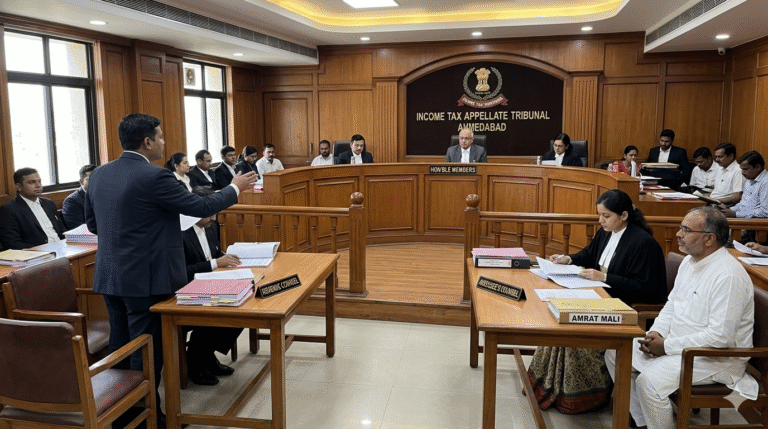
In a significant ruling reinforcing the principle that tax additions cannot rest merely on suspicion or unverified intelligence inputs, the Ahmedabad Bench of the Income Tax Appellate Tribunal (ITAT) has upheld the deletion of an addition of ₹26.08 lakh made against a taxpayer under Section 68 of the Income Tax Act.
The Tribunal ruled that information received from the Investigation Wing alone is insufficient to sustain an addition unless supported by independent enquiry and credible evidence directly linking the assessee to the alleged transactions.
The decision came in the case of Income Tax Officer v. Amrat Mali (I.T.A. No. 2003/Ahd/2025).
Background of the Case
The dispute arose out of reassessment proceedings initiated by the Income Tax Department based on information received after a search operation involving certain third parties, namely Jignesh Shah and Sanjay Shah.
According to the Revenue authorities, information emerging from the search indicated that the taxpayer had allegedly received accommodation entries amounting to ₹26.08 lakh through two companies:
- Pranatpal Tradelink Pvt. Ltd.
- Suramya Tradelink Pvt. Ltd.
Based on this information, the Assessing Officer (AO) concluded that the amount represented unexplained cash credit and proceeded to make an addition under Section 68 of the Income Tax Act.
The department alleged that the assessee had obtained bogus long-term capital gains (LTCG) through these entities and therefore treated the amount as taxable income.
Taxpayer’s Defence Before the Authorities
The taxpayer strongly disputed the allegations and denied having entered into any transaction with the companies named by the department.
During appellate proceedings, it was argued that the Revenue had failed to produce any independent evidence connecting the assessee to the alleged accommodation entry operators.
Further, the taxpayer highlighted that no exempt long-term capital gain had even been claimed in the return of income.
Instead, the taxpayer had disclosed a short-term capital loss of merely ₹39,775.
This factual inconsistency weakened the department’s allegation that the assessee had routed bogus exempt LTCG through entry providers.
Findings of the Commissioner (Appeals)
The Commissioner of Income Tax (Appeals) examined the record and concluded that the addition lacked evidentiary support.
The appellate authority found that the Assessing Officer had relied entirely on information supplied by the Investigation Wing without carrying out any independent verification.
No banking trail, transaction confirmation, or corroborative material was brought on record to establish any direct involvement of the taxpayer.
Accordingly, the Commissioner deleted the addition of ₹26.08 lakh.
ITAT Ahmedabad Upholds Deletion
The Revenue challenged the appellate order before the ITAT Ahmedabad.
However, the Tribunal dismissed the Revenue’s appeal and affirmed the findings of the Commissioner (Appeals).
The bench comprising Vice-President Dr. B.R.R. Kumar and Judicial Member Suchitra R. Kamble observed that the Revenue had failed to establish any direct nexus between the assessee and the alleged accommodation entry providers.
The Tribunal categorically held:
“No evidence has been brought on record demonstrating any direct nexus between the assessee and the alleged accommodation entry providers. In the absence of any independent enquiry or corroborative evidence linking the assessee with the impugned transactions, the addition made under Section 68 cannot be sustained merely on the basis of information received from the Investigation Wing.”
The Tribunal also noted that no bank verification or factual investigation had been conducted to substantiate the allegations.
Importantly, the Revenue could not rebut the factual findings already recorded by the Commissioner (Appeals).
The bench further observed that the assessment order itself referred to alleged bogus LTCG of ₹19.14 lakh and ₹6.94 lakh, but no supporting material was produced to establish that such gains were ever received by the assessee.
Consequently, the Tribunal found no legal infirmity in the deletion of the addition.
Key Takeaway from the Judgment
This ruling reiterates an important principle in income tax jurisprudence: information gathered by the Investigation Wing may trigger enquiry, but it cannot substitute actual evidence.
For an addition under Section 68 to survive judicial scrutiny, tax authorities must establish a clear evidentiary connection between the taxpayer and the alleged unexplained transaction.
The judgment also serves as a reminder that reassessment proceedings and additions cannot be sustained merely on assumptions, third-party allegations, or generic intelligence inputs without independent verification.
Case Details
- Case Title: Income Tax Officer v. Amrat Mali
- Case Number: I.T.A. No. 2003/Ahd/2025
- Forum: Income Tax Appellate Tribunal, Ahmedabad Bench
-
Outcome: Revenue’s appeal dismissed; deletion of ₹26.08 lakh addition upheld.
Follow the Link below to watch the video: