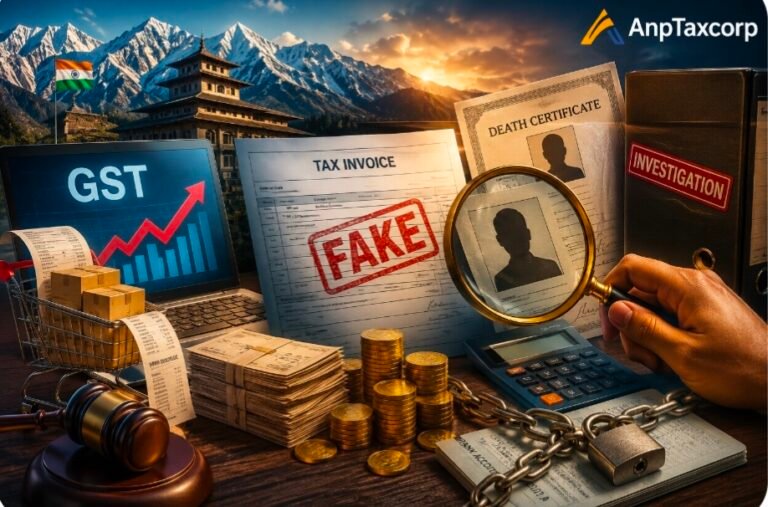
A major GST fraud case in Himachal Pradesh has come under the spotlight after the State Tax and Excise Department detected an allegedly fraudulent GST registration that was reportedly obtained using forged documents in the name of a deceased person. The registration was then allegedly used to generate fake GST invoices worth approximately ₹231 crore within just six months.
The case highlights the growing challenges faced by tax authorities in detecting fraudulent GST registrations and preventing the misuse of GSTINs for generating fictitious transactions and claiming or passing on Input Tax Credit (ITC).
Fraudulent GST Registration Allegedly Obtained Using Forged Documents
The suspected fraud was detected by the GST Enforcement Wing, South Zone, Parwanoo, following which the Himachal Pradesh State Tax and Excise Department initiated a detailed investigation.
According to preliminary departmental findings, a resident of Nichar in Kinnaur district allegedly secured GST registration by submitting a forged rent agreement and electricity bill. These documents were reportedly prepared in the name of an individual who had already died.
After obtaining the GST registration, the allegedly fake entity was used to record and issue transactions running into hundreds of crores. The suspected fraudulent invoices were reportedly generated between January and June 2026, with their aggregate value estimated at around ₹231 crore.
The department has constituted a team of three Assistant Commissioners from Paonta Sahib in Sirmaur district to investigate the matter and determine the complete chain of transactions.
Alleged IGST Fraud of ₹41.61 Crore
The preliminary investigation has also revealed a suspected Integrated Goods and Services Tax (IGST) fraud of approximately ₹41.61 crore.
The alleged misuse of the GST registration appears to have involved transactions across state borders, raising concerns regarding the possible creation of artificial purchase and sales chains for the purpose of facilitating fraudulent tax credit.
Investigators are now examining the underlying invoices, GST returns, e-way bills, banking transactions and other records to determine whether the reported supplies represented genuine commercial activity.
₹32 Crore Purchases Reportedly Shown From Delhi and Haryana
Another significant finding relates to purchases recorded by the allegedly fraudulent firm.
According to the department’s preliminary findings, the entity reportedly showed purchases worth approximately ₹32 crore from suppliers located in Delhi and Haryana. However, the amount of tax actually deposited through the cash ledger was reportedly only ₹247.
Such a substantial mismatch between the value of transactions and the tax deposited has raised serious questions about the genuineness of the business activities attributed to the GST registration.
The authorities are examining whether the transactions were merely paper entries created to facilitate the movement of fraudulent ITC without any corresponding supply of goods or services.
GST Registration Suspended and ITC Blocked
Following detection of the suspected irregularities, the GST Enforcement Wing reportedly suspended the concerned GST registration.
The department has also blocked an ITC balance of approximately ₹10.60 lakh in the electronic cash/credit records, as part of measures to prevent further misuse of the registration and associated tax credits.
The authorities have additionally taken steps concerning the banking operations of the person allegedly connected with the fraudulent entity.
Bank Account Frozen; KYC Documents Under Examination
The bank account of the accused in Kinnaur has reportedly been frozen. The concerned bank has been directed to furnish complete details relating to the opening of the account.
This includes documents submitted at the time of account opening and relevant Know Your Customer (KYC) information.
Such banking records could be important for investigators in establishing the identity of persons who actually operated the business, controlled the bank account or benefited from the transactions.
Investigation to Establish the Complete Fraud Trail
The investigation remains ongoing, and the authorities are examining the GST registration documents, purchase and sales records, financial transactions, tax returns and related documentation.
Investigators are also attempting to establish how forged documents were allegedly accepted for GST registration and whether other individuals, firms or intermediaries participated in the suspected network.
The Himachal Pradesh case demonstrates the importance of robust verification of GST registrations, business premises, identity documents and banking credentials. Fraudulent GST registrations can potentially be used to create large volumes of fictitious invoices, facilitate wrongful ITC and cause substantial revenue loss to the government.
As the investigation progresses, further details regarding the entities and persons allegedly involved, the actual tax loss and the legal action proposed by the department are expected to emerge.
Key Takeaway
The alleged ₹231 crore fake-invoice case in Himachal Pradesh is a significant reminder that GST authorities are increasingly scrutinising suspicious registrations and unusually large transaction volumes. Businesses should therefore ensure that their GST registrations, invoices, supplier credentials and ITC claims are properly documented and capable of being substantiated during departmental verification or investigation.