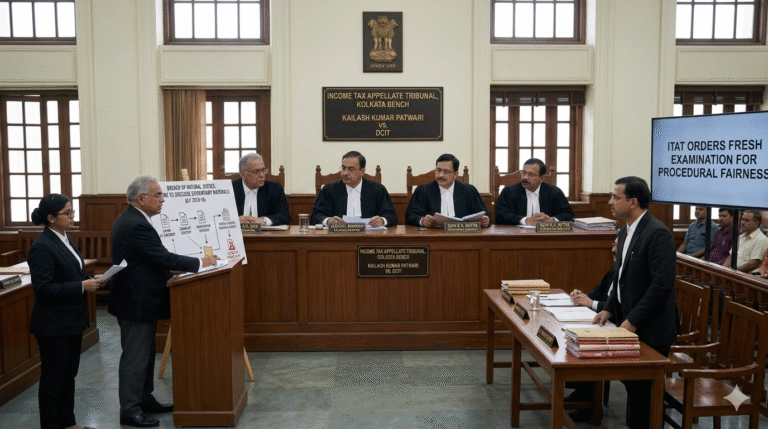
In a significant ruling reinforcing procedural fairness in tax administration, the Income Tax Appellate Tribunal (ITAT), Kolkata Bench, held that failure to provide an assessee with the tally data and forensic analysis report relied upon by the tax authorities amounts to a serious violation of the principles of natural justice.
The decision came in the case of Kailash Kumar Patwari vs DCIT, concerning Assessment Year (AY) 2013–14, which was treated as the lead matter for deciding similar issues involved in connected appeals across multiple assessment years.
The ruling highlights an important principle in reassessment proceedings—while tax authorities may rely on seized electronic evidence and statements recorded during search operations, such material must be disclosed to the taxpayer to ensure a fair opportunity to defend the case.
Background of the Case
The assessee originally filed an income tax return declaring total income of ₹1.84 lakh. Subsequently, a search operation under Section 132 of the Income Tax Act was conducted on 8 March 2022 at the assessee’s office premises, residence, and bank locker.
During the search proceedings, the department seized various documents and electronic records. Based on these findings, reassessment proceedings were initiated under Section 148.
In response to the reassessment notice, the assessee filed a revised return declaring income of ₹7.43 lakh.
The controversy arose when the Assessing Officer (AO) relied heavily on electronic tally data allegedly maintained under the name “SGJN,” which was recovered from a laptop seized at Todi Mansion.
According to the tax department, the seized data indicated that the assessee was involved in facilitating accommodation entries through multiple shell entities and had processed transactions amounting to approximately ₹1,334.10 crore during the relevant assessment year.
Assessing Officer’s Findings and Addition
The Assessing Officer concluded that the assessee had operated an accommodation entry business and earned commission income from these transactions.
Relying upon the tally records and statements recorded during the search, the AO estimated commission income at 1.5% of the alleged accommodation entry turnover.
This resulted in an addition of approximately ₹21.82 crore to the assessee’s income.
The department’s case was largely based on:
- Electronic tally data allegedly recovered during search;
- Statements recorded under Section 132(4);
- Alleged operation of shell companies;
- Routing of cash through banking channels; and
- Receipt of commission income from accommodation entries.
Assessee’s Challenge Before CIT(A)
The assessee challenged the reassessment and the addition before the Commissioner of Income Tax (Appeals) [CIT(A)].
The principal arguments advanced were:
1. Third-Party Data Cannot Be Blindly Relied Upon
The assessee contended that the tally data was not recovered from his own premises but from a third-party location. Therefore, the statutory presumption under Section 132(4A) could not automatically apply.
2. Forensic Report Was Never Supplied
It was argued that although the department relied upon forensic examination of electronic records, the forensic report itself was never supplied despite repeated requests.
3. No Effective Opportunity to Rebut Evidence
The assessee maintained that the tally ledgers and underlying electronic evidence were never shared, preventing meaningful rebuttal.
4. Search Statements Were Retracted
The assessee also argued that statements recorded during search had subsequently been retracted and lacked independent corroborative evidence such as cash trails, beneficiary confirmations, or documentary support.
CIT(A)’s Decision: Relief on Quantum but Not on Liability
The CIT(A) rejected the assessee’s objections regarding reopening and evidentiary reliance.
According to the appellate authority:
- Search proceedings had yielded incriminating materials;
- Statements recorded under Section 132(4) carried evidentiary value;
- The assessee had admitted involvement in accommodation entry operations;
- The subsequent retraction lacked convincing explanation.
However, the CIT(A) disagreed with the quantum of commission estimated by the Assessing Officer.
After reviewing judicial precedents dealing with accommodation entry businesses, the appellate authority observed that commission rates accepted in comparable cases generally ranged between 0.02% and 0.26%.
Considering this judicial trend, the CIT(A) reduced the commission rate from 1.5% to 0.15%.
As a result:
- Original addition: ₹21.82 crore
- Sustained addition after reduction: ₹2.00 crore
- Deleted amount: ₹19.82 crore
Arguments Before ITAT Kolkata
Before the Tribunal, both sides challenged different parts of the appellate order.
Assessee’s Submissions
The assessee argued that:
- Reassessment was invalid because no incriminating evidence was recovered from his own premises;
- Electronic records allegedly belonged to another person;
- Neither tally data nor forensic reports were supplied;
- Statements had been retracted before assessment proceedings commenced;
- No independent verification of beneficiaries was conducted;
- Several beneficiary entities were separately assessed without any corresponding additions.
The assessee alternatively requested remand for proper verification if required.
Revenue’s Contentions
The Revenue defended the original assessment and argued that:
- The assessee had admitted operating accommodation entry arrangements;
- Statements under Section 132(4) have legal evidentiary value;
- Retraction was delayed and unsupported;
- Commission calculations broadly matched figures appearing in seized data.
The Revenue sought restoration of the 1.5% commission estimation.
ITAT Kolkata’s Findings
After analysing the record and rival submissions, the Tribunal partly agreed with both sides.
Reopening Upheld
The Tribunal upheld reassessment proceedings under Section 147 and rejected the challenge to reopening.
0.15% Commission Rate Confirmed
The Tribunal agreed with the CIT(A) that estimating commission at 0.15% was reasonable and aligned with judicial precedents in similar accommodation entry cases.
Accordingly, Revenue’s appeal seeking restoration of the 1.5% rate was rejected.
Non-Supply of Evidence Violated Natural Justice
The Tribunal’s most important finding concerned procedural fairness.
ITAT observed that the entire addition was founded upon:
- Tally data;
- Electronic records; and
- Forensic analysis.
However, these materials were never furnished to the assessee.
The Tribunal held that when evidence forms the foundation of an adverse assessment, the taxpayer must be given access to such material and a meaningful opportunity to respond.
Failure to disclose the tally data and forensic report amounted to a grave violation of the principles of natural justice.
Final Outcome
The Tribunal restored the matter to the Assessing Officer with specific directions:
- Supply tally data to the assessee;
- Furnish the forensic analysis report;
- Consider objections and explanations;
- Examine claims regarding beneficiary entities;
- Recompute accommodation entry turnover wherever necessary;
- Apply the already approved commission rate of 0.15%.
The same approach was extended to connected assessment years.
As a result:
-
- Assessee’s appeals were partly allowed for statistical purposes.
- Revenue’s appeals were dismissed.
Key Takeaway
This ruling underscores that even in search and reassessment proceedings, procedural fairness cannot be compromised. Tax authorities may rely on electronic evidence and statements, but any material used against a taxpayer must first be disclosed. The decision reinforces that natural justice is not a technical formality—it is a substantive right that ensures fair adjudication under tax law.
Follow the Link below to watch the video: