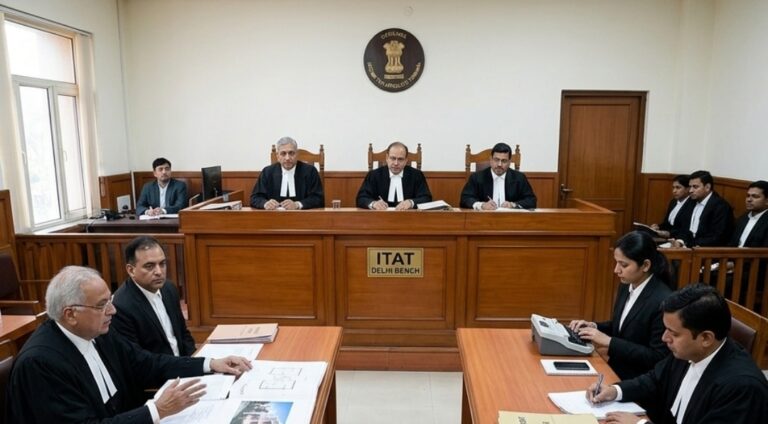
In an important ruling that provides clarity on capital gains exemption under the Income Tax Act, the Delhi Bench of the Income Tax Appellate Tribunal (ITAT) held that merely describing a property as “commercial” in a sale deed is not sufficient to deny exemption under Section 54. The Tribunal emphasized that the actual nature and use of the property must be examined instead of relying solely on nomenclature used in documents.
The decision came in Raj Krishan Gupta vs ACIT concerning Assessment Year 2015–16 and addressed multiple issues including deduction under Sections 54 and 54F, addition under Section 56(2)(vii), and indexed cost of acquisition.
Background of the Case
The taxpayer filed his income tax return declaring total income of ₹91.58 lakh. The return was selected for limited scrutiny because of discrepancies relating to capital gains arising from the sale of immovable property and increase in capital.
During assessment proceedings, the Assessing Officer (AO) made several additions and disallowances, including:
- Addition under Section 50C relating to valuation of property;
- Disallowance of exemption claimed under Sections 54 and 54F amounting to ₹88.41 lakh;
- Addition of ₹24 lakh under Section 56(2)(vii);
- Partial disallowance of indexed cost of acquisition concerning two properties.
The Commissioner of Income Tax (Appeals) affirmed these additions, leading the taxpayer to approach the ITAT.
Core Issue: Whether a Property Mentioned as “Commercial” Can Still Qualify for Section 54 Relief
The major controversy before the Tribunal revolved around exemption claimed under Sections 54 and 54F on sale of property located at Greater Kailash Part II, New Delhi.
The Assessing Officer rejected the exemption claim on two grounds:
- The sale deed categorized the property as a “commercial property”.
- The taxpayer allegedly owned more than one residential house, making him ineligible for Section 54F relief.
According to the department, these factors were sufficient to deny the capital gains exemption.
Assessee’s Arguments Before the Tribunal
The taxpayer strongly contested the findings and argued that the description in the sale deed did not reflect the actual character of the property.
It was submitted that:
- Only the ground floor of the building contained commercial shops.
- The basement and upper floors were residential in nature.
- These residential portions were occupied by the taxpayer and his brothers.
To establish residential use, extensive documentary evidence was produced, including:
- Completion certificate;
- Approved building plans;
- Municipal records;
- House tax receipts;
- Passport and voter identity documents;
- LIC policy records;
- Electricity bills showing domestic tariff;
- Valuation reports describing the building as commercial-cum-residential;
- Assessment order of the taxpayer’s brother, who was co-owner of the same property and had already received Section 54 relief.
The taxpayer also contended that another property situated at Kalkaji was commercial and therefore could not be counted as an additional residential house for Section 54F purposes.
ITAT Delhi’s Findings
After examining the evidence, the Tribunal disagreed with the tax authorities’ approach.
The ITAT observed that merely labelling a property as commercial in the sale deed cannot conclusively determine its actual nature. The surrounding evidence demonstrated that the property had mixed usage and substantial residential occupation.
The Tribunal noted:
- Completion certificates and approved plans supported residential usage.
- Municipal records and house tax documents aligned with residential classification.
- Electricity bills reflected domestic consumption.
- Valuation reports consistently categorized the building as commercial-cum-residential.
Importantly, the Tribunal took note of the fact that in the case of the taxpayer’s brother—who owned the same property—the department had already accepted the Section 54 deduction.
Based on these findings, ITAT held that:
- The ground floor may be treated as commercial.
- The basement and upper floors should be considered residential.
Accordingly, the Tribunal directed the Assessing Officer to determine the proportionate sale consideration attributable to the residential portion and allow deduction under Section 54 on that basis.
Grounds challenging denial of Section 54/54F exemption were therefore allowed.
Relief on Section 56(2)(vii) Addition
Another important issue involved addition under Section 56(2)(vii).
The taxpayer had purchased a property for ₹78 lakh while the stamp duty valuation was ₹1.02 crore. The tax department added the difference of ₹24 lakh to income.
However, the Tribunal found that the taxpayer had already disputed the stamp duty value before both lower authorities.
ITAT observed that once valuation is challenged, the Assessing Officer should ordinarily refer the matter to the Departmental Valuation Officer (DVO) instead of mechanically adopting stamp valuation.
Relying on earlier judicial precedent, the Tribunal restored the issue to the AO with directions to obtain DVO valuation and decide afresh in accordance with law.
These grounds were allowed for statistical purposes.
Other Grounds
The Tribunal noted that no arguments were advanced regarding disallowance of indexed cost of acquisition and therefore those grounds were dismissed.
The ground relating to charging of interest was treated as consequential.
Key Takeaway
This ruling reinforces an important principle in tax litigation: substance prevails over form.
For claiming exemption under Section 54, the actual use and character of a property matter more than labels used in sale deeds. Taxpayers dealing with mixed-use properties should preserve documentary evidence such as completion certificates, municipal records, utility bills, and valuation reports to support their claims.
The judgment also reiterates that where stamp valuation is disputed, tax authorities must follow proper valuation procedures instead of making automatic additions.
Follow the Link below to watch the video: