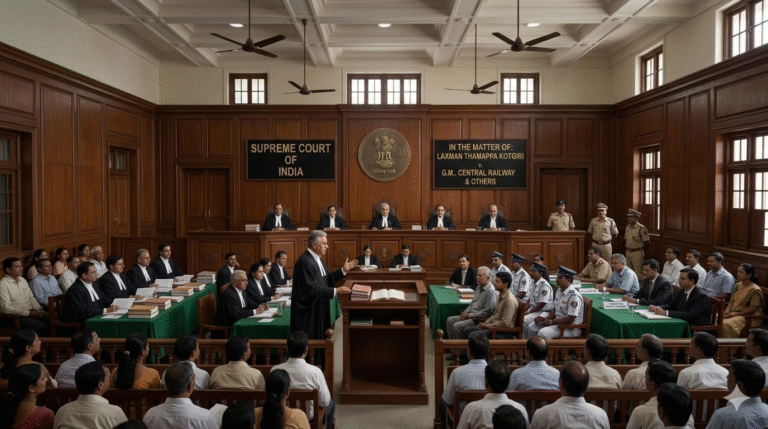
In a significant ruling strengthening consumer rights in employer-provided healthcare services, the Supreme Court of India held that medical treatment provided by an employer to its employees as part of service conditions cannot be treated as “free service” under consumer law. Consequently, complaints alleging medical negligence in such cases are maintainable under the Consumer Protection Act.
The judgment in Laxman Thamappa Kotgiri v. General Manager, Central Railway & Others remains an important precedent for employees seeking accountability in employer-sponsored medical facilities.
Background of the Case
The appellant, Mr. Laxman Thamappa Kotgiri, was employed with the Indian Railways. His wife underwent treatment at B.R. Ambedkar Hospital, a medical institution operated by Central Railway for the benefit of railway employees and their dependents.
According to the appellant, negligent medical treatment at the hospital resulted in the death of his wife. Aggrieved by the alleged deficiency in medical service, he approached the State Consumer Disputes Redressal Commission under Section 35 of the Consumer Protection Act, 1986.
However, the complaint was dismissed at the threshold.
Why the Consumer Complaint Was Initially Rejected
The State Commission held that the complaint was not maintainable because the Railway Hospital primarily provided treatment free of cost to railway employees.
The Commission reasoned that:
- The hospital was established mainly for railway employees and their families.
- Charges collected from employees were merely nominal.
- Such charges represented maintenance expenses and not actual consideration for treatment.
- Therefore, the services could not be categorized as “paid services” under consumer law.
For reaching this conclusion, reliance was placed on the Supreme Court’s earlier decision in Indian Medical Association v. V.P. Shantha (1995).
When the appellant challenged the order, the National Consumer Commission also upheld the dismissal.
Core Legal Issue Before the Supreme Court
The central question before the Supreme Court was:
Can medical services provided by an employer to employees under service conditions be treated as free services and therefore excluded from the Consumer Protection Act?
The answer depended on interpreting the principles laid down in Indian Medical Association v. V.P. Shantha.
Appellant’s Argument
The appellant argued that both consumer forums misunderstood the ruling in V.P. Shantha.
According to the appellant:
- Medical treatment provided as part of employment conditions is not genuinely free.
- Such benefits form part of the employee’s overall compensation package.
- Since employees earn these facilities through employment, they amount to consideration under consumer law.
Therefore, any deficiency or negligence in medical treatment should attract remedies under the Consumer Protection Act.
Railway Administration’s Defence
The respondents defended the earlier orders and relied upon another Supreme Court decision in State of Orissa v. Divisional Manager, LIC (1996).
They argued that:
- Government employees receiving medical benefits enjoy free medical services.
- Since no substantial payment is made at the point of treatment, consumer jurisdiction should not apply.
Accordingly, they contended that the complaint was outside the scope of the Act.
Supreme Court’s Analysis
The Supreme Court carefully examined the categories discussed in Indian Medical Association v. V.P. Shantha.
The Court noted that the earlier judgment had clearly distinguished among different kinds of medical services:
Category 1: Completely Free Medical Services
Where hospitals provide treatment entirely free to every patient without receiving consideration from anyone, such services fall outside the Consumer Protection Act.
Category 2: Government Hospitals Offering Universal Free Treatment
Where government hospitals treat all patients without charging fees, those services also generally remain outside consumer jurisdiction.
Category 3: Employer-Funded Medical Services
Where medical treatment is extended to employees and their family members as part of employment conditions and expenses are borne by the employer, such services are not considered free.
The Supreme Court observed that Railway Hospital services clearly belonged to the third category.
Important Observations of the Court
The Court emphasized that railway employees receive medical facilities because of their employment relationship.
Even though direct payment at the time of treatment may not occur:
- Medical benefits are part of service conditions.
- The employer bears the treatment cost.
- Employees effectively receive the service in exchange for employment.
Therefore, the existence of employer sponsorship does not convert the service into a gratuitous benefit.
The Court rejected the narrow interpretation adopted by the consumer forums.
Conflict Between Earlier Decisions
The Court acknowledged that the decision in State of Orissa v. Divisional Manager, LIC appeared to suggest otherwise.
However, the Supreme Court clarified an important legal principle:
When two judgments conflict, the decision delivered by the larger Bench carries greater precedential value.
Since Indian Medical Association v. V.P. Shantha was decided by a larger Bench, the Court chose to follow that precedent.
Final Decision
The Supreme Court allowed the appeal and set aside the orders passed by the National Commission.
Instead of deciding negligence itself, the Court remanded the matter back to the National Consumer Commission for adjudication on merits.
This meant that the appellant’s complaint could proceed under consumer law.
Key Takeaways
This judgment continues to be an important authority in medical negligence and consumer law because it establishes that:
- Employer-provided medical treatment may constitute “service” under consumer law.
- Medical benefits under employment contracts are not automatically free services.
- Employees and their dependents can invoke consumer jurisdiction for deficiency in medical care.
- Consumer forums cannot reject complaints solely because treatment was subsidized or employer-funded.
The ruling reinforces the principle that accountability in healthcare extends even to institutional medical facilities established for employees.
Follow the Link below to watch the video: