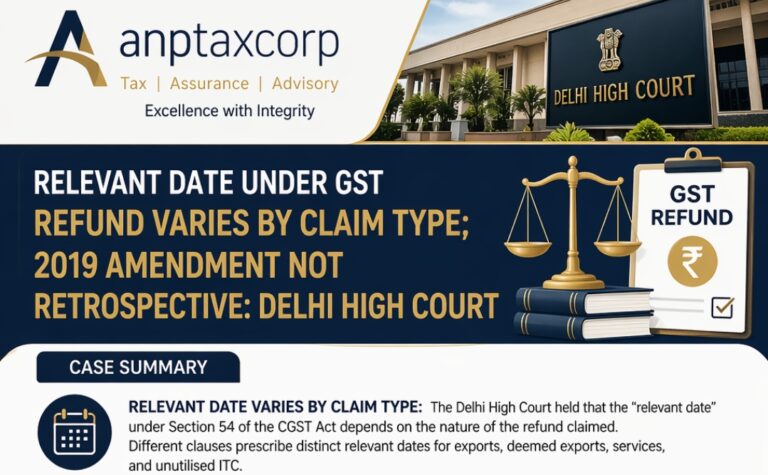
In a significant ruling that reinforces taxpayer rights under the Goods and Services Tax (GST) framework, the Delhi High Court has held that the determination of the “relevant date” for claiming a refund under Section 54 of the Central Goods and Services Tax Act, 2017 (CGST Act) varies depending on the nature of the refund claim. Importantly, the Court also ruled that the 2019 amendment to the provision cannot be applied retrospectively to deny legitimate refund claims.
Background of the Case
The judgment came in the case of Kanika Exports v. Union of India & Ors., where the petitioners challenged the rejection of their refund claims for unutilised Input Tax Credit (ITC). The tax authorities had dismissed the claims on the ground that they were filed beyond the prescribed limitation period of two years.
The central issue before the Court was the interpretation of the term “relevant date” under Section 54 of the CGST Act, which determines the starting point for calculating the limitation period for filing refund applications.
Understanding “Relevant Date” Under GST
Section 54 provides a uniform limitation period of two years for filing refund claims. However, the complexity arises in determining the “relevant date,” which is not uniformly defined across all types of refunds.
The Delhi High Court emphasized that the statute itself provides a detailed framework through Explanation (2) to Section 54, where different clauses prescribe different relevant dates depending on the nature of the transaction. These categories include:
- Export of goods
- Export of services
- Deemed exports
- Refund of unutilised ITC
The Court clarified that the “relevant date” must be determined strictly based on the specific category of refund being claimed and cannot be applied uniformly across all cases.
Pre and Post-2019 Amendment Position
A crucial aspect of the case involved the amendment made to Explanation 2(e) of Section 54, which came into effect on February 1, 2019.
- Before the amendment: The relevant date for claiming refund of unutilised ITC was considered as the end of the financial year in which the claim arose.
- After the amendment: The provision was modified to link the relevant date to the due date for furnishing returns in certain cases, thereby narrowing the time window for filing refund claims.
The tax authorities attempted to apply this amended provision retrospectively to reject refund claims pertaining to earlier periods.
Court’s Ruling: Amendment Not Retrospective
The Delhi High Court firmly rejected this approach and held that the 2019 amendment cannot be applied retrospectively. The Court observed that doing so would unfairly curtail the vested rights of taxpayers.
It noted that on the date when the transactions took place, taxpayers were entitled to compute the limitation period based on the law as it existed at that time. A subsequent amendment cannot be used to shorten that period or deny claims that were otherwise valid under the earlier regime.
Reliance on Judicial Precedents
The Court also relied on similar rulings from other High Courts to support its conclusion. It referred to:
- The Bombay High Court decision in Babasaheb Keda Shetkari Sahakari Soot Girni Ltd. v. State of Maharashtra
- The Jammu & Kashmir High Court ruling in Bharat Oil Traders v. Assistant Commissioner (2025)
Both judgments recognized that the right to claim a refund is a vested right and cannot be taken away by retrospective application of an amendment unless explicitly provided by law.
Key Takeaways for Taxpayers
This judgment provides much-needed clarity and relief to taxpayers dealing with GST refund claims, especially those involving unutilised ITC. The key takeaways include:
- The “relevant date” under Section 54 is not uniform and must be determined based on the type of refund claim.
- The limitation period of two years remains constant, but its starting point varies.
- The 2019 amendment to Explanation 2(e) cannot be applied retrospectively.
- Taxpayers’ vested rights cannot be curtailed by subsequent legislative changes.
Conclusion
The Delhi High Court’s ruling is a welcome development in GST jurisprudence, as it upholds the principles of fairness, certainty, and legal consistency. By recognizing that different refund scenarios require different interpretations of the “relevant date,” the Court has ensured that taxpayers are not subjected to arbitrary or retrospective restrictions.
This decision is expected to have a wide-ranging impact on pending and future GST refund disputes, particularly those involving limitation issues. Taxpayers who have faced rejection of refund claims on similar grounds may now have a strong basis to seek relief.