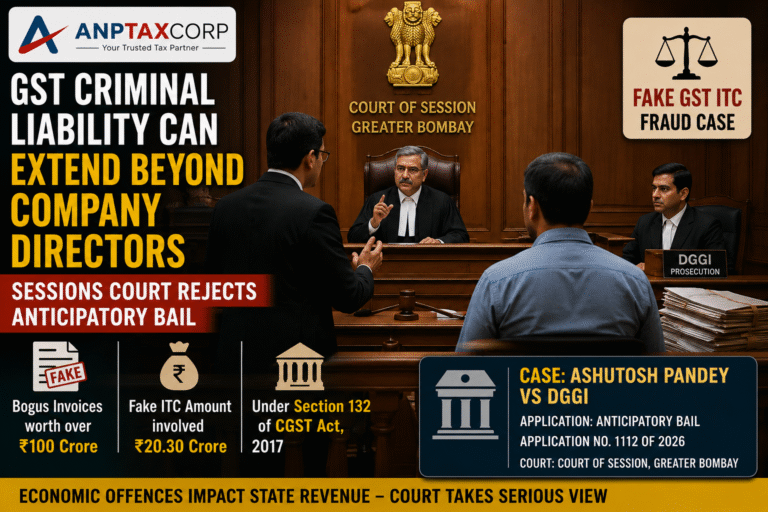
The fight against fraudulent Goods and Services Tax (GST) Input Tax Credit (ITC) claims has received another significant judicial endorsement. In a notable ruling, the Court of Session at Greater Bombay held that criminal liability under the Central Goods and Services Tax (CGST) Act, 2017 is not restricted only to company directors or individuals holding managerial positions. Employees and other persons who actively participate in fraudulent GST activities may also face criminal prosecution.
The court made this observation while rejecting an anticipatory bail application filed by an accountant accused of participating in a large-scale bogus GST ITC fraud involving fake invoices worth more than ₹100 crore.
Background of the Case
The case, Ashutosh Pandey vs Directorate General of GST Intelligence, arose from an investigation conducted by the Directorate General of GST Intelligence (DGGI) into an alleged fake GST Input Tax Credit racket.
The applicant, Ashutosh Pandey, approached the Sessions Court under Section 482 of the Bharatiya Nagarik Suraksha Sanhita (BNSS), 2023, seeking anticipatory bail.
Pandey argued that he was merely employed as an accountant and support staff with Drishti Steel Company. According to him, he neither held the position of director nor exercised any managerial control over Drishti Steel Company or SKDK Steels Private Limited.
His counsel contended that criminal liability cannot automatically be imposed on an employee merely because of his employment. It was further argued that the applicant had not committed any illegal act and that custodial interrogation was unnecessary.
DGGI’s Allegations
The Directorate General of GST Intelligence strongly opposed the anticipatory bail application.
According to the prosecution, the investigation was not confined to SKDK Steels Pvt. Ltd. but extended to an extensive network of entities allegedly engaged in fraudulent GST transactions.
The DGGI alleged that the applicant played a far more significant role than that of a routine accountant. Statements recorded during the investigation allegedly showed that he was actively involved in:
- Verifying buyers;
- Maintaining sales records;
- Arranging transportation of goods;
- Managing GST registration-related activities;
- Handling OTP-based authentication for GST portal transactions; and
- Conducting banking operations linked to the alleged fraudulent transactions.
The investigating agency further claimed that several supplier firms and intermediary entities were created using forged electricity bills and fabricated supporting documents solely to obtain GST registrations. These entities allegedly issued fake tax invoices without any actual supply or movement of goods.
Court’s Findings
After examining the material placed before it, the Sessions Court found that the allegations against the applicant went beyond mere employment in the company.
The Court observed that the investigation suggested active participation by the applicant in several operational aspects of the alleged fake ITC scheme. His involvement in buyer verification, transportation arrangements, maintenance of records, GST-related activities, and OTP-based banking operations demonstrated a direct connection with the transactions under investigation.
The Court emphasised that criminal liability under the CGST Act cannot be confined only to company directors or individuals formally managing the affairs of a business. Where the investigation reveals active participation in the commission of an offence, every individual involved may be held accountable irrespective of their official designation.
This observation reinforces the principle that actual conduct and participation are more important than job titles when determining criminal responsibility in GST fraud cases.
Fake ITC Fraud of ₹20.30 Crore
The Court also took note of the seriousness of the alleged economic offence.
According to the prosecution, the case involved fraudulent availment of fake GST Input Tax Credit amounting to approximately ₹20.30 crore, generated through bogus invoices exceeding ₹100 crore.
The Court reiterated that economic offences have far-reaching consequences on the financial health of the State and public revenue. Such offences are therefore required to be viewed with greater seriousness than ordinary criminal offences.
Given the magnitude of the alleged fraud, the Court observed that the investigation was still at a crucial stage.
Why Anticipatory Bail Was Rejected
While deciding the bail application, the Court noted that custodial interrogation remained necessary for a comprehensive investigation.
The investigating agency was required to ascertain:
- The precise role played by each individual involved;
- The manner in which fake firms were established;
- The creation and operation of shell entities;
- The movement of fake invoices; and
- The complete trail of fraudulent GST Input Tax Credit.
Since these aspects were yet to be fully investigated, the Court held that granting anticipatory bail at this stage could adversely affect the investigation.
Accordingly, the Court concluded that the applicant had failed to establish a sufficient case for grant of anticipatory bail under Section 482 of the BNSS and rejected the application.
Significance of the Judgment
This decision serves as an important reminder that GST-related criminal prosecutions are based on actual involvement rather than formal designation within an organisation.
The ruling clarifies that employees, accountants, consultants, and other individuals who knowingly participate in fraudulent GST activities may face criminal liability under Section 132 of the CGST Act, even if they are not directors or key managerial personnel.
As tax authorities continue to intensify their crackdown on fake invoice networks and fraudulent ITC claims, businesses must ensure robust internal compliance mechanisms. Employees handling GST registrations, invoicing, banking transactions, and statutory records should exercise heightened diligence, as active participation in fraudulent activities can expose them to serious criminal consequences.
Case Details
- Case Title: Ashutosh Pandey vs Directorate General of GST Intelligence
- Case No.: Anticipatory Bail Application No. 1112 of 2026
- Court: Court of Session at Greater Bombay
-
Statute Involved: Section 132 of the CGST Act, 2017; Section 482 of the Bharatiya Nagarik Suraksha Sanhita, 2023