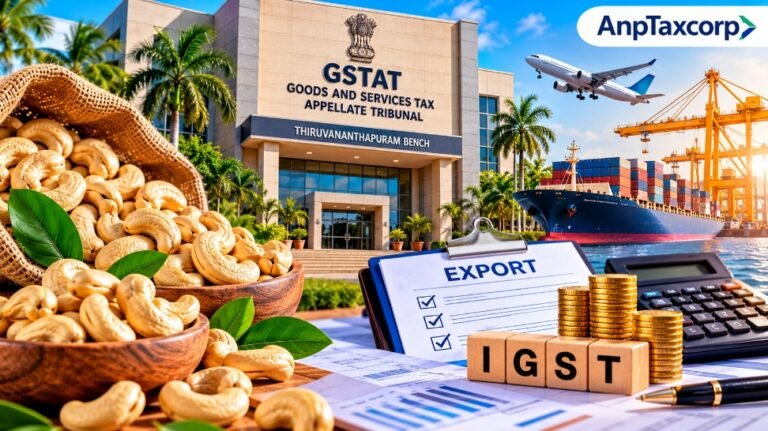
Thiruvananthapuram GSTAT allows a ₹19.79 lakh IGST refund to Associated Cashews, ruling that a genuine clerical error cannot justify denial of excess tax refund.
Introduction
In a significant ruling concerning GST refunds and errors in return filing, the Thiruvananthapuram Bench of the Goods and Services Tax Appellate Tribunal (GSTAT) has granted relief to a cashew exporter that paid Integrated Goods and Services Tax (IGST) twice because of an inadvertent clerical mistake in its GST returns.
The Tribunal allowed the refund of approximately ₹19.79 lakh to Associated Cashews, holding that a genuine procedural error cannot, by itself, justify the denial of a legitimate refund. The decision reinforces the principle that tax authorities cannot retain an amount collected in excess of the taxpayer’s lawful liability merely because an error occurred while reporting transactions in GST returns.
The ruling is particularly relevant for exporters who face refund delays or rejections due to discrepancies between GST returns and export documentation.
Background of the Case
Associated Cashews, engaged in the export of cashew kernels, paid IGST at the applicable rate of 5% on its export transactions. However, while filing its GSTR-3B return, the exporter inadvertently reported the export-related details under the column meant for domestic outward supplies instead of the appropriate export-related category.
This reporting mistake created a mismatch in the information available to the GST and customs systems. Consequently, the automated mechanism for processing the export-related IGST refund could not operate as expected.
To resolve the issue and obtain the refund, the exporter paid the IGST again and correctly reported the export transactions in a subsequent return. The authorities subsequently processed the refund relating to the second payment.
However, the original IGST payment remained with the department, even though the exporter contended that the same tax liability had effectively been discharged twice.
The exporter therefore sought a refund of approximately ₹19.79 lakh, representing the amount paid in excess. The tax authorities rejected the claim, taking the position that a refund had already been granted.
Key Issue Before the Tribunal
The principal question before the GSTAT was whether the department could deny a refund of IGST paid twice when the duplication arose from an explained clerical error in the GST return.
The dispute required the Tribunal to distinguish between the refund already processed against the subsequent payment and the separate amount retained by the department from the original payment.
The exporter argued that the two payments were distinct and that the earlier amount had not been refunded. It also relied on supporting documents and reconciliation statements to demonstrate the duplication of tax payment.
GSTAT’s Findings and Observations
The Tribunal examined the circumstances surrounding the two payments and found that the refund granted by the authorities related to the subsequent payment. It did not establish that the original payment had also been refunded.
Accordingly, the department’s reasoning failed to account adequately for the distinction between the two amounts.
The Bench observed that the clerical error was apparent from the record and had been properly explained. A minor reporting mistake, when supported by relevant evidence, should not result in the denial of a refund of tax paid in excess of the amount legally payable.
The Tribunal further emphasised that revenue authorities cannot retain money merely because a taxpayer made a procedural error. Where the evidence establishes that the same tax liability has been discharged twice, the excess amount must be considered in accordance with the applicable refund provisions.
The decision underscores the distinction between a substantive tax obligation and a procedural mistake in reporting a transaction. While taxpayers remain responsible for accurate GST compliance, an inadvertent error should not automatically deprive them of a refund to which they are otherwise entitled.
Reliance on Earlier High Court Decisions
In reaching its conclusion, the Tribunal relied on judicial precedents addressing refunds of taxes paid inadvertently or in excess.
These included:
- Rajendra Narayan Mohanty v. Joint Commissioner of State Tax — a decision of the Orissa High Court.
- Merck Life Science Private Limited v. Union of India — a decision of the Karnataka High Court.
The reliance on these decisions supports the broader proposition that tax administration must recognise genuine excess payments and assess refund claims on their merits rather than rejecting them solely because of procedural irregularities.
Final Decision of GSTAT
The Thiruvananthapuram Bench, comprising Vice-President Subramanya Rayaprol and Technical Member Ramamoorthi Sriram, set aside the orders rejecting the refund claim and allowed the three appeals filed by Associated Cashews, granting the consequential relief.
Case details:
- Case title: Associated Cashews v. Commissioner of CGST
- Case number: 13/TVP/KERALA/2026
- Forum: GST Appellate Tribunal, Thiruvananthapuram Bench
- Refund involved: Approximately ₹19.79 lakh in duplicate IGST payment
Practical Implications for GST Taxpayers and Exporters
This ruling offers an important lesson for exporters and other GST-registered businesses. Errors in GSTR-1, GSTR-3B, shipping bills or related export documentation can disrupt automated refund processing and create avoidable financial difficulties.
Taxpayers facing similar situations should maintain a clear reconciliation of tax payments, returns, invoices, shipping bills and refund applications. Where duplicate payment occurs, the supporting documents should establish the original payment, the subsequent payment, the refund already received and the amount that remains outstanding.
Businesses should also examine the applicable statutory refund procedure and limitation requirements before filing a claim. The Tribunal’s decision does not mean that every error in a GST return automatically entitles a taxpayer to a refund; the claim must be substantiated by evidence and satisfy the relevant legal conditions.
Conclusion
The GSTAT ruling in Associated Cashews v. Commissioner of CGST highlights the importance of fairness and substance in GST refund administration. It confirms that a genuine clerical mistake should not become a ground for retaining tax paid twice when the excess payment is established by reliable records.
For exporters, the decision reinforces the need for accurate return filing, systematic reconciliation and proper documentation while providing support for legitimate refund claims arising from duplicate IGST payments.
Disclaimer:
This article is for informational purposes only and does not constitute legal or tax advice. Readers should verify the original judgment and consult a qualified professional before acting. AnpTaxcorp accepts no liability for reliance on this content.