Introduction
The Gujarat High Court has reiterated an important principle of income tax law: issuing a reassessment notice within the prescribed time limit does not validate proceedings if the mandatory approval has been obtained from an authority lacking jurisdiction under the applicable law. The Court also emphasised that reassessment proceedings must be supported by relevant material establishing a prima facie connection between the taxpayer and the alleged escaped income.
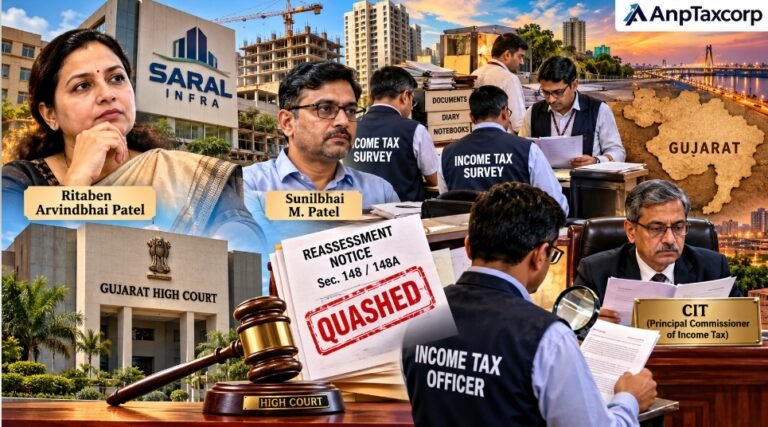
In Ritaben Arvindbhai Patel v. Assistant Commissioner of Income Tax, Central Circle 3, Surat, the Court examined the validity of reassessment proceedings for Assessment Year (AY) 2018–19. It held that the sanction granted by the Principal Commissioner of Income Tax was invalid because the authority prescribed under the law applicable at the relevant time was different. The Court subsequently quashed the reassessment order and consequential notice.
1. Case Background
The dispute arose from the Income Tax Department’s attempt to reopen the assessment of Ritaben Arvindbhai Patel for AY 2018–19, alleging escaped income of approximately ₹29.42 lakh.
The proceedings originated from a survey conducted at the premises of Saral Infra on April 18 and 19, 2019. During the survey, certain documents, diaries and notebooks were impounded. The Department also relied on a statement recorded from Sunilbhai M. Patel under Section 131 of the Income-tax Act, 1961, concerning certain land transactions.
Based on the material gathered, the Department initiated reassessment proceedings, alleging that income connected with property transactions had escaped assessment.
The taxpayer challenged the proceedings before the Gujarat High Court, questioning both the validity of the statutory sanction and the absence of sufficient material linking her to the alleged undisclosed consideration.
2. Key Legal Issue: Was the Sanction Granted by the Competent Authority?
The central issue concerned the interpretation of Sections 149 and 151 of the Income-tax Act, 1961, as applicable before April 1, 2023.
Section 149 prescribes the limitation period for issuing reassessment notices, while Section 151 specifies the authority whose approval is required before such notices can be issued.
For the relevant proceedings, the ordinary three-year period for AY 2018–19 expired on March 31, 2022. However, the Principal Commissioner of Income Tax (Central), Surat, granted approval on April 1, 2022.
The taxpayer argued that, once the three-year period had expired, approval from the higher authority prescribed under Section 151(ii), rather than the Principal Commissioner under Section 151(i), was necessary.
The Department disputed this interpretation and sought to justify the approval by relying on the period allowed to the taxpayer to respond to the notice under Section 148A(b).
3. Revenue’s Argument and the Taxpayer’s Response
The Income Tax Department contended that the nine-day period provided to the taxpayer for responding to the notice should be excluded while calculating the limitation period. According to the Revenue, this adjustment extended the deadline to April 9, 2022, making the Principal Commissioner’s approval dated April 1, 2022, valid.
The Department further argued that the amendment introduced by the Finance Act, 2023, to Section 151 was clarificatory in nature and should apply retrospectively.
The taxpayer, however, maintained that the authority competent to grant approval had to be determined according to the statutory provisions in force when the approval was granted. An administrative interpretation or subsequent legislative amendment could not validate an approval that was legally defective when issued.
4. Gujarat High Court’s Analysis and Findings
A Division Bench comprising Justice A.S. Supehia and Justice Vaibhavi D. Nanavati rejected the Revenue’s arguments and examined the matter on the basis of the statutory framework applicable to the case.
A. Mandatory sanction cannot be validated by extending the notice period
The Court held that the Department could not use the time allowed to respond to a reassessment notice to justify approval from an authority that was no longer competent under the applicable provisions.
The limitation provisions under Section 149 and the authority requirements under Section 151 operate within a defined statutory framework. The Revenue could not blur the distinction between them to sustain an otherwise invalid sanction.
B. The 2023 amendment could not operate retrospectively
The Court considered the amendment introduced by the Finance Act, 2023, which expressly addressed the adjustment of specified periods while determining the competent authority under Section 151.
As the amendment took effect from April 1, 2023, the Court held that it could not retrospectively validate the sanction granted in April 2022.
In reaching this conclusion, the Bench relied on the Supreme Court’s decision in CIT v. Vatika Township Private Limited, concerning the presumption against retrospective operation of legislation, particularly where an amendment affects substantive rights or legal obligations.
The Court also referred to Union of India v. Rajeev Bansal, recognising that obtaining approval from the competent authority is a jurisdictional requirement for reassessment proceedings.
C. No convincing connection with the alleged escaped income
The Court also examined the material relied upon by the Department. It found that the documents impounded during the survey did not name the taxpayer or establish her involvement in the alleged on-money transactions.
The taxpayer had sold the land to two other purchasers, and the Department had not established that Sunilbhai M. Patel acted as her broker. The Court found no sufficient live connection between the taxpayer and either Saral Infra or Sunilbhai M. Patel.
Consequently, the reassessment proceedings were unsustainable on the merits as well.
5. Final Verdict
The Gujarat High Court allowed the taxpayer’s writ petition and quashed the order passed under Section 148A(d) and the consequential notice issued under Section 148, both dated April 1, 2022.
The ruling reinforces the principle that reassessment proceedings must satisfy the statutory requirements governing limitation, approval and jurisdiction. A timely notice, by itself, cannot cure an invalid sanction.
Case details
-
Case name: Ritaben Arvindbhai Patel v. Assistant Commissioner of Income Tax, Central Circle 3, Surat
-
Court: Gujarat High Court
-
Case number: R/Special Civil Application No. 8482 of 2022
-
Assessment year: 2018–19
- Relevant provisions: Sections 131, 148A, 149 and 151 of the Income-tax Act, 1961.
6. Key Takeaways for Taxpayers and Tax Professionals
This judgment offers several practical lessons for income tax litigation:
-
Verify the sanctioning authority: Examine whether approval was granted by the authority prescribed under the applicable version of Section 151.
-
Check the limitation calculation: The date of the reassessment notice alone may not determine validity; the date and legal validity of the sanction must also be examined.
-
Challenge retrospective application: A later amendment cannot automatically validate earlier proceedings, particularly where the legislation expressly specifies its effective date.
-
Examine the underlying evidence: Third-party documents and statements must have a sufficient connection with the taxpayer and the alleged escaped income.
-
Raise jurisdictional objections promptly: Taxpayers should examine procedural defects at the earliest appropriate stage and seek suitable legal advice.
Conclusion
The Gujarat High Court’s decision in Ritaben Arvindbhai Patel underscores the importance of strict compliance with the statutory conditions governing income tax reassessment. The Revenue cannot sustain proceedings merely by arguing that the notice was issued within an adjusted timeframe when the underlying approval was granted by an incompetent authority under the law then in force.
For taxpayers facing reassessment proceedings, the judgment highlights the importance of scrutinising limitation, sanctioning authority and the evidentiary basis of the allegations. For tax practitioners, it provides a useful reference when examining jurisdictional defects in reassessment proceedings under the Income-tax Act, 1961.
Disclaimer: This article is intended for general legal information and professional awareness. Please refer to the full judgment for the precise legal reasoning and application to individual cases.