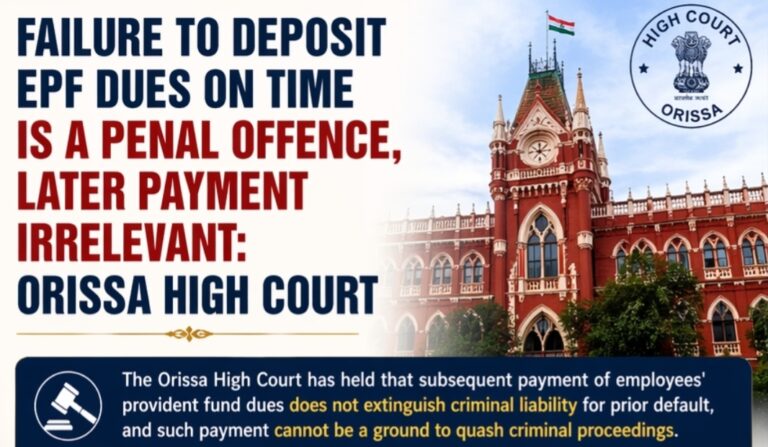
In a significant ruling reinforcing the strict compliance framework under labour welfare laws, the Orissa High Court has held that failure to deposit Employees’ Provident Fund (EPF) dues within the prescribed time constitutes a penal offence. The Court made it clear that subsequent payment of such dues does not erase the criminal liability arising from the initial default, nor can it be used as a ground to quash criminal proceedings.
This judgment highlights the judiciary’s firm stance on safeguarding employees’ financial security and ensuring employer accountability under the Employees’ Provident Fund and Miscellaneous Provisions Act, 1952.
Background of the Case
The case, Anil Kumar Gilra v. State of Odisha and Another, arose from a complaint filed by an EPF Inspector under Section 13 of the EPF Act. The allegations were directed against Anil Kumar Gilra, the former promoter and director of Cosboard Industries Pvt. Ltd.
It was alleged that the company had deducted EPF contributions from employees’ wages but failed to deposit the same with the statutory authorities within the prescribed time. The total default amounted to ₹15,14,533 for multiple periods between March 2012 and July 2013.
Based on these allegations, an FIR was registered under Sections 406 and 409 of the Indian Penal Code, which deal with criminal breach of trust. Aggrieved by the initiation of criminal proceedings, the petitioner approached the High Court seeking quashing of the FIR.
Petitioner’s Arguments
The petitioner advanced multiple arguments in defense. Firstly, it was submitted that the company had undergone insolvency proceedings before the National Company Law Tribunal (NCLT), Cuttack, and a resolution plan had been approved in February 2022 under the Insolvency and Bankruptcy Code, 2016.
Secondly, it was contended that the entire EPF dues had already been cleared between July 2014 and February 2015. On this basis, the petitioner argued that continuing criminal proceedings would be unjustified and unnecessary.
Stand of the Authorities
Opposing the plea, the prosecution emphasized the mandatory nature of EPF compliance. It was argued that EPF dues must be deposited within 15 days from the close of every month as per statutory requirements. Any delay beyond this period constitutes a punishable offence.
The authorities further contended that once the offence is committed, subsequent payment does not absolve the accused of criminal liability. The act of withholding employees’ contributions was characterized as a serious breach of trust.
Court’s Observations and Ruling
The Single-Judge Bench of Justice Sanjeeb Kumar Panigrahi dismissed the petition and refused to quash the criminal proceedings.
The Court categorically held that EPF contributions are not merely statutory dues but represent employees’ hard-earned savings meant for their future security. Failure to deposit such funds on time directly impacts employees’ right to pension and livelihood, which are integral to the right to life.
In a strong observation, the Court stated that the offence committed was grave in nature and could not be overlooked merely because the dues were later paid. The Bench emphasized that allowing such a defense would undermine the purpose of the law and weaken public trust in the legal system.
Impact of Insolvency Proceedings on EPF Dues
A key aspect addressed by the Court was whether EPF liabilities could be waived or diluted under insolvency proceedings. The Court clarified that EPF dues cannot be compromised or extinguished under the resolution process governed by the Insolvency and Bankruptcy Code.
It was observed that the EPF Act remains unaffected by amendments brought under the IBC, and statutory protections for employees’ provident fund dues continue to operate independently. Therefore, the approval of a resolution plan by the NCLT does not absolve past defaults relating to EPF contributions.
Why the Petition Was Rejected
The Court concluded that the petitioner’s actions amounted to a serious violation affecting employees’ financial security. It rejected the argument that subsequent compliance could cure the initial default.
Further, the Court noted that quashing the FIR in such circumstances would send a wrong signal and potentially encourage non-compliance among employers. Upholding the rule of law and protecting workers’ rights were deemed paramount.
Key Takeaways for Employers
This ruling serves as a crucial reminder for businesses and company directors regarding the importance of timely EPF compliance:
- EPF dues must be deposited within the statutory deadline without fail.
- Deduction of EPF from employees’ wages without depositing it constitutes criminal breach of trust.
- Subsequent payment does not erase the offence or prevent prosecution.
- Insolvency proceedings do not override EPF liabilities.
- Directors and responsible officers may face personal criminal liability for defaults.
Conclusion
The decision of the Orissa High Court reinforces the strict enforcement of employee welfare laws in India. By refusing to quash criminal proceedings despite subsequent payment, the Court has sent a clear message that statutory compliance cannot be treated casually.
For employers, this judgment underscores the need for robust compliance systems and timely deposit of statutory dues. For employees, it reaffirms the legal protection available for their financial security and retirement benefits.
As regulatory scrutiny continues to tighten, businesses must recognize that lapses in EPF compliance carry not only financial consequences but also serious criminal implications.